
Timely is an automatic time tracker. Its Memory app records the apps, documents and sites you work in, and AI turns that record into a draft timesheet. It does that job well. The reasons teams go looking for a Timely alternative usually sit elsewhere: there is no free tier, the cheapest tier stops at 5 users, and an invoice drafted in Timely can only go out through QuickBooks Online.
This page compares Timely with one specific alternative: actiTIME’s free Time Management Assistant, a Chrome extension that captures browser activity automatically, connected to actiTIME, where those hours land on approved timesheets, get billing rates and become PDF invoices. You will see what each product does, where each one fits better and what neither does well, so you can decide before you start a trial. If neither fits, a short section near the end names three other tools and the case each one covers.
- What Timely does and what it costs
- The actiTIME alternative: Time Management Assistant plus actiTIME
- Timely vs actiTIME, side by side
- A Timely alternative for agencies: from tracked time to an invoice
- What Timely costs as the team grows
- Which one fits your team better
- Honest limits on both sides
- How to switch from Timely in a week
- FAQ
What Timely does and what it costs
Timely now lives at timely.com, and its older timelyapp.com addresses redirect there. Timely time tracking is built around automatic capture. You install Memory on your computer, and it records the apps, documents and sites you work in to a private timeline. Timely’s downloads page offers Memory for Mac (macOS 14 Sonoma or later) and Windows 10 or later, alongside the web app and iPhone and Android apps. The AutoSheet feature then drafts the timesheet from that timeline, and each person reviews and approves the entries.
Privacy is a real strength. According to Timely’s help article “Can my boss or colleague see my data?”, memories are visible only to the person who recorded them, and colleagues see logged hours, not the raw activity. Memory does not run on phones: the Memory 101 handbook page says it only captures activity on a computer, while the mobile apps can add GPS location. Our full Timely review goes deeper into its features.
Timely has no free tier. After its 14 day trial you need a paid subscription. The prices below come from Timely’s pricing page, in US dollars per user per month:
| Timely tier | Price (billed yearly / monthly) | Limits and what it adds |
|---|---|---|
| Starter | $9 / $11 | Max 5 users and 20 projects; automatic tracking, AI timesheets, billable rates, budgets |
| Premium | $16 / $20 | Max 50 users; internal cost rates, invoicing through QuickBooks Online, team management |
| Unlimited | $22 / $28 | Unlimited users; overtime and undertime, locked time, capacity management |
| Enterprise | Contact sales | Dedicated onboarding and support |
| Tasks add-on | From $5 per person | Task assignment and progress tracking, on any tier |
The actiTIME alternative: Time Management Assistant plus actiTIME
The actiTIME answer to Timely comes in two parts that work alone or together.
The extension: automatic capture in Chrome
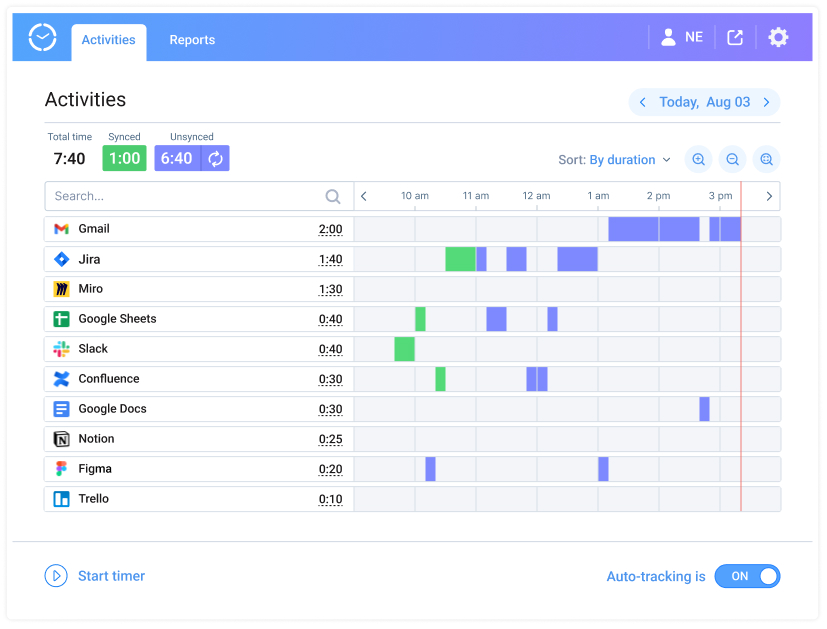
The Time Management Assistant is a free Chrome extension. Once installed, it records which websites and web apps you use, when, and for how long, and keeps a running list in its Activities tab. You can track everything with a few exceptions, or only the tools you pick, grouped into your own activity categories.
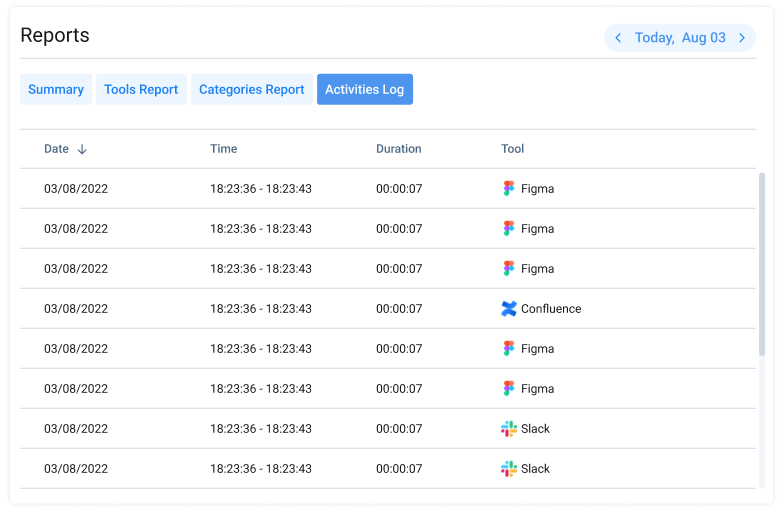
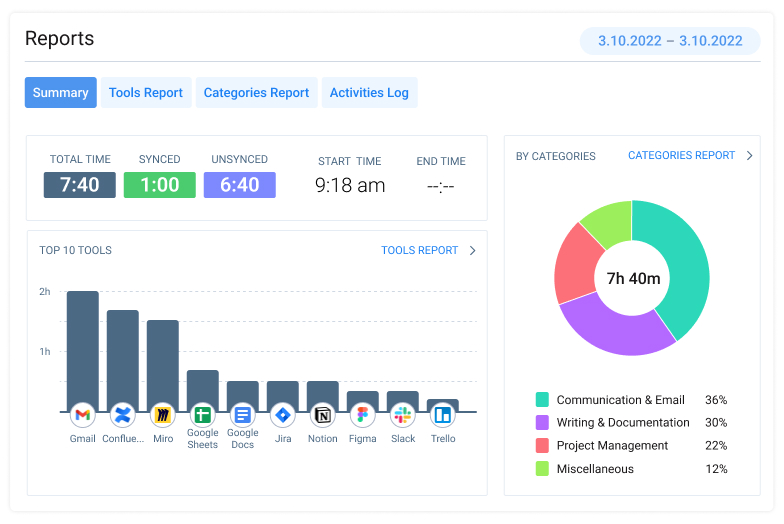
The Activity Log shows every site you visited during a day with start and end times and duration. The Summary report shows your most used tools and total time online, the Tools Report breaks down time per web tool, and the Categories Report shows which kinds of activity took the most time on any date.
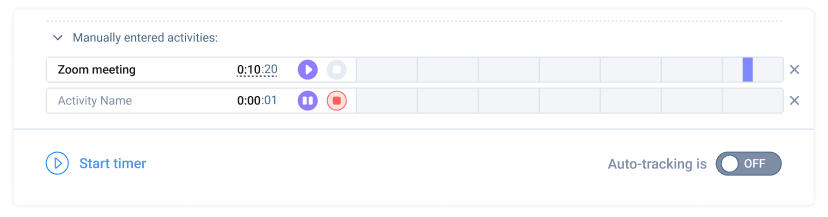
When you want to decide yourself when tracking starts and stops, the one-click timer at the bottom of the extension covers it.
actiTIME: where captured time becomes billing
Connect the extension to an actiTIME account, and its Sync Settings let you map web tools to actiTIME tasks. Time can then flow into timesheets automatically, or you can export it by hand from the Activities tab: in bulk, one activity at a time, or for a period you select on the timeline. Syncing with actiTIME is not part of actiTIME’s free version, so it runs during the 30 day trial and on paid options.
Inside actiTIME, work is organized as customers, projects and tasks. People see their hours in Timesheet View or as time cards in Calendar View, add anything the browser did not see (a client call, a site visit), and submit the week for approval.
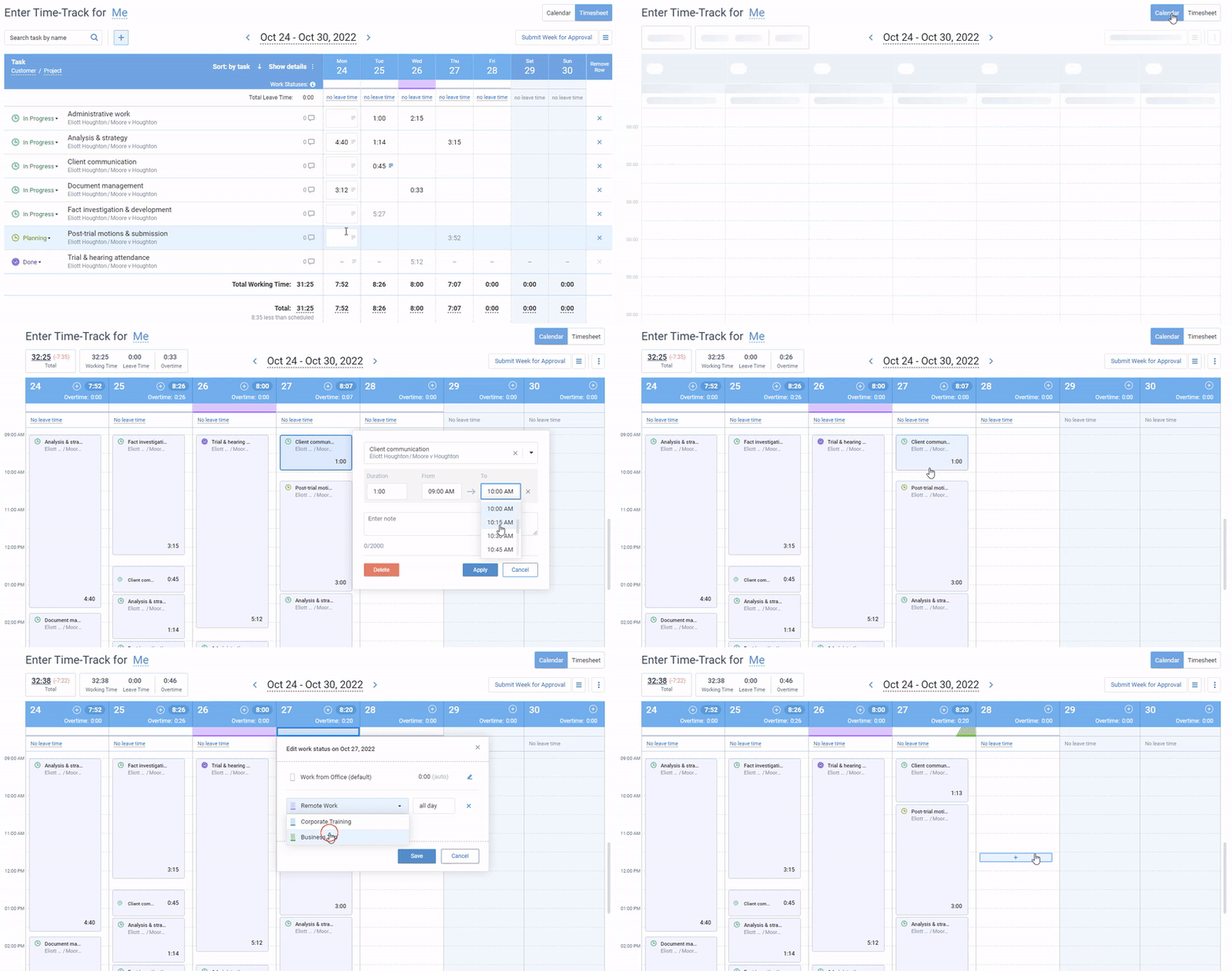
From there the hours turn into money. Each project picks a billing method: by type of work rates or by user rates. The Billing Summary Report totals billable amounts, PDF invoices are generated from billable time, the Cost of Work Report adds staff costs, and the Profit/Loss Report compares the two. Time-Track Approval puts a manager’s check on every week, Lock Time-Track keeps invoiced hours from changing later, and budgets on customers, projects or tasks turn red when they are exceeded.
Timely vs actiTIME, side by side
Timely captures more of your computer and drafts the timesheet with AI, while actiTIME captures only the browser and takes the hours further, through approval, locking, billing rates and invoices, without another tool. Timely details come from its pricing page and help center; actiTIME details come from the product itself.
| What you need | Timely | actiTIME with Time Management Assistant |
|---|---|---|
| Automatic capture | Desktop apps, documents and websites via Memory on Mac or Windows | Websites and web apps in Chrome only |
| Turning capture into entries | AI drafts the timesheet; the person approves | Mapping rules you set in Sync Settings, or manual export |
| Who sees raw activity | Only the user | Captured in the user’s extension; only synced time reaches actiTIME |
| Manual entry | Manual timer on phone, tablet or computer | Timesheet View, Calendar View, mobile app with timer, one-click timer in the extension |
| Billing rates | User specific hourly rates on all tiers | By type of work rates or by user rates, chosen per project |
| Invoices | Premium and Unlimited; drafts cannot be exported or printed and are sent through QuickBooks Online | PDF invoices generated in actiTIME from billable time |
| Approval and locking | Locked time listed on Unlimited only | Time-Track Approval and Lock Time-Track |
| Overtime and leave | Overtime and undertime on Unlimited | Overtime Registration, leave time in the timesheet, Time Balance and Overtime Report |
| Free option | None; 14 day trial | Extension free on its own; actiTIME free for up to 3 users; 30 day trial |
| Paid price | From $9 per user per month, billed yearly | From $5 per user per month |
| Own servers | No self-hosted option listed | Self-Hosted version for a one time $120 per user |
If you are also weighing a timer based tool, our Toggl vs Timely vs actiTIME comparison covers all three in depth.
A Timely alternative for agencies: from tracked time to an invoice
Agencies are where the gap between Timely and actiTIME shows most, because their hours have to end up on a client invoice. Automatic capture only pays off when the captured hours land on the right client and at the right rate. Here is one designer’s week in a small agency, followed from the browser to the invoice. The figures are illustrative.
The Time Management Assistant records 38 hours of browser activity. The designer leaves 2.5 hours of personal browsing unsynced. Sync Settings map the design tool in the browser to the task “Brand refresh: Design” (18 hours), shared documents to “Brand refresh: Copy review” (6 hours), and the mail and chat web apps to an internal, non-billable task (7.5 hours). The designer exports the 4 remaining hours by hand from the Activities tab to “Website build: Design”.
The billing method is set per project, so the agency can bill one client by type of work and another by each person’s rate in the same account. The Billing Summary Report and the PDF invoice follow whichever method the project uses.
Small mapping errors move real money. Suppose 2 of the 18 mapped design hours were really spent on another client’s file, and nobody reviewed the week before syncing. The Brand refresh invoice is overstated by 2 × $95 = $190, and the other client is undercharged by the same hours. This is where approval earns its place, because a manager who knows the projects sees the week before it is locked and billed.
In Timely the same week would end as a draft invoice too, but on Premium or Unlimited only, and, as its QuickBooks Online help page states, “Timely’s draft invoices cannot be exported or printed directly.” Taxes, discounts and currencies are handled in QuickBooks Online as well.

actiTIME helps us in data analysis and international reporting
actiTIME is pretty easy and understandable even for a layman. The app requires no big technical know-how. Simple user interfaces and stylish reporting became vital factor in making a decision on the application. It helps us a lot in data analysis, client billing and international reporting. There has been a tremendously positive impact on the process since we’ve been using the product!
What Timely costs as the team grows
Timely prices by tier, and each tier has a user cap, so the cost per person changes at 6 and at 51 users. The yearly totals below use Timely’s billed yearly prices from its pricing page.
| Team size | Lowest Timely tier that fits | Yearly cost, billed yearly |
|---|---|---|
| 3 users | Starter | 3 × $9 × 12 = $324 |
| 5 users | Starter | 5 × $9 × 12 = $540 |
| 6 users | Premium | 6 × $16 × 12 = $1,152 |
| 25 users | Premium | 25 × $16 × 12 = $4,800 |
| 51 users | Unlimited | 51 × $22 × 12 = $13,464 |
Adding a sixth person more than doubles the yearly bill, from $540 to $1,152, because the whole team moves to Premium. A 5 person team that needs invoices faces the same jump, since invoicing starts at Premium, and it also needs a QuickBooks Online subscription.
actiTIME is one product without feature tiers. Teams of up to 3 users can use it free, paid options start from $5 per user per month, and a team that grows from 5 to 6 people keeps the same features. The Time Management Assistant itself costs nothing. See actiTIME pricing for the current options.
Which one fits your team better
Choose Timely if most of your work happens in desktop programs such as design suites, code editors or spreadsheets on the desktop, you want AI to draft every timesheet, and your invoicing already runs through QuickBooks Online. Its privacy model, where nobody but the user sees raw activity, also suits teams that are wary of tracking.
Choose actiTIME with the Time Management Assistant if you want a Timely app alternative for client billing, your work happens mostly in the browser (web design tools, Google Docs, project and support apps), and you bill clients from tracked hours. You get approval, locking, billing rates per project and PDF invoices in one place, plus overtime, leave time and cost reports when you need them, and a Self-Hosted version if your data must stay on your own servers.
Use the Time Management Assistant alone if you only want to see where your own browser time goes. It is free, you can sign up with just an email, and its reports answer the personal productivity question without any team setup. Our guide to the Time Management Assistant walks through its settings.
When another tool fits better
Some needs fall outside both products. Three other Timely alternatives cover them, with facts taken from each vendor’s own pricing page:
- Clockify suits a team of up to 5 that wants automatic capture of desktop apps at no cost. Its free plan includes an auto tracker for apps and websites whose data only the user sees, but reports on the free plan cover a one month range, and invoicing, approval and locked time start at the Standard plan ($5.49 per seat per month, billed annually).
- Harvest suits teams that want invoices paid online. The Teams plan ($9 per seat per month, billed annually) includes invoicing with Stripe, QuickBooks Online and Xero integrations. It has no automatic capture, and timesheet approvals sit on the Enterprise plan.
- RescueTime suits people who want Timely style background tracking for personal focus. Solo Focus costs $7 per month billed annually, and timesheets come with the Solo+ and Team+ plans. It is built around focus and productivity reports rather than client billing.
Honest limits on both sides
Where actiTIME and the Time Management Assistant fall short
- The extension sees the browser and nothing else. Time in a desktop editor, a local spreadsheet or on a phone call goes into the timesheet by hand or with a timer.
- It runs in Chrome. Someone who works in another browser gets no automatic capture.
- There is no AI allocation. Mapping rules do exactly what you set, and they cannot guess which client a document belongs to, so a broad rule can put hours on the wrong task.
- The extension is free and actiTIME is free for up to 3 users, but syncing the two is not part of the free version.
Where Timely falls short
- After the 14 day trial every user needs a paid seat, because there is no free tier.
- Invoices depend on QuickBooks Online. Drafts cannot be exported or printed, and invoicing starts at Premium.
- User caps force tier changes: Starter stops at 5 users and 20 projects, Premium at 50 users.
- Overtime and undertime and locked time are listed on Unlimited only, and tasks cost extra as an add-on.
- AutoSheet proposes entries and each person approves them, so the weekly check stays even with AI in the loop.
What goes wrong in the first month of automatic tracking
Whichever tool you pick, the same problems show up. Broad rules send personal browsing or another client’s work to a billable task. People stop reviewing because the timesheet “fills itself”, and errors reach the invoice. Work that happens away from the computer, such as meetings in a room, calls and site visits, never gets captured and quietly drops out of billing. The fix is the same in both products: keep a short weekly review, and add work done away from the computer by hand. Our article on automated time tracking pros and cons covers this in more detail.


How to switch from Timely in a week
A switch is mostly setup. Run it on one team and one billing period before you move everyone.
-
Rebuild the structure in actiTIME.
Create customers, projects and tasks to match the clients and projects you track today, and assign people to them.
-
Set rates before anyone tracks.
Add types of work with billing rates, or user billing rates, and pick each project’s billing method in its Billing tab. Add cost rates per person if you want the Cost of Work and Profit/Loss reports.
-
Install the extension and connect it.
Install the Time Management Assistant from the Chrome Web Store, connect it to your actiTIME account, and choose which web tools to track and which to exclude.
-
Start with manual export.
For the first week, turn automatic export off and send time from the Activities tab by hand. You will see which mapping rules are too broad before they touch a timesheet.
-
Turn on mapping rules.
Once the rules are right, switch on automatic export in Sync Settings and let captured time flow to the mapped tasks.
-
Approve, lock and bill.
Submit timesheets for approval, lock the approved period, run the Billing Summary Report and generate the PDF invoice. Compare it with what Timely would have billed for the same period.
FAQ
Is there a free Timely alternative?
Yes. The Time Management Assistant is free on its own and tracks your browser activity automatically with reports, but it is a personal tool until you connect it to actiTIME. actiTIME itself is free for teams of up to 3 users, though syncing the extension and some features such as budgets and approvals need a paid option. Outside actiTIME, Clockify’s free plan covers up to 5 users and includes an auto tracker.
Does Timely have a Chrome extension?
Timely’s downloads page lists Memory for Mac and Windows, the web app and mobile apps, and no browser extension. Memory runs as a desktop app and records websites along with other programs. If you want automatic tracking that lives inside Chrome, the Time Management Assistant is built for that.
Can my manager see every site I visit?
In Timely, no: its help center says memories are private to the user and only logged hours are shared. With the Time Management Assistant, activity is captured in your own extension, and only the time you sync, automatically by your mapping rules or by hand, reaches the actiTIME timesheet that a manager approves.
Conclusion
Timely is a strong choice when work lives in desktop programs and invoicing already runs through QuickBooks Online. If your team works mostly in the browser and bills clients from tracked hours, the Time Management Assistant with actiTIME captures the time for free and carries it through approval, billing rates and invoices in one product. Start a free trial of actiTIME with full features for 30 days. After the trial, teams of up to 3 users can keep using it for free.