Software development cost estimation refers to calculating the overall costs linked to successfully completing a software project within the specified scope and time frame. It typically includes direct and indirect expenses such as labor, equipment, infrastructure, and licenses.
An early estimate of time and cost shapes the rest of the project. With it, you can work out how many people you need, plan for contingencies, and track progress against a baseline.
This guide covers the estimation techniques worth knowing, a step-by-step process with three free Google Sheets templates, a worked example with real numbers, and how to turn effort into a timeline, a budget, and a written estimate.
- What software development cost estimation includes
- Why estimates miss and how accurate they can be
- Software estimation techniques
- How to estimate software development cost step by step
- Software development cost formula
- Software project cost estimation example
- How to estimate software development time
- What drives software development cost
- From estimate to software development budget
- How to present a software estimate
- Common software estimation mistakes
- How to track software development costs
- FAQ
What software development cost estimation includes
A complete estimate answers five questions, and a quote that skips one of them tends to cause arguments later.
| Component | Question it answers | Typical unit |
|---|---|---|
| Size | How much software needs to be built | Features, user stories, function points |
| Effort | How much work that takes | Person-hours or person-months |
| Schedule | When it can be finished with the available team | Weeks or months on a calendar |
| Cost | What the effort and everything around it costs | Money, given as a range |
| Confidence | How likely the estimate is to hold | A range with a probability, such as 80% likely to stay under $120,000 |
Labor is the largest item but rarely the only one. These are the usual lines in a software development cost breakdown:
| Cost item | What it covers | How to estimate it |
|---|---|---|
| Development | Front end, back end, mobile apps, integrations | Hours per feature times the rate of each role |
| Design | Research, user flows, interface | Hours per screen or flow |
| Quality assurance | Manual and automated testing | Share of development hours, taken from your own past projects |
| Project management and analysis | Planning, requirements, stakeholder meetings | Share of the total, or hours per week over the project length |
| DevOps and environments | Servers, CI/CD pipelines, monitoring | Fixed setup hours plus monthly hosting |
| Licenses and third-party services | Paid APIs, SDKs, email and SMS providers, tools | Vendor price lists |
| Discovery | Workshops and prototypes before the build | A short fixed phase, often priced separately |
| Risk reserve | Known risks that may or may not happen | Probability times impact for each risk |
| Maintenance | Bug fixes, updates, and small improvements after launch | Yearly share of the build cost |
Some teams also add indirect costs, such as office space, hardware, or managers’ time. Include them when the estimate feeds a business case, and leave them out when it only compares delivery options.
Why estimates miss and how accurate they can be
Software development estimates tend to be too low, for two reasons. The first is timing: early in a project, nobody knows the full scope, so no method can produce a tight number. Steve McConnell’s cone of uncertainty shows how wide the honest range is at each stage. At the initial concept, the final cost can land anywhere from a quarter of the estimate to four times it, and the range narrows only as requirements and design settle. The second is overconfidence: in experiments by Magne Jørgensen and colleagues, the minimum and maximum effort that professionals gave were much too narrow for the confidence they claimed.
The cost of a miss is lopsided. A study of 1,471 IT projects by Bent Flyvbjerg and Alexander Budzier put the average cost overrun at 27%, a figure that hides the tail: about one project in six ran some 200% over budget and almost 70% over schedule.
That is why project managers match the type of estimate to the stage of the project:
| Project stage | Estimate type | Typical accuracy | Suitable methods |
|---|---|---|---|
| Idea or initial concept | Rough order of magnitude (ROM) | −25% to +75% | Expert judgment, analogy with past projects |
| Approved scope and main features | Budget estimate | −10% to +25% | Top-down by phase or feature, parametric models |
| Detailed requirements and design | Definitive estimate | −5% to +10% | Bottom-up from tasks, three-point estimates |
These ranges, widely taught in PMI-based project management training, describe what a well-run estimate can reach, and the cone suggests that early ranges are often wider still. Put the stage and the range next to every number you share, so a rough figure isn’t mistaken for a commitment.
Software estimation techniques
No technique is the most accurate in every situation, and Magne Jørgensen’s reviews of estimation research find that combining estimates from independent methods improves accuracy on average. In practice, software development estimation uses a quick method to frame the number and a detailed one to check it. The table below covers the methods used in software project estimation; for other industries, see our guide to project cost estimation techniques.
| Technique | How it works | Fits best at | Needs |
|---|---|---|---|
| Expert judgment | Experienced people estimate from what they know about similar work | Idea stage, and as a sanity check at any stage | People who have built something comparable |
| Analogous (top-down) | Take a finished project that resembles the new one and correct its real cost for what is different | Idea and approved scope | Records of past projects with real hours |
| Bottom-up (WBS) | Break the scope into tasks, estimate each one, and add them up | Detailed requirements | A work breakdown structure and the people who will do the work |
| Three-point (PERT) | Estimate optimistic, most likely, and pessimistic values and take a weighted average | Any stage with known risks | Three figures per task |
| Parametric (COCOMO II and similar) | Calculate effort from a size measure and adjustment factors | Approved scope, larger projects | A size measure and calibration data |
| Function point analysis | Measure size by the functionality users see, then convert it to effort | Approved scope | A trained counter and productivity history |
| Story points and velocity | Size work in relative points and divide the backlog by points per sprint | Agile projects with a running team | A stable team and several sprints of history |
| Wideband Delphi | Several experts estimate anonymously, discuss outliers, and repeat | High-stakes bids | Three to five experts and a facilitator |
| Monte Carlo forecasting | Simulate many possible outcomes from the team’s past throughput | Running teams | Several months of delivery data |
Three-point estimation and the PERT formula
For each task, write down an optimistic (O), a most likely (M), and a pessimistic (P) figure. The PERT formula weights the most likely case:
Expected effort = (O + 4M + P) / 6
A task estimated at 20, 30, and 60 hours gives (20 + 120 + 60) / 6, or about 33 hours. That is three hours above the most likely figure, because the pessimistic tail is long. The gap between O and P also shows where the risk sits, which helps when you size the reserve later.
COCOMO II and other parametric models
COCOMO is one of the oldest models for cost estimation in software engineering. Like other parametric models, it turns a size measure into effort. COCOMO, first published by Barry Boehm in 1981 and updated as COCOMO II in 2000, estimates effort in person-months from size in thousands of lines of code, five scale factors that make effort grow faster than size, and 17 effort multipliers such as product complexity and team experience. The Software Engineering Institute’s explainer on software cost estimation walks through the formula. Commercial tools such as SEER-SEM and SLIM work on the same principle. These models pay off in software cost estimation when an organization calibrates them with its own past projects; with generic settings, their figures look precise but can be far off.
Function point analysis
Function points measure what a system does for its users rather than how much code it takes. The IFPUG method counts five function types (external inputs, external outputs, external inquiries, internal logical files, and external interface files), weights each by complexity, and adds them up. Because the count doesn’t depend on the programming language, it suits comparing vendor quotes for the same scope or tracking productivity across projects. Effort comes from multiplying the count by your own hours per function point.
Estimating cost in Agile projects
In Agile projects, scope changes from sprint to sprint, so teams usually fix the cost of a sprint and estimate how many sprints the backlog needs:
- Cost per sprint = team hours per sprint × average rate
- Release cost = (backlog in story points ÷ velocity) × cost per sprint
For example, a team of six working 70 hours each per two-week sprint at an average of $95 an hour costs $39,900 per sprint. A 240-point backlog at 30 points per sprint needs eight sprints, or about $319,000. If velocity moves between 25 and 35 points, plan for seven to ten sprints, which means $279,000 to $399,000.
Points are only comparable within one team, so the method needs a team that already has a few sprints behind it. Our guide to story point estimation explains how teams size work in points.
Using AI to draft an estimate
AI assistants can turn a requirements document into a first work breakdown and suggest effort ranges, which saves time on large scopes. Treat that draft as input for the people who will build the software: they check each line and add what the model missed, and the final number is theirs.
How to estimate software development cost step by step
The five steps below move from a rough top-down figure to a detailed bottom-up estimate:
- Analyze the requirements, including the non-functional ones.
- Develop the scope of work and a first top-down estimate.
- Divide the scope into tasks of no more than 60–80 hours.
- Estimate each task with best-case, realistic, and worst-case figures.
- Price the hours by role, add the risk reserve and non-labor costs, and cross-check the total.
Three of the steps come with a free software development estimate template for Google Sheets that you can copy.
Perform requirements analysis
The first step towards successful software development cost estimation is building a project brief – a short pitch describing the software project to stakeholders and the product owner.
A good software development project brief outlines problems that the software is going to solve, its description and positioning on the market, target audience, functional and non-functional requirements.
Give non-functional requirements numbers or names, for example, a booking page that handles 300 requests per second, or payment data that meets PCI DSS. Performance, security, and compliance requirements change the cost as much as features do, and they are the easiest to leave out. Anything the brief can’t answer yet goes on a separate list: unresolved questions are risks, and the estimate has to price them.
At this step, you get familiar with the type, size and complexity of the software project and can proceed to developing the scope of work, the project plan and estimated software development costs.
Develop the scope of work (SOW)
After project requirements have been approved by the relevant parties, you can move on to developing a project scope – a document outlining the work to be performed on the project, which includes project timeline, milestones, deliverables and reports. To create an accurate scope of work, consider creating a work breakdown structure – an essential tool for defining the project scope.
Work breakdown structure (WBS) is a visual deconstruction of a project displaying hierarchical organization of project activities, their dependencies, priorities and durations.

Start with listing out project phases, features or deliverables relying on project requirements. Use your expert judgment or review historical data from your time tracking software to make rough time estimations. If you want to calculate rough software development cost estimates at this stage, add responsible people across every project phase or deliverable, calculate their average hourly rate and multiply it by estimated number of hours.

Get your top-down software development cost estimation template
Note that time and cost forecasts made at this stage are based on generalized knowledge and don’t reflect reliable timeframes and costs. Yet, if you have a record of successfully delivered software projects, you can discuss your predictions with stakeholders to manage their expectations.
Divide the project scope into tasks
More accurate project time and cost forecasts can be made by means of bottom-up estimation. Now that you’ve listed out all project phases, you can break phases down into tasks and dependencies with a work breakdown structure template. Remember that tasks should be specific, doable and assigned to a single person, meaning they usually don’t take longer than 60–80 hours. Break anything bigger into smaller tasks, since a large task usually hides choices the team hasn’t discussed, and that is where the hours disappear. Draft a list of tasks, assign responsible people, and move on to task estimation.
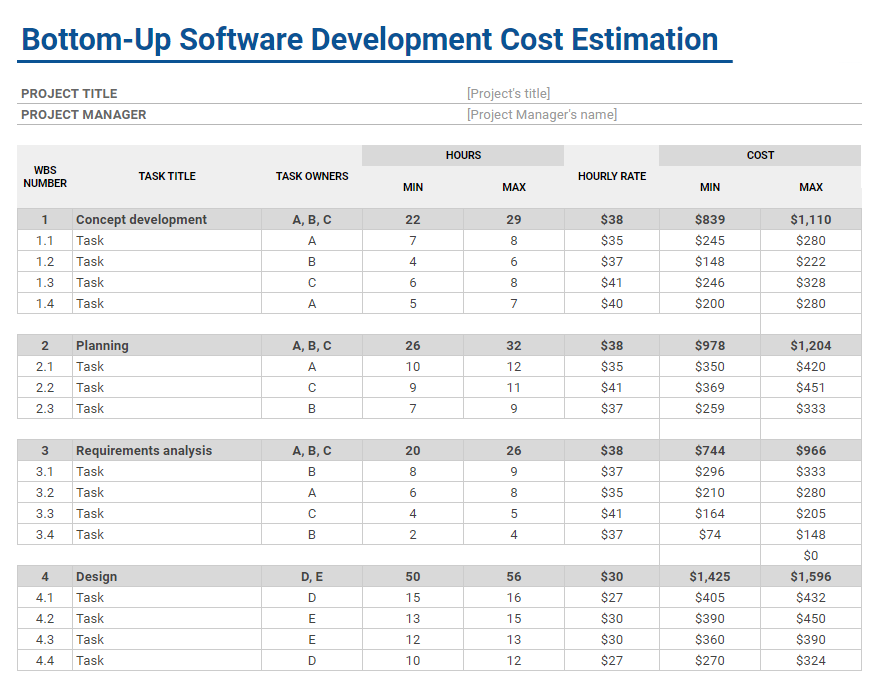
Get your free bottom-up software development cost estimation template
Estimate each project component independently
Now that you have a draft of the project schedule, it’s time to develop the most accurate time and cost predictions using bottom-up estimation. Review historical data of the previous projects and make your time range predictions for each item, taking risks and contingencies into account. For the most objective and reliable results, develop best-case, realistic and worst-case estimates.
Turn the three figures into one expected value with the PERT formula from the section on techniques, and estimate in real working hours that already account for meetings and reviews. Note which tasks show the widest spread between the best and worst case: they are the first candidates for a short technical spike before the estimate is shared.
Share a clean copy of the project plan with your team, get them to make their own estimates for tasks assigned to them, compare their estimates with yours and discuss the differences and potential risks at a meeting. Together, negotiate estimates for each project task.
Estimate software development cost
Finally, with a well-rounded project schedule, you can get a detailed estimate of software development costs with bottom-up estimation. Go through the project schedule once again to make sure that there are no assignment overlaps and all risks are taken into account. Now add hourly rates of people responsible for project activities and calculate potential budget deviations for the best-case, realistic, and worst-case cost estimations.
Use a separate rate for each role, because a senior engineer and a junior QA specialist differ a lot in cost and the mix changes from phase to phase. For in-house staff, use the fully loaded rate, which adds benefits and employer taxes to the salary (the worked example below shows the calculation).
Size the risk reserve from the risks themselves instead of adding a flat percentage. List each known risk, estimate its impact in hours and its probability, and multiply: a 25% chance of losing 80 hours adds 20 hours to the reserve. That sum covers the known risks; unknown ones belong in a separate management reserve.
Then add everything that is paid for by the month or the year rather than by the hour, such as servers, software subscriptions, and usage fees for external services, plus the first year of maintenance. As a last check, compare the total with a second method, such as an analogy with a past project. A large gap between the two often means one of them is missing part of the scope.

Get your free best-case, realistic, and worst-case cost estimation template
Software development cost formula
Every estimate above comes down to one calculation:
Cost = Σ (hours per role × rate per role) + risk reserve + non-labor costs
Hours per task come from the PERT formula above, and the risk reserve is the sum of probability times impact for each known risk, priced at the average rate. A table like this one, or the templates above, works as a simple software development cost calculator:
| Line | Where the hours come from | Rate to use |
|---|---|---|
| Development | Sum of expected hours per task, by role | Rate of each role |
| Design | Hours per screen or flow | Designer rate |
| Quality assurance | Share of development hours from your past projects | QA rate |
| Project management | Share of the total or hours per week | PM rate |
| DevOps | Fixed setup hours | DevOps rate |
| Risk reserve | Sum of probability × impact | Average rate |
| Non-labor costs | None: take prices from vendors | Monthly or yearly price |
Software project cost estimation example
This worked example estimates a web app that lets members of a chain of fitness studios book classes, pay for memberships, and sync bookings with their calendars. All figures are invented for the illustration, so replace them with your own.
Step 1. Development effort with three-point estimates
| Feature | Optimistic (h) | Most likely (h) | Pessimistic (h) | Expected, PERT (h) |
|---|---|---|---|---|
| Accounts and sign-in with Google | 40 | 60 | 100 | 63 |
| Class schedule and booking | 80 | 120 | 200 | 127 |
| Payments and memberships | 60 | 100 | 200 | 110 |
| Calendar sync (Google, Outlook) | 30 | 50 | 120 | 58 |
| Admin panel for studios and trainers | 80 | 110 | 180 | 117 |
| Email and SMS notifications | 20 | 30 | 60 | 33 |
| Reports for studio owners | 40 | 60 | 110 | 65 |
| Import of existing members from spreadsheets | 20 | 40 | 120 | 50 |
| Total | 370 | 570 | 1,090 | 623 |
Development comes to about 623 expected hours. The member import has the widest relative spread (20 to 120 hours), followed by calendar sync and payments, so those three get a spike first.
Step 2. The rest of the team and the risk reserve
- Quality assurance at 25% of development: 156 hours
- Design: 90 hours
- Project management at 15% of development: 93 hours
- DevOps setup: 40 hours
With development, that is 1,002 hours. The risk register adds the reserve:
| Risk | Probability | Impact (h) | Reserve (h) |
|---|---|---|---|
| Edge cases in membership billing | 40% | 60 | 24 |
| Rate limits in calendar APIs | 30% | 40 | 12 |
| Messy data in the member spreadsheets | 50% | 50 | 25 |
| Changes requested by the pilot studio | 50% | 80 | 40 |
| Total | 230 | 101 |
The planned effort is 1,103 hours. If every listed risk happened, it would reach 1,232 hours.
Step 3. Rates and the total cost
For an in-house team in the US, start from salary and add what the employer pays on top. A salary covers both the time worked and paid leave, which together make up 77.5% of what private employers spend on employee compensation; insurance, retirement contributions, bonuses, and legally required benefits make up the rest. Dividing the May 2025 median wage for software developers, $135,980 according to the Bureau of Labor Statistics, by 0.775 gives a full annual cost of about $175,000. Paid leave takes roughly a tenth of paid hours, so a developer works about 1,880 of 2,080 paid hours a year, and the fully loaded rate comes to about $93 an hour, before equipment and office space. For simplicity, the example uses this one blended rate for every role.
| Scenario | Rate | Planned (1,103 h) | All risks happen (1,232 h) |
|---|---|---|---|
| In-house team, fully loaded | $93 | $102,600 | $114,600 |
| Contractor at an assumed blended rate | $70 | $77,200 | $86,200 |
A lower rate isn’t automatically cheaper: an outside team needs onboarding and more coordination, and those hours belong in its estimate too.
Step 4. Build plus the first year in production
- Build, in-house team, planned effort: $102,600
- Hosting and monitoring for 12 months, $300 a month: $3,600
- Email and SMS services: $1,200
- Design and testing tools: $1,500
- Maintenance in the first year after launch, at 15% of the build: $15,400
The build and the first year in production come to about $124,300. Shared with stakeholders, this becomes a budget estimate of $103,000 to $115,000 for the build and about $124,000 including the first year in production, valid for the scope in the table above.

How to estimate software development time
Effort and calendar time are different numbers. Effort is the sum of hours; the delivery date depends on how many people work in parallel, how many hours a week they really spend on the project, and what they have to wait for. Software development time estimation turns the first into the second:
- Use productive hours, not paid hours. Meetings, code reviews, support duty, and switching between tasks take part of every week. Measure the share from your own time data, or start with five to six project hours a day and correct it after the first sprint.
- Divide by the people who can work in parallel. Work that depends on one integration or one specialist can’t be split, however many people join.
- Follow the dependencies. Design starts before development, and testing and release preparation continue after it.
- Lay the plan over a real calendar with holidays, vacations, and other projects the team supports.
- Give a range with a confidence level, such as 16 to 18 weeks, with the later date covering the known risks.
In the fitness studio example, about 720 hours of development work (623 expected hours plus the 101-hour risk reserve) shared by three developers at 25 project hours a week each takes about 10 weeks. Add two weeks of design before development and two weeks of stabilization after it, and the realistic schedule is around 14 weeks, or 16 to 18 if every listed risk happens and holidays fall inside the project.
In Agile teams, velocity replaces most of this arithmetic, since the backlog divided by points per sprint gives the number of sprints. Once the project is running, our guide to time management in software development covers how to keep it on schedule.
What drives software development cost
- Scope and complexity: the number of features, user roles, and business rules. A second user role with its own permissions can add more work than three new screens.
- Integrations and data migration: each external system comes with its own documentation and test environment, so estimate every integration as a separate item with its own range. Migrating data from old systems almost always takes longer than planned.
- Non-functional requirements and compliance: performance targets, security reviews, and standards such as HIPAA or GDPR add testing and documentation work.
- Team seniority: senior engineers cost more per hour but usually need fewer hours on unfamiliar problems, and a team that hasn’t worked together needs time to settle in.
- Technology stack: mainstream stacks are faster to staff, while niche or legacy technology raises rates and hiring time.
- Deadline pressure: compressing the schedule means more people, overtime, or less testing, and each of those has a price.
- AI coding tools: they speed up some routine work, but generated code still needs review and testing, so measure their effect on your own projects before cutting the estimate.
Many of the same factors explain why budgets break during delivery; our article on the causes of cost overruns looks at them from that side.
From estimate to software development budget
An estimate says what the work is likely to cost; a budget is the amount the organization sets aside for it. The difference lies in two reserves:
- Contingency reserve covers the known risks from the risk register, and the project manager can use it without new approval.
- Management reserve covers risks nobody has identified yet, and spending it needs a sponsor’s sign-off. Its size depends on how new the work is to the team.
Agree in advance which of time, budget, and scope is fixed. With a fixed budget, scope has to give way when risks happen, so rank features by priority before work starts and decide how to handle scope creep. The first-year figure in the example above is a simple software development budget example; a full budget would add a management reserve on top of it.
Estimating maintenance and enhancement costs
Software maintenance cost estimation follows the same logic as the build, with two differences. Ongoing work is easier to estimate from history, because the hours spent on bug fixes, updates, and support in past months are the best baseline. It also has to be planned every year. Before you have that data, a common starting point is 15% to 20% of the initial build cost per year, replaced with your own figures after the first year in production. Larger enhancements are best estimated as small projects of their own, with a breakdown and a reserve.
If you estimate for a client, the pricing model decides who carries the risk: a fixed price puts it on the vendor, who prices it in, while time and materials leaves it with the client. Our article on software pricing models compares the options.
How to present a software estimate
A single number without context quickly turns into a promise. Whether you use a software estimation document template or a plain page, the document should include:
- The range and what each end means, for example, $103,000 for the planned effort and $115,000 if every listed risk happens
- The stage and the estimate type: rough order of magnitude, budget, or definitive
- The scope included, as a list of features or deliverables
- Exclusions, such as hosting after launch or content creation
- Assumptions, for example, that the client provides API access by week three
- Risks, with their impact and how the reserve covers them
- When the estimate will be updated, for example, after discovery or after the first two sprints
When the scope changes, written assumptions give each change a visible price, so the discussion turns to trade-offs.
Common software estimation mistakes
- Estimating before the scope is clear and then treating the number as fixed
- Giving one number instead of a range
- Letting someone other than the people doing the work set the hours
- Trusting the most likely case, which the planning fallacy makes look shorter than it is
- Counting ideal hours and forgetting meetings, reviews, and support duty
- Leaving out testing, project management, or DevOps
- Skipping non-functional requirements and integrations
- Forgetting maintenance and running costs after launch
- Never comparing the estimate with actual hours, so the next estimate repeats the same errors
How to track software development costs
In principle, software development cost tracking is simple: you already know (or can easily calculate) hourly rates of your staff – all that’s left is their working hours tracked across project tasks. Cost tracking becomes especially tricky if your staff works on several projects simultaneously – managing time and costs manually in spreadsheets turns into a hassle, and not tracking time and costs at all is a grave mistake.
To track project time and costs without spreadsheets and give clients accurate reports, use a time tracking system. Choose the software carefully: it should meet your resource tracking needs and also fit your internal processes.
Tracking also closes the estimation loop. When hours are logged against the same tasks you estimated, you can compare estimate with actual for each type of work and use the ratio to correct the next estimate. This is also one of the time-based developer productivity metrics, and after a few projects it shows which kinds of tasks the team underestimates every time.
One option is actiTIME, flexible time and work management software that allows you to distribute project work across employees, track their performance and see if your project goes as planned.
Most importantly, actiTIME lets you set up tasks from the project schedule with estimates, deadlines, work rates and other parameters. After your team logs some of their working time, you can review their productivity and project health using real-time widgets and reports. Review project profitability, costs, profits and losses, staff performance, the gap between estimated and actual time, and more.
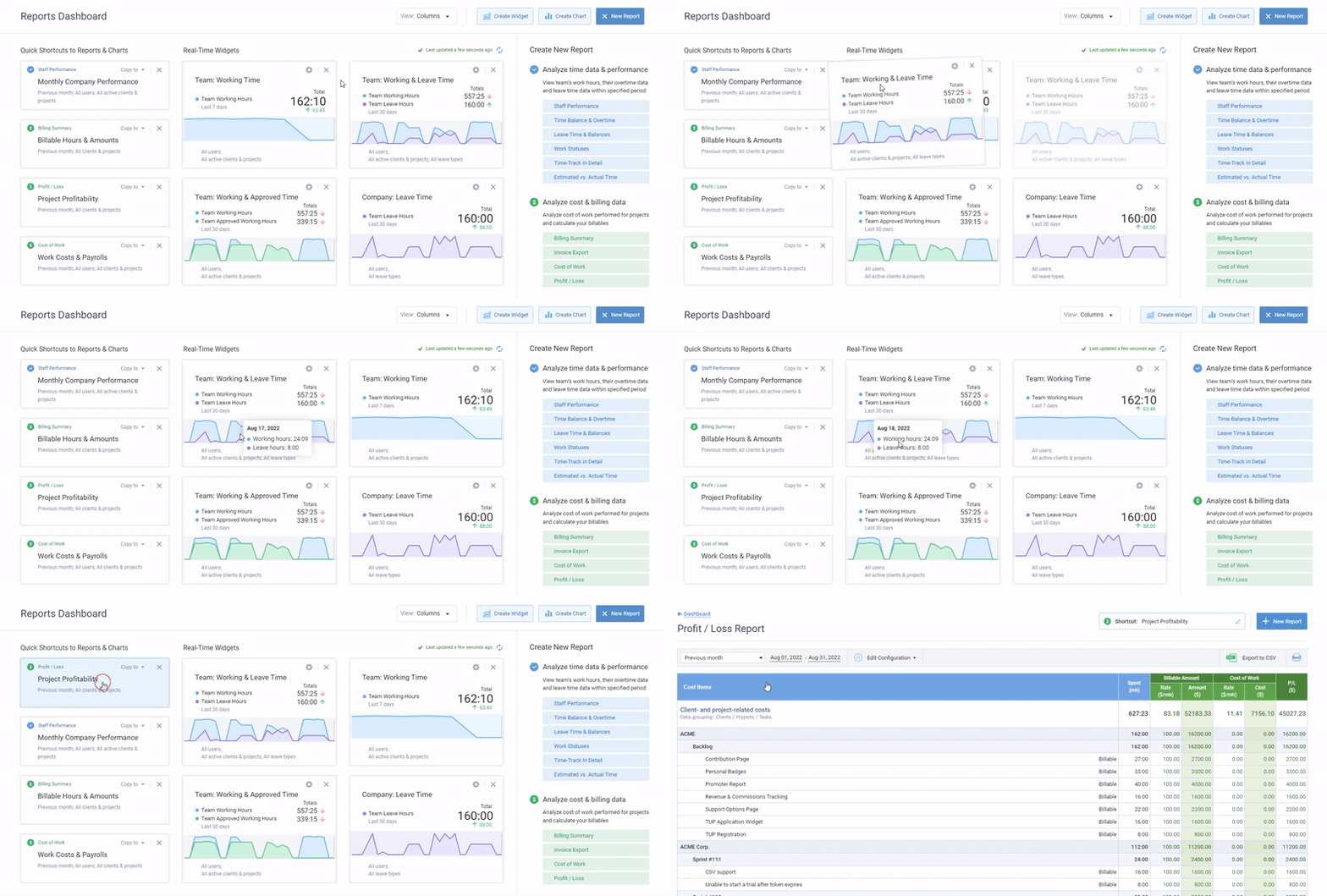
actiTIME adapts to how your team works: set up the work structure, manage user roles and permissions, assign individual, overtime, and type of work rates, customize report views, and save report templates. Billable amounts can be calculated by type of work or by each person’s rate, depending on how you bill, so invoices for teams with mixed seniority reflect who actually did the work.
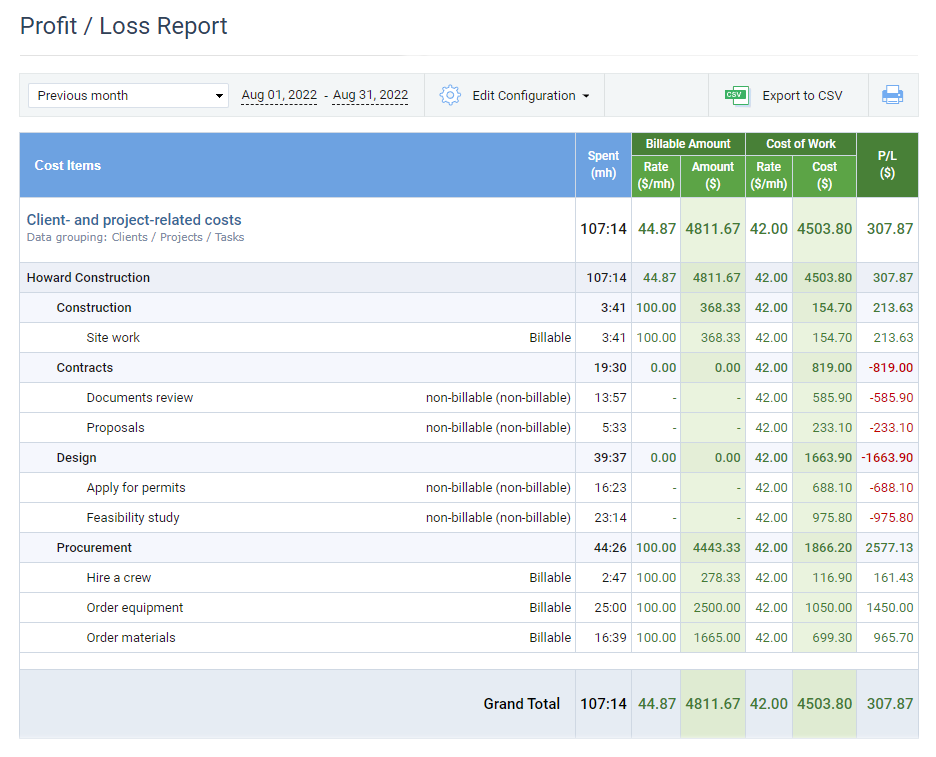
Hours reach actiTIME from wherever developers work: the browser timesheet, the iOS and Android app, or a Chrome extension that picks up time spent in web tools on its own. For the rest of your stack, there is an API and a Zapier connection to over 2,000 apps.
To check your next estimate against real hours, try actiTIME free for 30 days with all features and no credit card. When the trial ends, teams of up to three people can switch to the free version; paid access is $6 per user per month for teams of 1–40 and $5 per user per month for 41–200 users, billed annually.
FAQ
Is software development a capital or an operating expense?
It depends on what the software is for and which accounting rules your company follows. Under US GAAP, costs of internal-use software are generally expensed while the project is still being explored and capitalized once management has committed the funding and completion is probable; the FASB’s ASU 2025-06, effective for annual periods beginning after December 15, 2027, sets out that threshold in place of the older project-stage model. Planning, training, and maintenance are usually expensed, software built for sale follows separate rules, and IFRS has its own. Agree with your accountant early how the costs will be split, because it changes how the estimate appears in the budget.
How do you estimate a project your team has never done before?
Start with a wide range and say so. Ask people who have built something similar, inside or outside the company, and break the unfamiliar parts down as far as you can. For the riskiest pieces, run a time-boxed spike of a few days and estimate from what you learn. Present the first number as a rough order of magnitude and agree on a date to re-estimate once the spike or discovery phase is done.
How often should a software estimate be updated?
Update a software estimate whenever the scope or the risks change: after discovery, after the design is approved, and at each major milestone. Agile teams usually refresh the forecast every sprint or two from actual velocity. Each update should narrow the range; if it keeps getting wider, the scope is not under control.
Who should estimate software development work?
The developers and testers who will build the software, with a technical lead checking the breakdown for gaps. Estimates set by a manager or a salesperson are targets, not estimates. Running the estimate as a group, for example with planning poker or Wideband Delphi, catches tasks one person would miss and reduces the pull of the first number someone says out loud.
Are online software development cost calculators accurate?
Only as a rough order of magnitude. Calculators on vendor websites price a list of features at typical market rates, so they know nothing about your integrations, data, or team. They help you sanity-check a figure at the idea stage. For a number you can budget against, use your own breakdown and rates, as in the formula and templates above.