



Every manager eventually deals with an employee who consistently falls short: missed deadlines, low output, too many errors. The question isn’t whether to act, but how. A performance improvement plan gives you a structured, documented way to address these problems while giving the employee a real chance to turn things around.
Our free performance improvement plan template covers everything from SMART performance objectives to check-in schedules and consequences, so you’re not starting from scratch each time. Download it below, then read the guide to learn how to use it effectively.
What Is a Performance Improvement Plan?
A performance improvement plan (PIP) is an official HR document created for an underperforming employee. It identifies specific gaps in that employee’s work and lays out the objectives, actions, and timeline required for them to meet acceptable performance standards.
The plan is typically drafted by a direct supervisor, team leader, or project manager — someone with first-hand knowledge of the performance issues. HR then reviews and approves the document before it’s shared with the employee.
One thing to understand upfront: a PIP is a tool for genuine improvement, not a paper trail toward termination. If you’re creating one primarily to document a path to dismissal, you’re using it for the wrong purpose, and experienced HR professionals will spot it.
Performance Improvement Plan Template: 5 Key Elements
Every effective performance improvement plan contains five core elements:
- Purpose and problem statement
- Performance goals and the actions to reach them
- Deadlines
- List of participants and their roles
- Consequences for success and failure
Our free, editable performance improvement plan template gives you a ready-made structure for all five. Here’s what to put in each section:
1. Purpose and problem statement
This section explains why the plan exists. It should document specific performance deficiencies — not impressions, but observable facts. What exactly is the employee doing wrong? How long has this been happening? What feedback have they already received?
The employee should read this and understand clearly what the problem is, why it matters, and what the company expects going forward.
2. Objectives and actions
This is the core of the plan. Objectives must be SMART performance objectives — Specific, Measurable, Attainable, Relevant, and Time-bound. Vague goals (“improve in customer service”) give the employee nothing concrete to aim for and give you nothing to measure at the end.
Alongside each objective, list the actions, training, tools, or resources the employee can use to reach it. If a content writer needs to increase output, the objective might be “Write ten 1,000-word articles per month.” Supporting actions could include:
- Time tracking
- Productivity audit
- Distraction blocking
- Automated editing and grammar-checking software
- Copywriting courses
3. Deadlines
A PIP without clear deadlines is a conversation, not a plan. The document should specify:
- The duration of the improvement period (typically 30, 60, or 90 days, depending on the problem)
- Dates for interim check-ins
- The date for the final review
90 days is the most common duration for complex performance issues. Simpler problems like chronic lateness may need only 30. Choose a timeline that’s genuinely realistic — setting someone up to fail by compressing a 90-day problem into 30 doesn’t serve anyone.

4. Participants and their responsibilities
The employee is the main actor, but they’re not alone. List everyone involved: the direct manager, HR, any mentor or coach, and the employee. Be specific about who does what. Who conducts the check-ins? Who provides the training? Who signs off on the final review? Clarity here prevents confusion and miscommunication down the line.
5. Consequences
What happens if the employee meets the objectives? What happens if they don’t? Both scenarios need to be stated explicitly. Possible consequences for non-improvement include extension of the plan, reassignment, demotion, or termination. Possible rewards for success might include formal recognition or a salary review. Don’t leave either outcome vague.
When to Use a PIP — and When Not To
A PIP is the right tool when:
- The performance problem is specific and observable
- You genuinely believe the employee can improve with proper support
- The employee hasn’t yet had a structured opportunity to address the issue
- You’re prepared to invest time in coaching, check-ins, and resources
A PIP is not the right tool when:
- The problem is a skills mismatch or culture fit issue that goal-setting can’t fix
- The real intention is to create documentation for a termination you’ve already decided on
- The manager hasn’t first tried informal coaching, direct feedback, or clearer expectations
Before writing a PIP, check whether a simpler approach might work first: a direct conversation, targeted training, a role adjustment, or clearer briefing on expectations. If those approaches haven’t worked and you’ve documented that they haven’t, then a formal plan is the appropriate next step.
Is a PIP Worth the Effort?
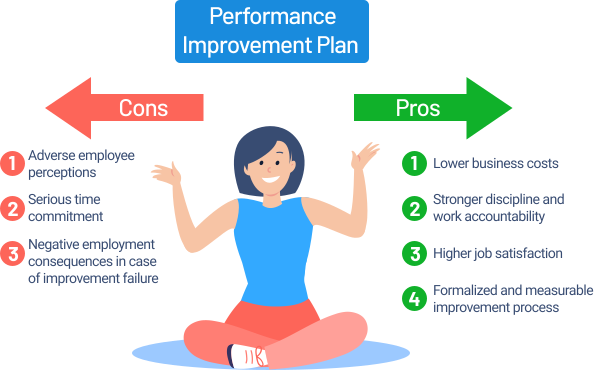
Many employees hear “PIP” and assume it means they’re about to be let go. That perception makes the plan harder to implement effectively. The reality is that a properly run PIP produces genuine business value:
- Lower recruitment costs. Replacing an employee typically costs 50 to 200 percent of their annual salary when you factor in recruitment, onboarding, and lost productivity. A successful PIP avoids that cost entirely.
- Stronger accountability. When expectations are documented and progress is checked consistently, employees know exactly what’s required and by when. That structure tends to improve focus and output even without additional support.
- Higher engagement. Employees who complete a PIP successfully often report higher engagement afterward. Being genuinely invested in is motivating. Being managed out without a fair chance breeds resentment, and that perception travels.
- Better legal protection. If the plan doesn’t work and termination becomes necessary, a properly documented PIP makes that decision more defensible.
The catch: none of this holds if the manager isn’t genuinely committed to helping the employee succeed. A PIP run as a checkbox exercise fails almost every time.
When Do You Need a Performance Improvement Plan?
A performance improvement plan should never be used as a means to start the termination process. Use it only when a real possibility for improvement exists — when you believe the employee can change and you’re ready to help them do it. Otherwise you turn a useful HR tool into a harmful one.
Here are five examples of situations where a PIP is appropriate:
Example 1
Performance problem: Low-quality customer service and frequent customer complaints.
SMART objective: Increase the customer satisfaction score by two points within 60 days.
Actions and tools:
- Active listening training,
- Respond to client emails within five minutes.
Progress assessment methods: Customer ratings and feedback.
Example 2
Performance problem: Too many errors that require significant time to fix.
SMART objective: Reduce coding errors to five or fewer per month within 60 days.
Actions and tools:
- Coding skills development,
- Use an automated code checker.
Progress assessment methods: Work quality evaluation form.
Example 3
Performance problem: Output consistently below team expectations.
SMART objective: Write ten 1,000-word articles per month.
Actions and tools:
- Carry out productivity audit,
- Apply automated text editing software.
Progress assessment methods: Number of articles written / tasks completed.
Example 4
Performance problem: Recurring work delays that disrupt project timelines.
SMART objective: Meet all task deadlines for 30 consecutive days.
Actions and tools:
- Improve task estimation,
- Use time tracking to identify inefficient behaviors,
- Prioritize important tasks.
Progress assessment methods: Number of deadlines met.
Example 5
Performance problem: Frequent tardiness and unexcused absences.
SMART objective: Arrive at the office by 10:00 AM every working day for 90 days.
Actions and tools:
- Identify reasons for frequent tardiness,
- Develop a time management plan.
Progress assessment methods: Clock-in and clock-out records.
How to Write and Run a Performance Improvement Plan
Step 1: Identify the root cause of the performance problem
Before you write anything, understand why the performance gap exists. The cause shapes the solution. A skills gap calls for training. Unclear expectations call for clarification. Personal circumstances may call for flexibility. Lack of motivation is a different problem than lack of ability.
Don’t rely on gut feel. Pull previous performance reviews, task completion records, and any documented feedback the employee has already received. If they’ve been missing deadlines, check whether those deadlines were realistic. If output is low, verify the workload is manageable. Rule out confounding factors before attributing the problem to the employee.
Step 2: Assess whether a PIP is the right response
Ask yourself: do you genuinely believe this employee can improve with the right support? Have you tried less formal approaches first — direct feedback, coaching, clearer instructions? If not, start there and document it. A PIP that comes after nothing else was tried is harder to defend and harder for the employee to accept.
Step 3: Design the plan
Download the template and fill in each section with specifics. Keep the problem statement factual. Set objectives that are achievable within the timeline, not aspirational ceilings. Include the training, tools, or resources the employee needs. Lock in check-in dates before you finalize anything.
Step 4: Involve the employee from the start
A PIP works considerably better when the employee has input. Meet with them before the plan is finalized. Present the specific performance issues, share the data behind them, and ask for their perspective. Sometimes they’ll identify a root cause you hadn’t seen: a tool they were never trained on, a process gap, a workload problem.
The goal is shared accountability. Employees who feel the plan was developed with them rather than handed down to them are more likely to commit to it. Align the process with effective motivation strategies — a focus on personal development and growth is far more effective than leaning on the threat of consequences alone.
Step 5: Provide active support throughout
Don’t wait until the final review to find out things have gone wrong. Check in at every scheduled milestone. Ask what’s working, what isn’t, and what additional support the employee needs. If the objectives or timeline turn out to be unrealistic partway through, adjust them and document the change.
Step 6: Monitor progress with concrete data
Whatever metric you chose to measure success, track it consistently. Task completion records, customer satisfaction scores, output counts, attendance logs — use the data that corresponds to the objective. Subjective impressions aren’t enough, and they won’t hold up if the process is later challenged.
For teams tracking time-based performance metrics — deadline adherence, task completion rates, hours logged per project — actiTIME gives you the objective data you need to assess progress fairly and consistently.
What Happens at the End of a PIP?
Three outcomes are possible, and the plan should address all three before it starts:
- Objectives met. The employee has reached the improvement goals by the deadline. The PIP concludes, the employee continues in their role, and the situation moves out of active monitoring. Documentation stays on file.
- Partial improvement. The employee has made genuine progress but hasn’t fully met all objectives. Depending on the severity of the original problem and the extent of progress, the manager and HR may choose to extend the plan for an additional 30 to 60 days with revised milestones.
- No improvement. The employee has not met the objectives and shown no meaningful progress. The documented plan now provides the record needed for termination, demotion, or reassignment. Clear documentation matters here — both for legal defensibility and for treating the employee with transparency about what comes next.
Common PIP Mistakes to Avoid
- Setting vague objectives. “Improve communication” is not a measurable goal. “Respond to all internal messages within 24 hours” is. Every objective needs a number, a timeframe, or an observable behavior you can verify.
- Excluding the employee from the process. Handing someone a finished plan they had no input on reduces their commitment and increases the chance the whole thing becomes adversarial.
- Not documenting interim progress. Check-in notes and milestone records matter if the employee later disputes the process. Don’t rely on memory.
- Treating the PIP as a formality. If the manager doesn’t deliver the promised support, the plan loses credibility fast. The employee notices, and so does HR.
- Using a PIP for the wrong problem. If the real issue is that this person is wrong for the role, a 90-day plan will not fix that. Be honest about what the tool can and can’t do.
Conclusion
A performance improvement plan works when it’s specific, supported, and honestly intended. Vague goals, absent follow-through, and a manager who has already made up their mind produce the kind of PIP that damages morale and creates legal exposure. A well-designed plan — with clear objectives, real resources, regular check-ins, and honest feedback — gives the employee a fair shot and gives the manager a defensible record regardless of the outcome.
Download the free template, fill in the sections with specifics relevant to your situation, and commit to the process. The time investment is small compared to what it costs to recruit and onboard a replacement.