


According to the Project Management Institute, 14% end in complete failure. Nearly 50% of the completed ones fail to meet the deadline, 43% exceed budget, and 32% fail to meet product quality requirements.
Why does it happen?
“During projects, there are always stumbling blocks of some kind,” Mercedes Graves-Johnston, the Project Director at Anyways Creative, said, and the key to overcoming these lies in well-thought-out project management processes.
This quick guide explores the processes involved in each project lifecycle phase and the techniques that can help you optimize them.
The Importance of Process Optimization
Optimizing project processes involves implementing best practices to make the most of available resources, mitigate risks, enhance daily workflows, and boost employee productivity.
Moreover, ensuring that all project tasks and procedures operate efficiently brings several additional advantages.
- Enhanced Consistency: Clearly defined objectives and responsibilities lead to more reliable outcomes.
- Improved Efficiency: By eliminating low-priority tasks, you and your team can dedicate more time to high-impact activities. Effective communication and teamwork facilitate quicker project completion.
- Minimized Risks and Errors: Leveraging data analytics to pinpoint potentially risky or overly complex processes allows for timely interventions.
- Streamlined Compliance: Automated tracking and reporting systems can be tailored to adhere to local regulations effortlessly.
Nonetheless, when implementing new processes, challenges may arise, such as insufficient data and resources. Additionally, encouraging team members to adjust their established routines and embrace new methods can be difficult.
For comprehensive strategies on overcoming these challenges with the right tools and approaches, download our complete guide on How to Optimize Project Management Processes to Prevent Failure.
Key Project Processes and What You Need to Optimize Them
The project management lifecycle is a framework of business and work processes required to deliver a successful product.
It’s usually split into four (sometimes five) phases or stages.
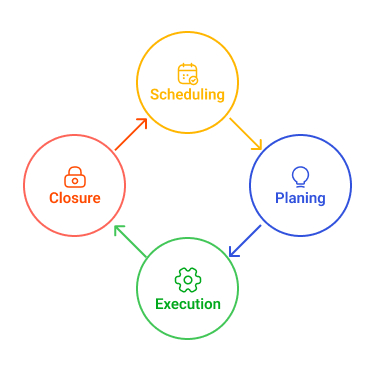
As a project manager, your task is to analyze processes at each stage and determine if and how they should be optimized.
Here are the five steps to do this.
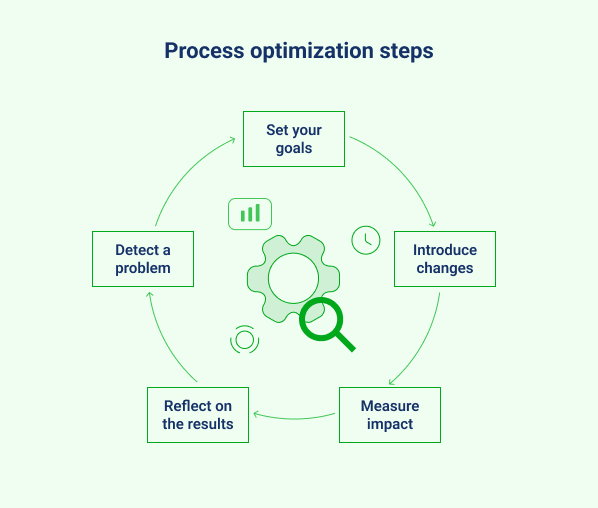
- Detect a problem. Start with making a list of project stages or specific task types that usually take too long or often end in failure.
- Set your goals. Define which part of the process, e.g., tracking method, the report types, etc., needs to be changed and state exactly how you plan to assess their completion.
- Introduce changes. Make steps or introduce measures to solve the problem. Act gently not to overwhelm your team and avoid confusion.
- Measure impact. Leverage analytics to see how effective your optimization efforts were.
- Reflect on the results. If one tactic doesn’t work, you can always consider another. Don’t hesitate to collect feedback and dive into analytics even more.
Now let’s look at each project management phase and dive into processes to be optimized.
The Planning Stage
In the planning phase, your abstract project idea turns into a set of meaningful goals, tasks, and technical requirements combined in the project roadmap. The project manager estimates the project timeline and determines the responsibilities of each team member.
Processes to optimize at this stage include goal setting, project scope identification, and creation of the work breakdown structure.
Mistakes during planning may take you to the situation when the work is done, but the final product fails to meet the customer’s expectations.
What to do?
- Ensure your goals meet the SMART criteria and are linked to company plans and values.
- Communicate the project tasks to the team clearly and intelligibly. Breaking the scope into a work breakdown structure makes this much easier — see our roundup of work breakdown structure software.
- Create a goal-to-task structure for your project to avoid decomposing beyond the level that makes sense.
Use actiTIME to streamline work scope management.
The Scheduling Stage
At this stage, the project manager creates a detailed project schedule, establishes a timeline for each task, and identifies the workforce and other resources needed.
Processes to optimize at this stage include estimation, creating project timeline, and assigning tasks.
Mistakes at the scheduling stage may result in budget overruns, delays in product delivery, and employee frustration.
What to do?
- Use historical project data to make your estimations more accurate.
- Use workflow visualization tools to identify and manage hidden and broken dependencies.
- Include detailed instructions, and add references to the tasks.
Plan and schedule your project in actiTIME to ensure traceability and transparency.
The Execution Stage
At this phase, the project plan is implemented, teams work on their tasks, and the project manager monitors progress to resolve potential problems and ensure the project is on track.
Processes to optimize at this stage include task tracking, progress monitoring, and fixing issues.
At this stage, your project is most vulnerable and subject to many unpredictable factors. Such issues as micromanagement, focusing on the wrong metrics, and being guided by emotions will not just result in miscommunication and a blame game but can lead to project manager burnout. Structured methods like decision tree analysis help replace gut feeling with clear, data-based choices.
What to do?
- Set unified metrics for measuring project progress and employee performance and apply them across teams and departments.
- Leverage automation to collect sufficient data and share it with your colleagues.
- Focus on discovering not who did something wrong but why it happened and how it impacted the project.
Assign tasks in actiTIME to visualize progress and individual task statuses and investigate problematic cases.


The Closing Stage
This phase is needed to compare the actual project progress against the plan, the team’s strengths and weaknesses, and plan corrective actions to address the issues.
Processes to optimize at this stage include measuring KPIs, comparing effort and cost, and documenting project learnings.
Though this stage occurs after the final product is delivered, planning future projects and mitigating potential risks is crucial. Human error or failure to sort out the collected data can lead to an unfair evaluation of the team’s performance and loss of motivation.
What to do?
- Introduce automation (if you haven’t done it before) into KPIs monitoring, cost tracking, etc.
- Use comparison reports to connect each issue detected during the current project to a respective data set.
- Exclude unnecessary evidence from project learnings.
Use actiTIME widgets and reports to contrast different datasets and compare different metrics.
Conclusion
So is there a way to manage projects perfectly? Unfortunately, even with all business processes optimized, some things can go out of control at any moment.
However, there are five fundamental principles to stick to stay on the safe side:
- Proper planning with clear goals and the project scope aligned with them.
- Well-thought-out project schedule with no resources and no employees overloaded.
- Ongoing execution monitoring involving proactive, informed decisions to avoid delays and budget overruns.
- Automated performance analytics based on transparent and objective criteria.
- Recorded and analyzed wins and losses used to introduce improvements, not to shift blame.
Such a data-driven approach will provide extra protection to your upcoming project, leaving nothing but productive work to your team.