



A church employee timesheet records the hours each staff member works every day and every week, along with what the time was spent on and any leave taken. For non exempt staff such as administrators, custodians, childcare workers and many youth or music staff, that daily and weekly record is what federal wage law expects an employer to keep when the Fair Labor Standards Act (FLSA) applies. Volunteers are tracked separately, because their hours are not wages.
This guide covers when wage and hour rules apply to a church, what a church employee timesheet should include (with a sample week), how to handle volunteer hours, and how a time tracking tool differs from church management software.
Do churches have to track employee hours?
Often yes, but the answer depends on what the church does and what each employee does. The US Department of Labor explains in Fact Sheet #14A that non profit organizations are not covered enterprises under the FLSA for their charitable or religious activities, only for activities “performed for a business purpose,” such as running a gift shop. Three situations still bring church staff under federal wage rules:
- Individual coverage. An employee is covered if they are engaged in interstate commerce, for example by regularly making calls to other states, ordering supplies across state lines or handling interstate mail, even when the church as a whole is not a covered enterprise.
- Schools and similar institutions. Under 29 U.S.C. 203(s)(1)(B), an enterprise that operates a school, hospital or certain care institutions is covered whether it is public or private, for profit or not. A church that runs a preschool or day school should assume its staff there are covered.
- Commercial activities. A bookstore, café or rental business that competes with ordinary businesses is a business purpose activity.
State wage laws can reach further than the FLSA, so check with your state labor department. Most churches find it simpler to keep timesheets for every non exempt employee rather than decide coverage person by person.
Where the FLSA applies, Fact Sheet #21 lists “hours worked each day” and “total hours worked each workweek” among the required records. Payroll records must be kept for at least three years, and the time cards behind them for two years. The DOL also says “employers may use any timekeeping method they choose,” so a paper sheet, a spreadsheet and software are all acceptable as long as the record is complete and accurate.
For churches in the EU. In case C-55/18 in 2019, the Court of Justice of the European Union ruled that member states must require employers to set up a system that measures each worker’s daily working time. How that applies to a church depends on national law.
What a church employee timesheet should include
A useful church timesheet does two jobs: it gives payroll the hours it needs, and it shows leadership where staff time goes across ministries. Include these fields:
- employee name, role and whether the role is exempt or non exempt;
- the workweek dates, using the same fixed 7 day period every week;
- hours worked each day, and start and stop times where your state requires them or where shifts are long;
- the ministry or activity for each block of time, such as worship, youth, childcare, facilities or administration;
- leave taken by type, such as vacation or sick leave;
- weekly total, overtime hours and the employee’s and supervisor’s sign off.
Here is a sample week for a part time youth and family coordinator. Evening and weekend events are where church timesheets most often go wrong, because the hours feel like ministry rather than work.
| Day | Activity | Hours |
|---|---|---|
| Monday | Administration: planning, parent emails | 4:00 |
| Tuesday | Leave: sick leave | 4:00 |
| Wednesday | Youth ministry: evening youth group, setup and cleanup | 5:30 |
| Thursday | Administration: volunteer schedule, supplies | 3:00 |
| Saturday | Events: community outreach day | 6:00 |
| Sunday | Worship: children’s program during two services | 4:30 |
| Total | Work time 23:00; leave 4:00 | 27:00 |
Recording the activity is what turns a payroll form into a planning tool. After a few months you can see how many paid hours each ministry uses, which helps with budgets and with deciding when a role needs more hours or a volunteer team needs more support.
Staff hours vs volunteer hours
Under the FLSA, individuals may volunteer for religious, charitable and similar non profit organizations without being treated as employees, as long as they give their time freely and “without contemplation or receipt of compensation,” according to Fact Sheet #14A. Two limits matter for churches. Volunteers generally should not work in commercial activities such as a gift shop, and paid employees cannot volunteer to provide the same type of services they are employed to provide. If your paid custodian “volunteers” to clean after Sunday services, those hours are work time.
Volunteer hours are still worth tracking. They show which ministries depend on volunteers, help you schedule fairly so the same people are not asked every week, and give you numbers for annual reports and volunteer recognition. Keep them in the same system as staff hours but clearly separated, so volunteer time never flows into payroll. Our guide to volunteer time tracking software compares tools built for this.
Paper, spreadsheet or software?
A small church with one or two hourly employees can manage with a paper or spreadsheet timesheet, signed weekly by the employee and the supervisor. The weak points show up as staff grows: sheets filled in from memory at the end of the week, hours lost between versions, no record of who changed what, and hours by ministry that someone has to total by hand.
Time tracking software fixes those points by recording hours when they are worked, routing each week to a supervisor for approval and producing reports by person, ministry or period. For more on what counts as a sound record, see our guide to timekeeping.
Church management software vs time tracking software
Church management software (ChMS) is built to manage a congregation. It typically handles member records, giving and donation statements, child check in, small groups and communication. It is about the people the church serves.
Time tracking software is about the people the church employs and the volunteers who serve regularly. It records hours, leave and approvals, and it reports on where staff time goes. actiTIME belongs to this second group: it is not a church management system and does not handle membership, giving or check in. Many churches use both, a ChMS for the congregation and a time tracker for staff, and export hours to their payroll provider.
| Need | Church management software | Time tracking software |
|---|---|---|
| Member directory and groups | ✓ | — |
| Giving and donation statements | ✓ | — |
| Staff timesheets and approvals | Varies by product | ✓ |
| Overtime and leave balances | Varies by product | ✓ |
| Hours and staff cost by ministry | Varies by product | ✓ |
Setting up church time tracking in actiTIME
actiTIME has been on the market for more than 20 years and is used by staff teams of all kinds, churches and religious organizations among them. Here is how its features map to a church’s needs.
Organize time by ministry
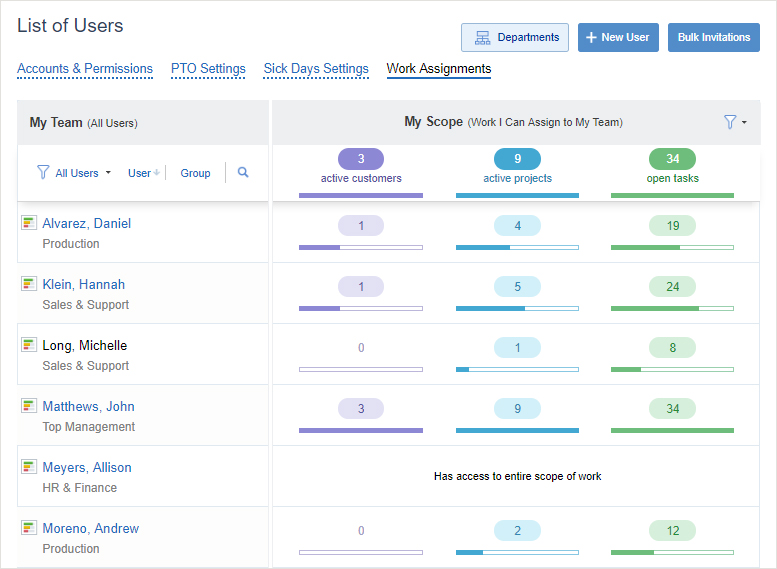
Work in actiTIME is organized in three levels, Customer, Project and Task, and you can rename all three. A church might use Ministry, Program and Activity, so that registration work for the summer camp is logged under Youth ministry, then Summer camp, then Registration.
Managers assign ministries, programs or individual activities to each staff member or volunteer, so people only see the work that applies to them.
Weekly timesheets, approval and locking
Staff record hours in a weekly timesheet, or log exact start and stop times in Calendar View, which suits evening and weekend events. Leave is entered in the same timesheet against leave types you define, and those types can be tied to PTO and sick day balances with accrual rules.
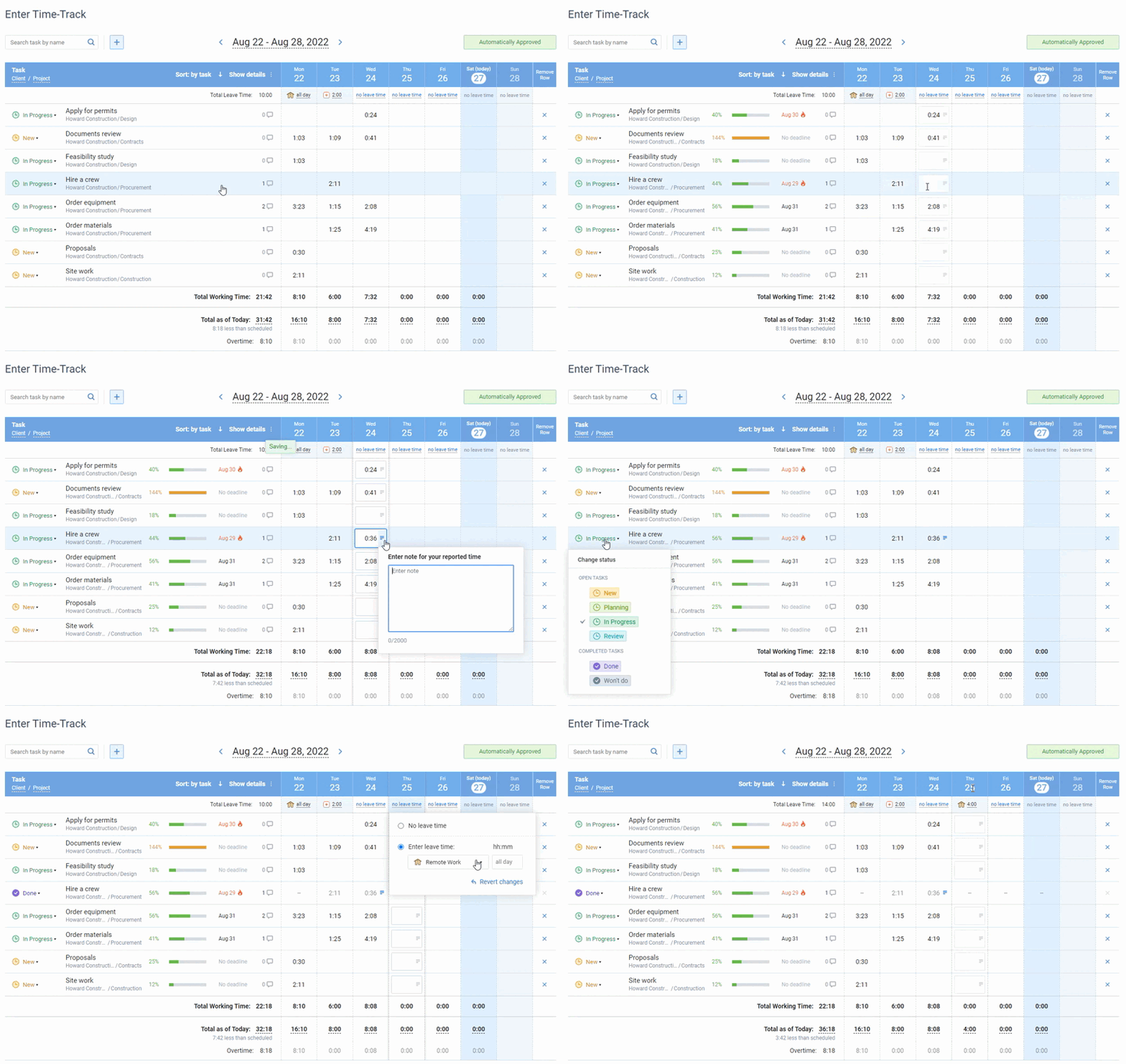
At the end of the week, each person submits the timesheet for approval with one click. A supervisor reviews it and approves or rejects it, and approved periods can be locked so hours that went to payroll cannot be changed afterward.

Great way to see how our volunteers spend time
With actiTIME, our service missionaries and volunteers have a simple way to log their hours, while our supervisors have a powerful tool that allows them to easily review and assess their performance.
Track time away from the desk
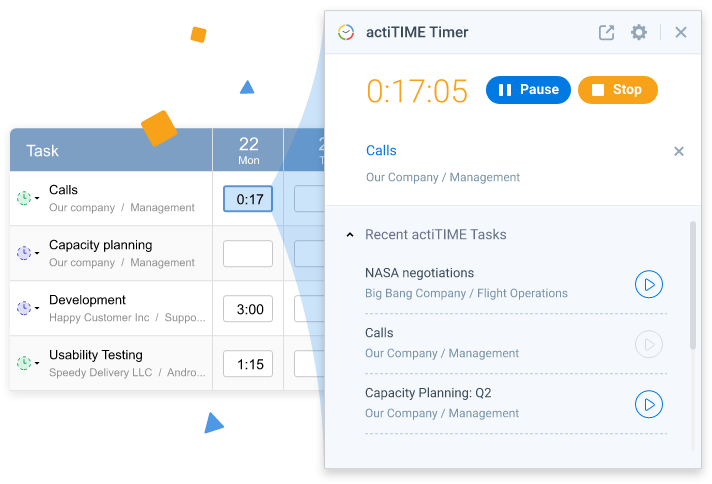
Staff who work at a desk can use the Time Management Assistant browser extension, a one click timer that syncs to their actiTIME timesheet.
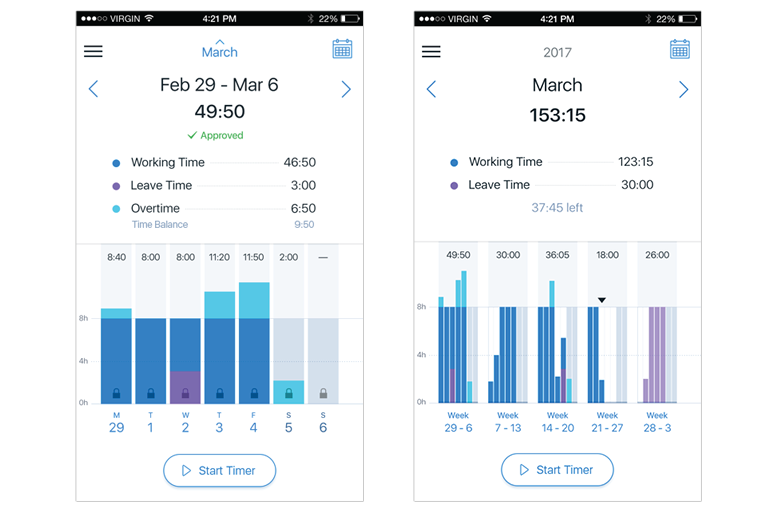
Facilities staff, youth workers and volunteers who move around can use the mobile app for iOS and Android to log hours manually or with a timer, add notes, and review their time log.
Reports for payroll and budgets
The Time-Track Report shows work and leave time for any period, grouped by person, ministry or date, and the Time-Track in Detail Report gives entry level data for payroll checks. With Overtime Registration on, the Time Balance and Overtime Report compares hours worked with each person’s schedule. The Leave Time and Balances Report shows who took leave and what PTO is left.
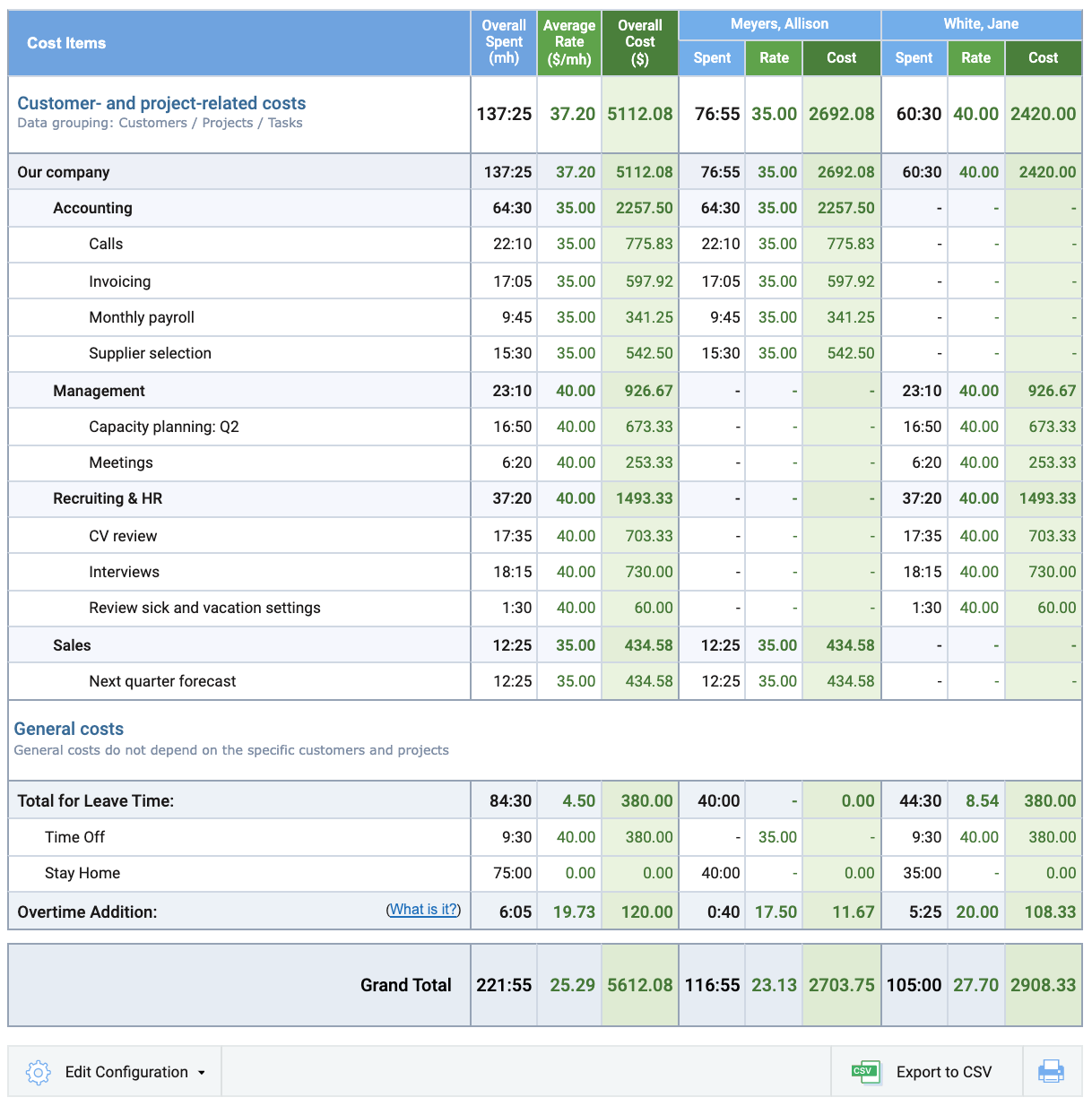
If you enter pay rates for staff, the Cost of Work Report shows the staff cost of each ministry, including overtime and leave costs, which is useful when building the annual budget. Time and cost budgets can also be set for a ministry or program, with a progress bar that turns red when the budget is exceeded.
What it costs
actiTIME is free forever for teams of up to 3 users, with a limited feature set; approvals, overtime and budgets are in the paid versions. Paid online use starts at $5 per user per month, billed yearly, and a self hosted version is available for a one time fee. The pricing page notes discounted rates for nonprofit organizations, so ask the sales team whether your church qualifies.


FAQ
Do church employees get overtime?
Non exempt church employees who are covered by the FLSA, individually or because they work in a church school or commercial activity, must be paid time and a half after 40 hours in a workweek. Some states add their own overtime rules, so check state law as well.
Are churches exempt from the FLSA?
Not entirely. The DOL says a non profit’s religious and charitable activities do not make it a covered enterprise, but employees can still be covered individually, and schools and commercial activities run by a church are covered.
How long should a church keep employee timesheets?
Under the FLSA, payroll records must be kept for at least three years and time cards for two years. State rules can require longer, so many churches keep both for three years or more.
Should church volunteers fill out timesheets?
They do not need payroll timesheets, because volunteers are not paid wages. Logging volunteer hours separately still helps you schedule fairly and report what volunteers gave over the year, and it keeps volunteer time clearly apart from paid work.
What is the best time tracking software for a church?
Look for weekly timesheets, supervisor approval, leave tracking, a mobile app for staff away from the office, and reports by ministry. Check whether there is a free version or a nonprofit discount.
Can small churches benefit from church management software?
Yes, if they need help with member records, giving or check in. For staff hours, a small church can start with a free time tracker, such as actiTIME’s free version for up to 3 users, and add a ChMS separately.
Start with one week of real hours
A church employee timesheet protects both the church and its staff: employees are paid for every hour, and leadership sees how paid time is spread across ministries. Start by recording one month of hours by activity, and the gaps in staffing and budgets usually become clear.
To try it with your team, start a free 30 day trial of actiTIME, or book a demo if you want a walkthrough.


