A timesheet app earns its price when the hours people log come out the other end as something you can use: a payroll export, a client invoice, an approved week, a project that you know is over budget before the client does. Plenty of apps can record time. Far fewer make it easy to log accurately and then do something with the numbers.
A good timesheet app lets people enter time the way they actually work, on the web and on a phone, sorts every hour by client, project and task, routes timesheets through approval, handles overtime and leave, and turns the result into reports, invoices and exports. This checklist walks through those ten features, explains why each one matters, and ends with a short way to test them during a free trial.
- What a timesheet app is (and is not)
- The timesheet app checklist at a glance
- 1. Time entry that fits how people work
- 2. A mobile app people will open
- 3. Clients, projects, tasks and billable work
- 4. Approval and locking
- 5. Reminders for missing timesheets
- 6. Work schedules and overtime
- 7. Leave and PTO balances
- 8. Reports and exports
- 9. Billing, costs and budgets
- 10. Integrations, security and hosting
- Which features matter for your team
- How to test a timesheet app in a trial
- FAQ
What a timesheet app is (and is not)
A timesheet app is software where employees record the hours they spend on work, usually against a client, project or task, and submit them to a manager. It replaces the paper form or the shared spreadsheet, adds up the totals for you, and keeps every entry in one place so it can be approved, reported on and exported.
Two neighbouring tools get mixed up with it. A time clock app records when people start and finish a shift, which suits hourly staff whose pay depends on attendance. An employee monitoring tool records what happens on a computer, such as apps used or screenshots. A timesheet app answers a different question: what was the time spent on, and who pays for it. Some products blend all three, so it helps to know which question you need answered before you compare features. If you are still weighing whether to move off paper or spreadsheets at all, see our overview of alternatives to traditional timesheets.
If you already know you need one and want product picks, our roundup of online timesheet apps compares eight of them with current prices. The rest of this page is about the features to check, whichever app you end up testing.
The timesheet app checklist at a glance
Use this table as a shortlist filter. The first five features decide whether people log time at all, and the last five decide whether the data is worth collecting.
| Feature | What to check | Why it matters |
|---|---|---|
| Time entry options | Weekly grid, start and stop times, a timer | People log time daily only when entry takes seconds |
| Mobile app | iOS and Android, timer, notes, leave requests | Hours worked away from a desk still get recorded |
| Work structure | Client, project, task levels; billable and non-billable work types | Without it you get hours but no answer to “on what?” |
| Approval and locking | Submit, approve, reject with comment, lock past periods | Payroll and invoices run on numbers nobody can change later |
| Reminders | Automatic emails for missing or late timesheets | Managers stop chasing people every Friday |
| Schedules and overtime | Per user schedules, automatic overtime, separate overtime rate | Daily and weekly hours feed payroll and labor law records |
| Leave tracking | Leave types, PTO and sick day balances, accrual rules | Absences and work time live in the same record |
| Reports and exports | Grouping by client, project, user; CSV and PDF export | The data has to leave the app in a usable shape |
| Billing, costs, budgets | Billing and cost rates, invoices, budget alerts | Hours turn into revenue and margin, not just totals |
| Integrations and security | Accounting sync, API, two factor login, hosting choice | The app fits your stack and your data rules |
1. Time entry that fits how people work
The interface is where most timesheet rollouts succeed or fail. If logging a day takes more than a minute, people batch it on Friday afternoon from memory, and the numbers drift. Look for an app that offers more than one way to enter time, because a designer who works on one project all day and a consultant who switches clients every hour need different screens.
The common formats are a weekly grid where you type total hours per task per day, a calendar view where you drag blocks with start and stop times, and a running timer. actiTIME, for example, has a weekly Timesheet view that accepts hours as 2:30 or 2.5, and a Calendar view with time cards you can drag, drop and copy to other days. Small details matter too: adding last week’s tasks in one click, an undo button, and the option to hide features your team does not use so the screen stays uncluttered.

Some teams also want automatic capture. A browser extension that records time spent in web apps and lets you start a timer with one click can fill gaps for people who forget to log. actiTIME’s Chrome extension works this way and sends captured time to the timesheet; our overview of automated time tracking in actiTIME shows how the two fit together.
2. A mobile app people will open
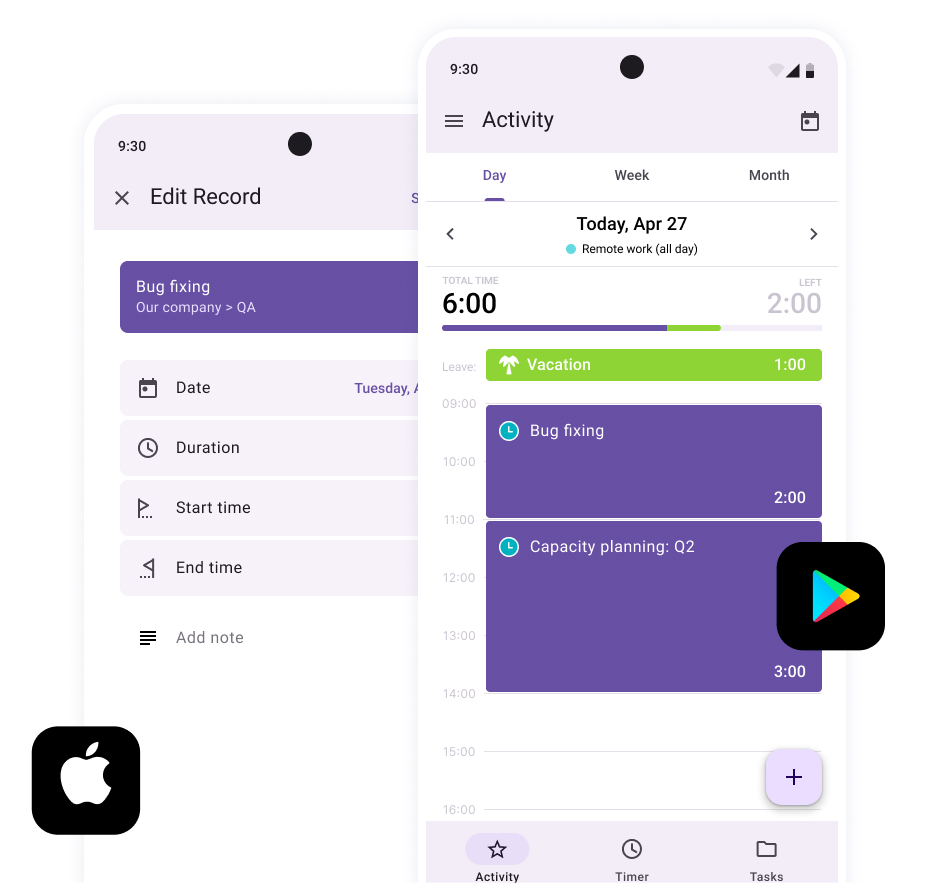
Anyone who works at client sites, travels, or simply finishes the day away from a laptop needs to log time from a phone. Otherwise those hours either go missing or get entered days later. A useful mobile app does more than show a timer: it lets people add notes to entries, review what they logged this week, and handle related tasks such as requesting leave.
The actiTIME mobile app for iOS and Android covers timer and manual entry, PTO requests and work status changes, and syncs with the web account so managers see the same data.
3. Clients, projects, tasks and billable work
A total of 40 hours a week tells you almost nothing. The value comes from knowing that 12 of those hours went to one client’s project, that 5 were non-billable admin, and that a particular task took twice its estimate. For that, the app needs a work structure that mirrors yours.
Check for at least three levels, typically client, project and task, and for the ability to rename them if your business uses words like “engagement” or “job”. Then check how billable and non-billable work is separated. In actiTIME this is done with types of work: each task gets a type such as billable design or internal meeting, and the billing rate follows from it. Task estimates and deadlines on the same structure let you compare planned and actual time later.
4. Approval and locking
If timesheets feed payroll or invoices, someone has to confirm them. An approval workflow lets employees submit a week with one click, and lets managers approve it or send it back with a comment that explains what to fix. Look for bulk approval, so a manager with twenty reports does not open twenty screens, and for the option to auto approve people who do not need a review.
Approval alone is not enough if anyone can still edit an approved week. Locking closes that gap. In actiTIME, managers approve or reject timesheets from a dedicated Approve Time-Track tab, editing an approved week sends it back to “Not Ready”, and a lock permission freezes selected days or everything up to a chosen date once payroll or invoicing is done. Our guide to timesheet management covers how to set up a weekly review routine around this.
5. Reminders for missing timesheets
The most common timesheet problem is not wrong data, it is no data. Automatic email reminders for incomplete or unsubmitted timesheets remove the need for a manager to chase people by hand. Check whether reminders can go to both the employee and the approver, and whether you can set when they fire, for example on Friday afternoon and again on Monday morning. Deadline reminders on tasks help as well, because they prompt people to open the app in the middle of the week.
6. Work schedules and overtime
For hourly, non-exempt employees in the US, the Fair Labor Standards Act requires employers to keep a record of hours worked each workday and total hours each workweek. The Department of Labor’s recordkeeping fact sheet also says no particular form is required, payroll records should be kept for at least three years, and time cards for two. A timesheet app is one way to keep those records accurate, but only if it knows each person’s schedule and calculates overtime against it.
Look for schedules you can set company wide or per user, overtime that is calculated automatically rather than added up by hand, and a separate overtime rate so the cost shows up correctly in reports. actiTIME lets you choose the overtime mode per user: switched off for staff who are not entitled to it, calculated automatically and either shown or hidden in their timesheet, or entered manually. Overtime hours then appear in the Time Balance and Overtime report, and their cost in the Cost of Work report.
7. Leave and PTO balances
Leave and working time belong in the same record. When vacation and sick days are logged in the timesheet, a week with 32 worked hours and 8 hours of PTO reads correctly instead of looking like a short week, and payroll gets both numbers from one place.
Check whether you can define your own leave types, whether balances update automatically through accrual rules (monthly, yearly or on the hire date, with caps), and whether you can block leave on busy dates. actiTIME handles this in the timesheet itself, with PTO and sick day balances, accrual and reset rules, and blackout days. Teams that need leave requests and a shared absence calendar can connect actiPLANS, a separate absence management tool; see our list of absence management software for other options.
8. Reports and exports
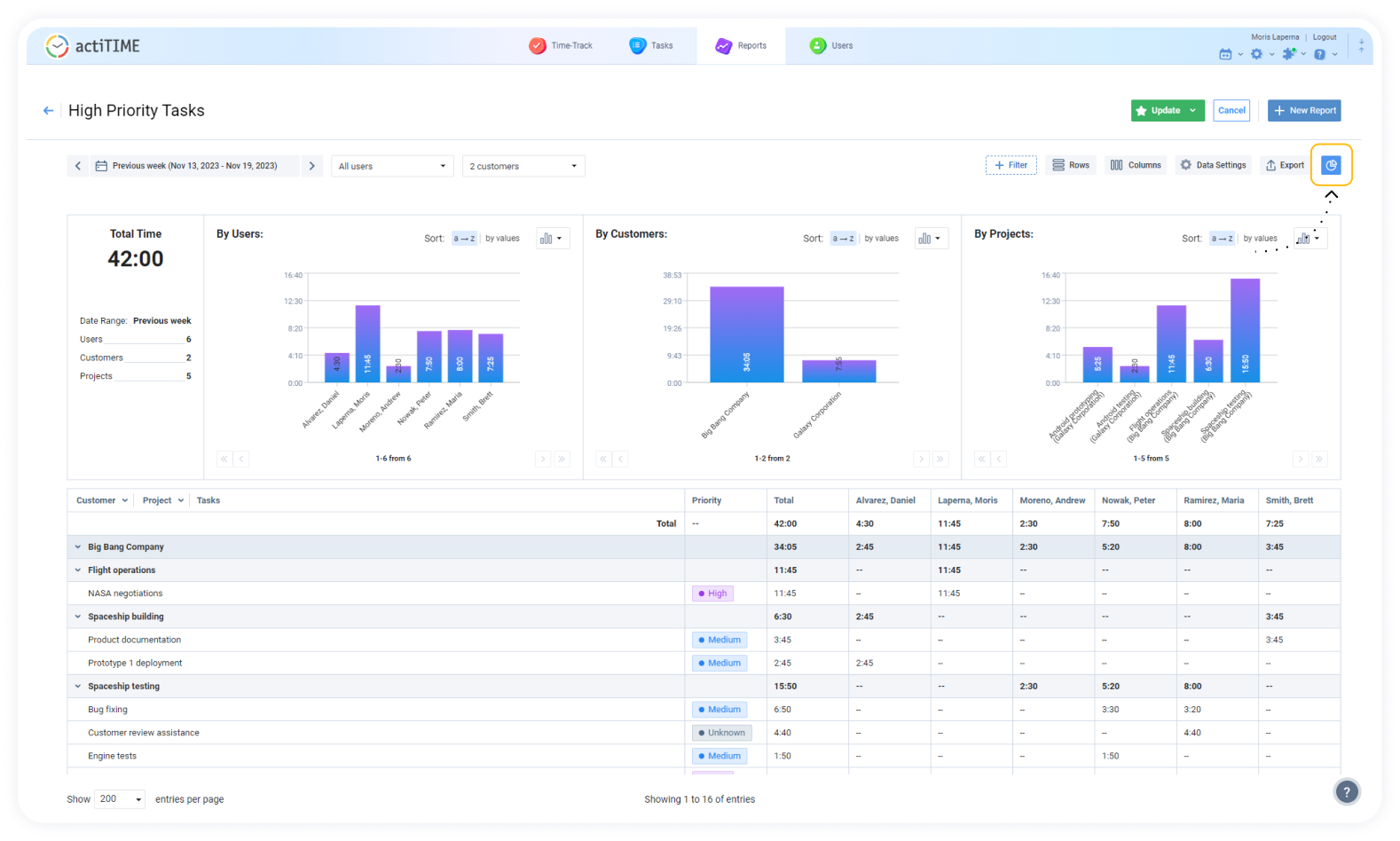
Timesheet data is only useful if you can slice it. A good report builder lets you group hours by client, project, task, user or type of work, filter by period, and save a configuration so you can rerun it next month in one click. Ask which reports exist out of the box, not just whether “reporting” is on the feature list.
In actiTIME, the Time-Track report covers work and leave time for any period, the Estimated vs. Actual Time report shows where tasks overran, and the Staff Performance report breaks down each person’s logs. Most reports export as CSV for further processing, and several, including invoices and the overtime report, export as PDF. A reports dashboard with saved shortcuts keeps the ones you use weekly one click away.
9. Billing, costs and budgets
If you bill clients by the hour, the app should turn approved billable time into amounts and invoices without a spreadsheet in between. If you run internal projects, the same data answers a different question: what did this project cost in staff time, and are we still within budget? Either way, check for three things: billing rates, cost rates, and budgets.
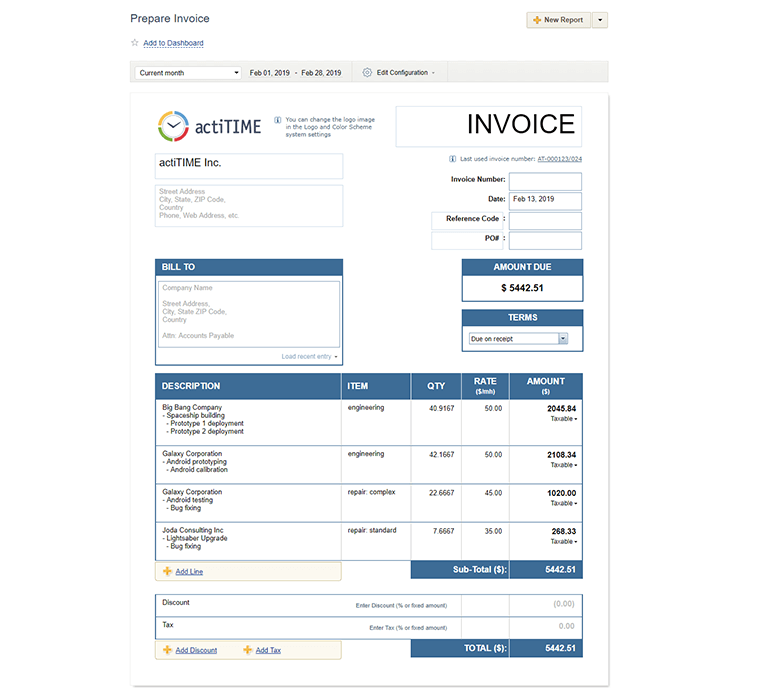
In actiTIME, billing rates are set by type of work, or per user with project specific rates if a project’s billing method is switched to user rates. Cost of work rates are set per employee, with separate regular, overtime and leave rates. Time, cost and billing budgets can sit on a client, a project or a task, and the progress bar turns red when a budget is exceeded. From there the Billing Summary, Cost of Work and Profit/Loss reports show revenue, expenses and margin, and PDF invoices are generated from billable time. Our guide to managing project costs walks through the setup step by step.
10. Integrations, security and hosting
Finally, check how the app fits around everything else you use. The useful integrations for a timesheet app are usually accounting and payroll (actiTIME, for instance, sends time records to QuickBooks Online), an automation tool such as Zapier, and an API for custom reports or backups. Ask how data gets out if you ever leave.
On security, look for two factor authentication, password and lockout policies you can configure, and regular backups. Some organizations also need the data on their own servers. actiTIME is one of the few timesheet apps that offers a self-hosted version alongside the cloud one, paid once per user rather than monthly.

Time tracking became a breeze
With actiTIME’s mobile app, tracking time on the client’s side became a breeze. Now accountants simply switch on the timer on their phone as they start another task and get accurate time logs without taking notes.
Which timesheet app features matter for your team
Not every team needs all ten features on day one. The table below shows where to put your attention first, depending on what the hours are for.
| Team type | Must have | Can wait |
|---|---|---|
| Hourly staff paid through payroll | Mobile entry, schedules and overtime, approval and locking, leave balances, payroll export | Billing rates, invoices, budgets |
| Agencies and consultancies billing clients | Client and project structure, billable work types, approval, billing rates and invoices, budgets | Detailed leave accrual rules |
| Internal project teams | Task structure with estimates, Estimated vs. Actual reports, cost rates and budgets, reminders | Invoices |
| Organizations with strict data rules | Two factor login, lockout policy, self-hosted option, API for backups | Browser extension |
For a smaller team that wants a short list of products rather than features, our guide to timesheet software for small business is the better starting point.
How to test a timesheet app in a trial
Feature lists all look alike, but two weeks of real work in a trial show the differences quickly.
-
Set up your real structure.
Add three or four actual clients, projects and tasks, with your real billable and non-billable work types, instead of the sample data.
-
Invite a small, mixed group.
Include someone who works mostly on a phone, someone who switches tasks often, and one manager who will approve.
-
Log a full week, then approve it.
Have everyone log daily, submit on Friday, and have the manager reject one timesheet with a comment to see how corrections flow back.
-
Run the reports you would run at month end.
Pull hours by client, an overtime summary and, if you bill, a draft invoice. Export to CSV and open it in the tool your payroll or finance team uses.
-
Ask the team what they would change.
If logging felt slow or confusing, adoption will drop after the trial. That answer matters more than any single feature.


FAQ
What features should a good timesheet app include?
At minimum: quick time entry on the web and a phone, a client, project and task structure with billable and non-billable work, an approval workflow with locking, reminders, schedules and overtime, leave tracking, and reports you can export. If you bill clients or track budgets, add billing and cost rates, invoices and budget alerts.
Is there a free timesheet app?
Yes. Several apps have permanent free versions with limits on users or features. actiTIME is free for teams of up to 3 users, with some features such as approval, overtime and budgets reserved for the paid version. Other vendors set their own limits, so check how many users the free version covers and which features it leaves out before you rely on it.
What is the best timesheet app for my phone?
The best one is the app your company already uses on the web, as long as it has a native iOS and Android app with a timer, notes and leave requests. A standalone phone app that does not sync with your team’s account creates a second record that someone has to reconcile. Our comparison of online timesheet apps notes which ones have mobile apps.
What’s the difference between a timesheet app and a time clock app?
A time clock app records when people clock in and out, which is mainly used to pay hourly staff for attendance. A timesheet app records what the time was spent on, usually by project or task, and is used for payroll, client billing and project costs. Many timesheet apps include a timer, and some time clock apps add basic job codes, but the focus differs.
Do timesheet apps help with overtime compliance?
They help with the records. Under the FLSA, employers must keep daily and weekly hours for non-exempt employees, and a timesheet app with schedules and automatic overtime calculation keeps those numbers accurate and stored. It does not decide who is exempt or which state rules apply, so pair it with a review of your classification and state law.
Should a timesheet app track screenshots or activity?
Only if you specifically need proof of work for remote contractors. For most teams, screenshots and activity scores add friction without making project data more accurate. A timesheet app that makes entry fast and gets weeks approved usually gives better numbers. Our article on employee tracking for remote workers covers the pros and cons in more detail.
Summary
The right timesheet app is the one your team will fill in every day and whose numbers you can take straight into payroll, invoices and project decisions. Use the checklist to narrow the field, then test the top two with real work.
actiTIME covers all ten features in one product, with a free version for up to 3 users and a self-hosted option for teams that keep data in house. Start a free 30-day trial, or book a demo if you want a walkthrough.