



What is time?
An irreversible sequence of events, a linear flux of interconnected instances or an intangible substance measured by clocks? Throughout human history, philosophers, scientists and creatives have tried to answer this question, but the concept of time is still open to interpretation.
One thing is certain: time rules over our lives. It dictates how we approach our daily pursuits, plan events and act on various goals. Although such a fact of reality may be imperceptible for some, every experienced project manager is well aware of it.
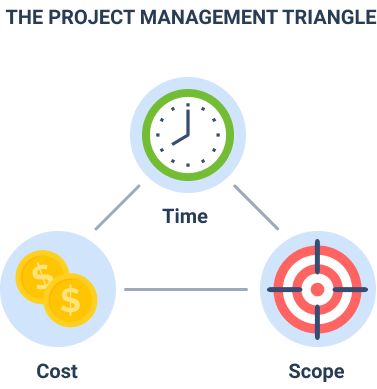
Time is among the central elements in the Project Management Triangle, also known as the Triple Constraint Model, which suggests that for bringing any project to successful closure and achieving formulated objectives, it is vital to have a realistic and thought-through picture of:
- Project expenses and income (Budget),
- Operations and activities required to meet desired objectives (Scope),
- Deadlines and timeframes for every project task (Time).
Simply put, time planning provides background for effective project realization, and the practice of time estimation is at its very core since time estimates drive schedule design and give structure to numerous work processes.
With this in mind, in the present article, we will explore the notion of time estimation in project management, why it matters, the main estimation techniques, and how to estimate project time accurately.
Definition of Time Estimation
The term “time estimation” refers to the assessment of the number of hours needed to complete a task or a series of tasks. The deeper your understanding of work specifics and nuances is, the more accurate time estimates you can receive. Therefore, to evaluate the volume of time for a project as a whole, you should do the following:
- Identify the amount of work – develop a detailed work breakdown structure and create a list of tasks for achieving significant project milestones and deliverables;
- Assess how many hours, days or weeks each of the project activities may take and sum up individual estimates to get the grand total of time necessary to complete the project.
As you can see, time estimation is an integral part of initial project planning, and, along with other planning practices, it serves to:
- Set realistic project expectations,
- Foresee risks,
- Organize processes,
- And promote a focus on priorities from the very start.
There are more ways to track and save project time than you think. Pass our quiz to learn more.
Spheres of Application
Two fields where time estimation is commonly applied are:
- Software development,
- And all sorts of construction projects, beginning with the erection of buildings and ending with large-scale infrastructure changes.
Nevertheless, time estimation can be of help across a variety of industries and sectors of performance, especially those using a project-based approach to business or, in other words, those that regularly initiate carefully designed, timebound and usually collaborative undertakings in order to attain specific aims.
Time estimation can be useful even beyond our jobs since one can implement it to set deadlines for personal projects and self-improvement endeavors. So, if you wish to accomplish something outside of your regular professional environment – be that an educational level-up or any other type of work towards a goal with measurable outputs – time estimates can become a thing to give you a long-awaited push to proceed in the right direction. What they do is show us that, with a little bit of discipline and a good action plan, all the conceived targets are achievable.

Why Are Accurate Time Estimates Crucial for Project Success?
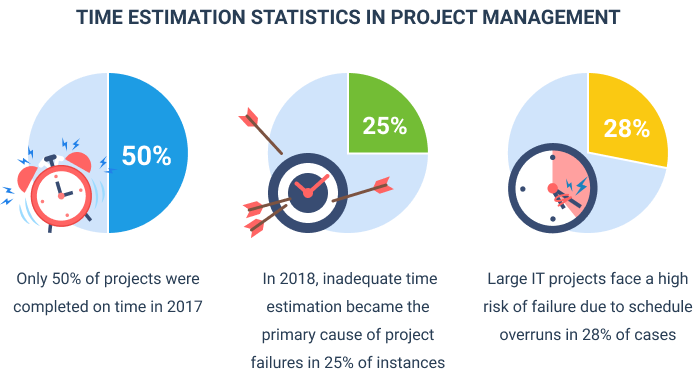
The PMI’s Pulse of the Profession study of 2017, which involved over 3,200 project management professionals, indicated that only about 50% of projects were completed on time that year.
The same study conducted in 2018 revealed that, among 5,402 of the surveyed international specialists, 25% viewed inadequate time estimation as a primary cause of recent project failures in their organizations.
Additionally, the results of a somewhat older analysis by Gartner showed that schedule overruns contributed to failures in large IT projects with budgets of more than a million USD in 28% of cases.
Of course, inefficient time estimation doesn’t necessarily result in complete project failure at once. As for schedule delays, there are a plethora of other variables to consider:
- It is always challenging to determine deadlines and stick to them in massive and complex projects;
- Sometimes delays may happen due to third parties’ actions or environmental factors that are out of your direct control;
- In other situations, they may be an outcome of unforeseen changes in project scope (i.e., scope creep) and poor initial project plans.
Nevertheless, the provided statistics demonstrate that inadequate time estimation increases the risks for project underperformance and unsatisfactory outcomes.
Here are two main reasons why you should dedicate a lot of attention and efforts to arrive at as precise time estimates as possible:
Cost overruns
The Triple Constraint Model prompts that a project’s scope, deadline and budget are closely interrelated, and changes in one of these parameters inevitably cause changes in the others. While the amount of project tasks conditions the duration of a project, time estimates and schedules may define its overall price to a large extent (especially when a portion of project costs is calculated depending on workers’ hourly rates).
In this way, inadequate time estimation can interfere with your capability to create sound budgets and get credible cost forecasts. As a consequence, you may experience cost overruns, and the bigger they grow, the harder it is to cope with them. That is to say, cost overruns often result in financial loss and inability to complete projects on time (if at all) because of the scarcity of resources.
Impaired managerial credibility and negative stakeholder perceptions
Time and cost estimates serve as performance objectives, and every manager has a responsibility to meet them. Also, estimates announced prior to starting the actual work on a project form stakeholder expectations. Based on them, not only you but your partners make assumptions regarding the quality, functionality and duration of projects and plan their own operations in accordance with those assumptions.
Besides, along with costs and budgets, time estimates frequently determine the attractiveness of newly planned projects to sponsors for reasonable deadlines imply that a project is feasible to realize. Sponsors have a considerable stake in projects and bear the highest level of accountability for their outcomes. Thus, if estimates showcased during the bidding process turn out to be wrong at the later stages in the project life cycle, sponsors become the first ones to trial all the harmful effects of that mistake.
The main takeaway from the above is that time estimation errors – especially when they severely impact the performance of your own team, as well as plans, operations and activities of essential stakeholders – may degrade your credibility as a manager and be perceived as a sign of professional weakness by others. In the end, such errors can take a toll on your sense of managerial self-efficacy and relationships with different parties involved in project realization.
Time Estimation Techniques
There is no single way to estimate time in project management. The right method depends on how much detail you have, how much time you can spend estimating, and how much uncertainty the work carries. Most estimates rely on one of five techniques, and experienced managers often combine them.
With three-point estimating, the expected duration is usually calculated as (optimistic + 4 × most likely + pessimistic) ÷ 6, which pulls the estimate toward the most likely value while still accounting for the best and worst cases. Analogous estimating is the fastest of the five but the least precise, while bottom-up is the most accurate and the most time-consuming, so many managers start with a quick analogous figure and refine it with bottom-up detail as scope becomes clear.
How to Estimate Time for a Project
A reliable estimate is less about guessing well and more about following a repeatable process. Here is a simple sequence that works for most projects.
- Break the work down. Build a work breakdown structure so every deliverable is split into tasks small enough to estimate on their own.
- Choose a technique. Match one of the methods above to your data and deadline, using bottom-up for detail and analogous for a quick early figure.
- Estimate each task. Assign hours to every task, and use three-point estimating for anything uncertain so the risk is built into the number.
- Add contingency. Include a buffer for risks, dependencies, and interruptions rather than assuming everything goes perfectly.
- Validate against history. Compare your estimate with how long similar work actually took, since past data is the best defense against wishful thinking.
- Track and refine. Once work starts, record actual time and adjust future estimates, so each project makes the next one more accurate.
This is where time tracking pays off. With actiTIME, you set an estimate on each task, log the time actually spent, and compare the two in the Estimated vs Actual Time Report, so your estimates improve with every completed project.
Time and Cost Estimation
Time and cost estimates are two sides of the same coin. When part of your budget depends on hourly rates, the hours you estimate largely determine the price of the project, which is why the Triple Constraint Model ties scope, time, and budget together. A slipping schedule almost always means a rising cost, so it pays to estimate time and cost together and revisit both whenever scope changes.
In Conclusion
Time estimation plays a particularly important role in the process of project planning. It protects against delays that may lead to cost overruns and negative stakeholder perceptions, threatening the very ability to complete a project in the long run.
To avoid that, dedicate enough resources to administer time estimation the right way and obtain all the data needed to make forecasts as accurate as possible, namely:
- A work breakdown structure and information on project scope;
- Analysis of external risks that may interfere with the timely delivery of desired outputs;
- Analysis of internal risks, including potentially inaccurate budget estimates and their possible effects on project schedule.
The keys to correct time estimation are the use of hard evidence, avoidance of overly optimistic presumptions, and consideration of uncertainties.
actiTIME allows you and your employees to track time, see how long tasks actually take, and adjust future estimates based on historical data.


Frequently Asked Questions
What is time estimation in project management?
Time estimation is the practice of assessing how many hours, days, or weeks a task or a whole project will take. Managers break the work into tasks, estimate each one, and add them up to forecast the total, which then drives the schedule, budget, and stakeholder expectations.
What are the four types of estimating?
The four estimating methods used most often in project management are analogous (based on similar past work), parametric (a unit rate multiplied by quantity), three-point or PERT (an average of optimistic, most likely, and pessimistic figures), and bottom-up (estimating every task and summing them). Bottom-up is the most accurate, while analogous is the fastest.
What is three-point estimating in PMP?
Three-point estimating reduces bias by using three figures for each task: optimistic, most likely, and pessimistic. The expected duration is usually calculated with the PERT formula (optimistic + 4 × most likely + pessimistic) ÷ 6, which accounts for uncertainty instead of relying on a single guess.
How do you estimate time for a project accurately?
Start with a work breakdown structure, pick an estimation technique that fits your data, estimate each task with a buffer for risk, and validate the total against how long similar projects actually took. Tracking actual time against your estimates, for example with actiTIME, is the most reliable way to make each future estimate sharper.