


A clinical trial can look profitable in the contract and lose money in practice. The gap opens quietly, through screen failures that consumed a week of coordinator effort, unscheduled safety visits nobody logged, monitoring visit prep that took two days instead of four hours, and reconsent work after an amendment that was never priced into the original budget. By the time finance notices, the study is half over and the hours are gone.
Contract Research Organizations run on billable labor. When that labor is recorded in memory, spreadsheets, or a system nobody reconciles against the sponsor contract, the CRO absorbs the cost. Time tracking software for contract research organizations exists to close that gap, turning the work your staff actually performed into evidence you can invoice against and margin you can measure per study.
actiTIME has worked with CROs and research groups for over 20 years, and teams in 130+ countries use it to connect hours to cost, billing, and project outcomes. This guide compares actiTIME against four other tools CROs actually consider – ClickTime, DATABASICS, Deltek Replicon, and BigTime – and it is honest about where each one stops, actiTIME included.
Prefer to watch? This quick video walks through five time trackers built for CRO project management, so you can spot unprofitable trials while there’s still time to act.
Why time tracking is a financial control for CROs
Sponsors outsource to CROs for expertise, infrastructure, speed, and cost control. Those same pressures become the core challenges Contract Research Organizations face, and each one traces back to a question about hours: who worked on what, for how long, against which contract line, and did we get paid for it.
Budget leakage in clinical research rarely arrives as one large error. It accumulates through ordinary work. A coordinator takes a forty minute call about a rescheduled visit. A CRA spends an afternoon preparing for a monitoring visit and another responding to findings. A protocol amendment triggers retraining and reconsent across a dozen participants. None of it feels large enough to invoice, and none of it gets recorded, so the site or the CRO donates the labor.
The fix is unglamorous. Record effort at the point it happens, tie it to the study and activity it belongs to, and compare it against what the sponsor agreed to pay. Everything below is built on that.
What to look for in CRO time tracking software
Whether you run a five-person research site or a global CRO, the same handful of things determine whether a time tracking tool actually closes the budget-leakage gap above or just adds another screen nobody updates.
Billable and non billable separation, with real rates
Screen failures, monitoring visits, and reconsent work are billable or not depending on the contract, and the tool needs a rate structure that reflects that – not a single blended hourly number.
Tagging by protocol, phase, or site
A CRO running several studies at once needs to slice reported time by protocol, therapeutic area, or site without waiting on IT to build a custom report every time a question comes up.
Budget tracking with alerts, not just totals
Knowing a study went over budget at close-out is a post-mortem. A tool worth using flags it while there is still time to act – ideally before the next invoice, not after. See our guide to clinical trial budget management for what actually goes into a defensible study budget.
Approval and locking before invoicing
Once a period is billed to a sponsor, the underlying time records need to stop moving. Approval workflows plus a hard lock on closed periods are what make an invoice defensible if a sponsor ever queries it.
Time capture that works away from a desk
CRAs are at investigator sites with unreliable connectivity more often than they’re at a desk. Offline mobile capture, not just a mobile-friendly website, is what keeps that time from getting lost or reconstructed from memory on Friday.
Integration with what you already run
None of these tools replace a CTMS or EDC, so how cleanly time and billing data flows into payroll, accounting, and reporting tools matters as much as the time-tracking features themselves.
Data security that matches your obligations
Time and billing records for clinical work carry sponsor-confidential and sometimes patient-adjacent information, so encryption, access controls, and – for organizations with stricter residency requirements – a self-hosted option are worth checking before you commit.
With those criteria in mind, here’s a closer look at 5 tools worth considering.
5 time tracking tools for CROs
1. actiTIME
Key features:
- Mobile app with offline mode
- Custom fields
- Cost, billing and time budgets
- Self-hosted option
Why it works for CROs: actiTIME organizes work as Customer, Project, and Task – renameable to Sponsor, Study, and Activity – with custom fields for protocol number, phase, or site, and Types of Work that carry their own billable rate. Cost of Work, Billing Summary, and Profit/Loss reports turn that structure into study-level margin, and cost, billing, and time budgets flag overruns before close-out.
Best for: CROs and research sites that want transparent, affordably-priced study cost and margin tracking without adopting a full professional-services-automation platform – especially those with data-residency requirements a self-hosted install can satisfy.
Pricing: Free forever for 1–3 users; the paid option, from $6/user/month for 1–40 users, billed annually, dropping to $5/user/month for 41–200 users; Self-Hosted from $120/user, one-time.
Free trial: 30 days, no credit card required.
Rating: Capterra 4.6 (111 reviews).
Pros:
- Publicly listed, straightforward pricing with a genuine free tier and a one-time self-hosted option – rare among the tools on this list
- Renameable work structure and custom fields map onto sponsor/study/protocol vocabulary without a consultant-led setup
Cons:
- Not a CTMS, EDC, or professional-services-automation platform – it’s a focused time, cost, and billing layer, not resourcing or proposal-to-cash automation
2. ClickTime
Key features:
- 70+ pre-built reports
- DCAA-compliant audit trails
- Resource and utilization planning
- Real-time budget alerts
Why it works for CROs: ClickTime positions itself as finance-first time tracking, categorizing time as billable, CapEx, OpEx, or R&D at entry so audit-ready data doesn’t need retroactive sorting. Built-in approval workflows and complete change history are aimed squarely at organizations that face external audits – government-funded trials and DCAA reviews among them.
Best for: CROs and research sites running federally funded or grant-restricted studies that need DCAA-compliant labor documentation and funder-ready reports out of the box.
Pricing: Starter from $12/user/month, Team $15/user/month, Premier $27/user/month, Enterprise custom (annual billing brings these down roughly 15–20%). ClickTime doesn’t publish pricing on its own site; treat these as directional and confirm current rates directly.
Free trial: 14 days on Starter and Team, no credit card required; Premier and Enterprise by demo.
Rating: Capterra 4.5 (rated across G2, Capterra, GetApp, Software Advice, and TrustRadius).
Pros:
- Reporting depth (70+ reports) and audit-ready records are purpose-built for DCAA and grant-compliance scenarios common in publicly funded research
- Consistently praised support, including phone access to US-based staff
Cons:
- Mobile app lags the web experience, and pricing isn’t public – you’ll need to confirm current rates directly
3. DATABASICS
Key features:
- Unified time and expense
- Multi-currency, multi-country
- P-Card and reimbursement management
- OCR receipt capture
Why it works for CROs: DATABASICS has a dedicated CRO industry offering, built around the reality that clinical trial staff cross borders and submit expenses as often as they log hours. Project and cost allocations code both time and expense to grants, projects, and trials, with localized currency, language, and work rules for international sites.
Best for: CROs running multi-country trials that need time and expense tracking unified in one system – travel, per diem, and reimbursements included – rather than bolting a separate expense tool onto a time tracker.
Pricing: From $7/user/month.
Free trial: Not publicly listed – sold via demo request.
Rating: Software Advice 4.5 (28 reviews).
Pros:
- Time and expense genuinely unified in one system, with multi-currency and multi-language support built for cross-border trial staff
- Reviewers consistently cite strong customer support
Cons:
- Reporting is a recurring weak point in reviews, and no self-serve trial is listed
4. Deltek Replicon
Key features:
- AI-automated time capture
- 100+ app integrations
- Global labor compliance
- Advanced analytics (Tableau/Power BI)
Why it works for CROs: Replicon’s Dela AI layer captures time from 100+ work apps and pre-populates timesheets, aimed at reducing the manual entry that causes missed billable hours across large, distributed teams. Modular products (TimeBill, TimeCost, Polaris PSA) scale from straightforward time-and-billing up to full resourcing and revenue recognition for enterprise CROs already inside the Deltek ecosystem.
Best for: Larger or enterprise CROs managing global, multi-currency workforces that need AI-automated capture and deep ERP/CRM integrations, and that have the budget and implementation runway for an enterprise-grade platform.
Pricing: Modular and quote-based; publicly referenced starting points include Time and Attendance from $6/user/month, ProjectTime from $29/user/month, and TimeBill Plus from $39/user/month. Full PSA (Polaris) pricing requires contacting sales.
Free trial: Not consistently publicly listed – largely sold via demo.
Rating: Capterra 4.5 (540 reviews, Replicon Time Tracking).
Pros:
- AI-automated capture across 100+ apps reduces manual entry at a scale few competitors match
- Deep global compliance and ERP/CRM integration for large, multi-country organizations
Cons:
- Modular pricing and enterprise-grade implementation are a heavy lift for a small or mid-size research site
5. BigTime
Key features:
- Flexible billing models
- AI-powered resource planning
- Native QuickBooks integration
- Plans vs. actuals reporting
Why it works for CROs: BigTime is a professional-services-automation platform built around winning work, resourcing teams, billing clients, and analyzing margins. Its flexible billing models – time and materials, fixed fee, retainer, or blended – map onto the hybrid contracts common in CRO work, where hourly monitoring sits alongside fixed-fee or milestone-based deliverables.
Best for: CRO finance and operations teams that need strong QuickBooks-integrated billing across mixed hourly and fixed-fee contracts, without Replicon-level enterprise complexity.
Pricing: Essentials $20/user/month, Advanced ~$35/user/month, Premier ~$45/user/month, Enterprise custom (annual billing).
Free trial: 30 days.
Rating: Capterra 4.6 (662 reviews).
Pros:
- Flexible billing models handle the mixed hourly/fixed-fee/retainer contracts common in CRO work, not just a single hourly rate
- Implementation typically completes within 60 days – fast relative to enterprise PSA platforms
Cons:
- No native payroll or attendance verification (no geofencing), and advanced analytics require the Premier plan
Side-by-side comparison
Now that you’ve seen how each tool works, here’s the same 5 side by side – the goal is to make the trade-offs easy to scan, not to crown a single winner.
The rest of this guide goes deeper on actiTIME specifically – the tool built into this comparison – covering exactly how it handles capture, billing, budgets, and security for a CRO.
A closer look at actiTIME
Capture time where the work actually happens
Clinical research staff do not sit at one desk. A CRA is at an investigator site with unreliable connectivity. A medical writer works in long focused blocks. A coordinator handles fifteen interruptions before lunch. Ask all of them to reconstruct the week on Friday afternoon and you get fiction.
actiTIME offers four ways to record time, and CROs typically use more than one.
Time entry options:
- Weekly timesheet for staff who log totals per task, in HH:MM or decimal format
- Calendar view for exact start and stop times per activity, useful for monitoring visits and billable travel
- Mobile app for iOS and Android that works offline, so a CRA at a site with no signal still records the visit
- Chrome extension with a one click timer and automatic activity capture that syncs into the timesheet
Every entry carries an optional comment, which is where the narrative detail lives. A line reading “3.5 hours, Site 104” tells finance nothing. A comment reading “repeat screening labs after reflex test, subject 104-0012” is the thing that survives a sponsor query six months later.

Time tracking became a breeze
With actiTIME’s mobile app, tracking time on the client’s side became a breeze. Now accountants simply switch on the timer on their phone as they start another task and get accurate time logs without taking notes.
Separate billable trial work from everything else
actiTIME organizes work as Customer, Project, and Task. All three level names are configurable, so a CRO can rename them to Sponsor, Study, and Activity, or to whatever vocabulary your contracts already use. Time is always recorded against a task.
On top of that structure, two features carry most of the weight for CROs.
Types of work mark an activity as billable or non billable and carry the billing rate. Data management, medical writing, pharmacovigilance, monitoring, and internal admin can each have their own rate. Assign a type of work to a task and every hour logged against it prices itself.
Custom fields let you categorize tasks by attributes actiTIME does not know about natively. Fields can be text, dropdown, or numeric with units and limits, which covers protocol number, study phase, therapeutic area, site ID, and amendment version. The Custom Fields Report then slices performance across those categories, so you can answer questions like how much coordinator effort Phase I oncology studies consume compared with Phase III.
Setting this up across a large study does not have to be manual. Tasks import from a CSV template, and bulk actions update priority, status, custom field, type of work, estimate, and deadline across many tasks at once.
See study margin, not just study hours
Most time trackers stop at the hour count. For a CRO that is the least interesting number. The useful question is whether the study earned more than it cost.
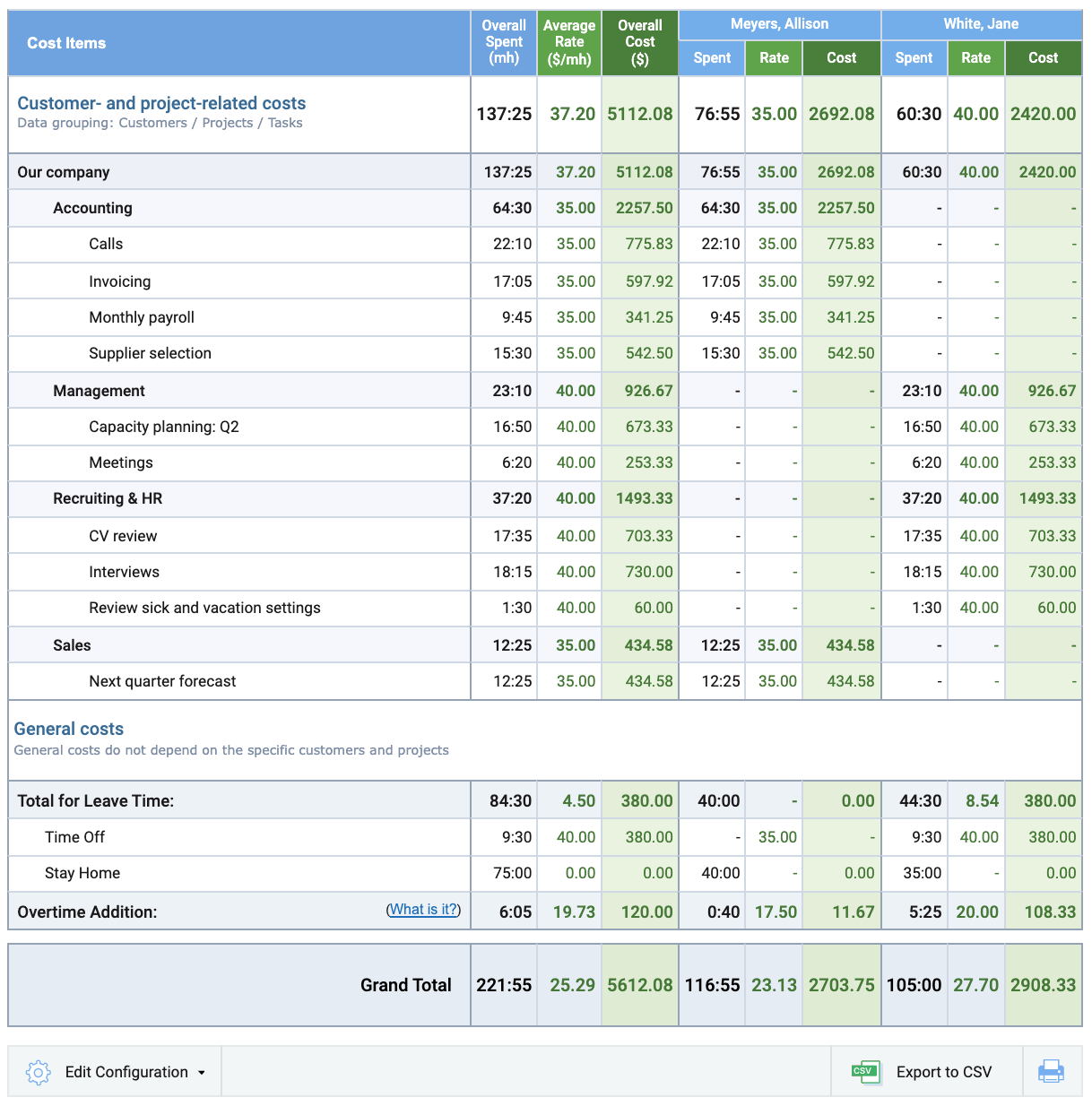
actiTIME answers it by holding two sets of rates. Cost of work rates sit on each employee, with separate regular, overtime, and leave rates. Billing rates sit on types of work. Once staff track time, three reports do the arithmetic.
- Cost of Work Report shows staff expense per user, including overtime and leave cost
- Billing Summary Report shows total billable time and amounts for the period
- Profit/Loss Report compares the two by customer, project, or task, which for a CRO means by sponsor, study, or activity
Invoices come out of the same data. actiTIME accumulates billable amounts from time entries and billing rates, then generates a PDF invoice with your branding, taxes, and discounts applied. There is no separate invoicing tool to reconcile against, which removes one of the places where sponsor billing disputes usually start.
When a sponsor challenges a line item, the Time-Track in Detail Report gives you entry level backup for every hour, with the comment the person wrote at the time.
Catch budget overruns while you can still act
A budget you review at close out is a post mortem. actiTIME supports three independent budget types, and each one can sit at the customer, project, or task level, meaning you can budget a whole sponsor relationship, a single study, or one activity within it.
-
Cost budget.
Tracks staff expense based on employee pay rates. Use it when your exposure is internal labor.
-
Billing budget.
Tracks billable amounts against the contracted value. Use it to see how much of the sponsor’s budget you have consumed.
-
Time budget.
Tracks hours invested against hours allocated. Use it for fixed scope activities like database lock or a set number of monitoring visits.
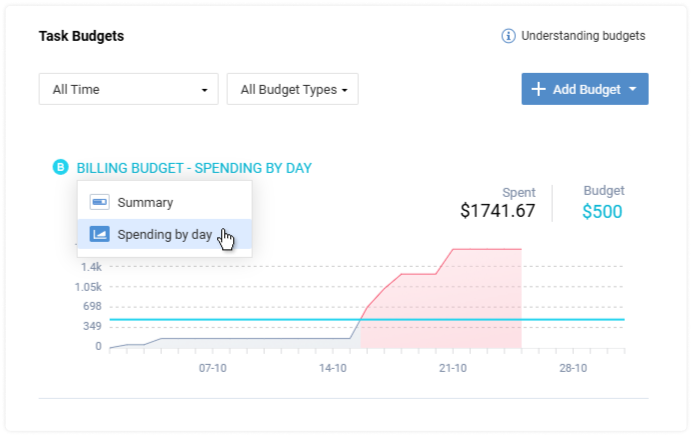
Each budget shows a progress bar that turns red once exceeded, viewable as a total or day by day. Admins can also receive an email the moment a project cost passes its budget, which is considerably more useful than discovering it during quarterly review. For the broader process this fits into, see our guide to project cost management.
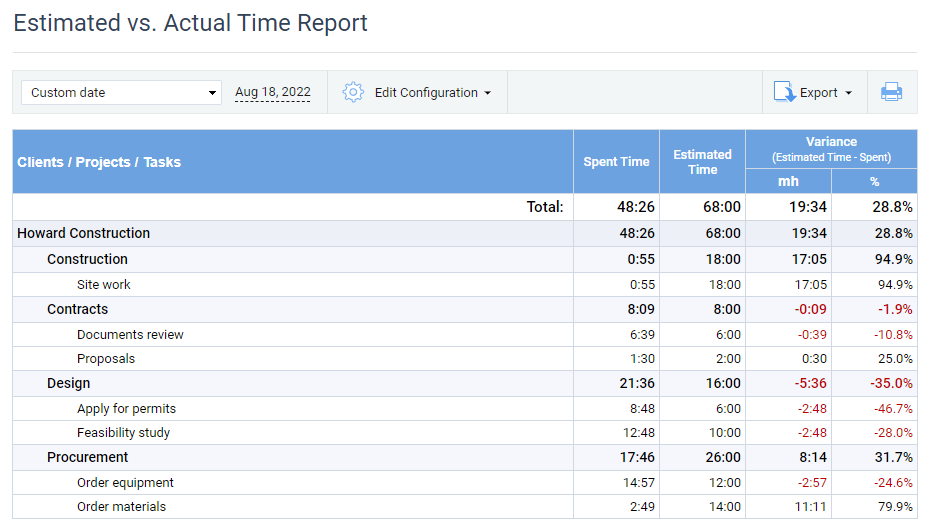
Alongside budgets, task estimates test whether your bid was realistic in the first place. Set the estimated hours before the study opens, let the team work, then run the Estimated vs. Actual Time Report. The variance it shows per customer, project, or task is the single best input you have for pricing the next protocol. Sites that consistently underprice screening effort find it here.
Control who sees what, and lock the record
Trial work carries confidentiality obligations, and not every person should see every study. actiTIME handles this through work assignments. A manager assigns a customer, project, or task to specific people, and assigning a customer automatically includes its projects. Staff see only what they are assigned to. Role based permissions govern who can approve time, manage billing data, or change the scope of work.
Once hours are recorded, two features protect them.
Time-Track Approval lets staff submit a week with one click. A manager reviews it from the timesheet or the Approve Time-Track tab, approving or rejecting in bulk and adding a comment explaining a rejection. Each person can have several approvers but needs only one approval, and editing an approved timesheet rolls its status back so the change is visible. See how the full workflow plays out in our guide to timesheet approval.
Lock Time-Track then freezes entries so they cannot be edited after approval, after invoicing, or after a period closes. Managers can lock selected cells, specific days across all users, or every date up to a chosen cutoff. Pairing approval with locking is what stops a timesheet from quietly changing after you have already billed the sponsor.
For infrastructure control, actiTIME Self-Hosted installs on your own premises as a one time purchase, which matters when patient adjacent or commercially sensitive data cannot sit on a vendor’s servers. Two factor authentication, configurable password and account lockout policies, and daily backups on the cloud version cover the rest.
Resource CRAs without burning them out
Monitoring visits cluster. Database locks create crunch. Overtime in a CRO is not an anomaly, it is a seasonal pattern, and it costs real money that has to land somewhere.
Overtime Registration calculates overtime per user according to state and company regulations, in one of four modes ranging from fully automatic and hidden to manual entry by the employee. Overtime is paid at a separate rate set in the user’s profile, and that cost flows into the Cost of Work Report rather than disappearing. The Time Balance and Overtime Report shows work time against scheduled hours across the team, which is how you spot the CRA who has been carrying two studies for a month.
Leave runs on customizable leave types tied to PTO or sick day balances. Accrual rules run on a schedule, balances reset yearly or on hire date, caps prevent unlimited rollover, and leave requests are automatically rejected when the ending balance would fall below a threshold you set. PTO blackout days block time off during periods you cannot afford to lose people, such as a site initiation window. Leave carries an hourly rate too, so vacation and sick time appear as real cost in the Cost of Work Report.
For organizations with medical writers, statisticians, data managers, and clinical operations under one roof, user departments group people so reports can be filtered by team. Corporate calendars and per user work schedules handle staff spread across countries with different holidays.
Fit into the systems you already run
actiTIME is not trying to replace your CTMS or your EDC. It connects to them.
- An API for data backups, custom reports, and connections to third party systems
- QuickBooks Online integration that imports time records for payroll and invoicing
- Zapier for connections to 2,000+ apps, including automatic notifications when tasks, projects, or customers change
- actiPLANS for absence tracking and attendance management alongside actiTIME
One practical use of Zapier at CROs is a change log. Pipe timesheet and task updates into Google Sheets and you have a running record of what changed and when, which is helpful during internal review even though it is not a formal system feature.

Pricing options for CROs
actiTIME is one product with no feature tiers, so a small research group and a global CRO get the same capabilities. There are three ways to buy it.
- Free forever for up to 3 users, with a limited feature set and no credit card
- Online from $5 per user per month, or a flat $1,500 per month for unlimited users
- Self-Hosted at $120 per user as a one time purchase, installed on your own infrastructure
Overtime Registration, Time-Track Approval, Departments, Task Estimates, Custom Fields, the API, and the Chrome extension are not in the free version, and most of them appear somewhere in the workflows above, so a CRO evaluating actiTIME should run the 30 day trial rather than the free version. The trial is full featured, and every option includes human support and free onboarding. Full pricing details are here.
FAQ
What is the difference between a CTMS and time tracking software for a CRO?
A clinical trial management system runs the trial itself, handling protocol data, site management, patient randomization, and regulatory documentation. Time tracking software runs the business behind the trial, recording who worked how many hours on which study, what those hours cost, and what they should bill. Most CROs need both, because a CTMS will tell you a monitoring visit happened and will not tell you the visit cost you $1,400 in unbilled CRA time. See where time tracking sits alongside EDC, eTMF, and the rest of the stack in our roundup of the best clinical trial software by category.
How should a CRO handle billable travel time to investigator sites?
Create a dedicated type of work for travel and give it its own billing rate, which may be lower than the rate for on site monitoring or zero if the contract treats travel as non billable. CRAs then log travel against that type of work using the Calendar view, which records exact start and stop times. Travel hours stay visible in the Cost of Work Report as real staff expense even when they bill at a reduced rate, so you can see what site coverage genuinely costs before you agree to the next geographic footprint.
Does actiTIME satisfy FDA 21 CFR Part 11 or DCAA audit requirements?
No. actiTIME does not provide a system wide audit trail, and it has not been validated as a regulated system of record for clinical trial data. It does offer timesheet approval workflows, time-track locking that prevents edits after a period closes, task level change history, and a self-hosted option that keeps data on your own infrastructure. If your sponsor contract requires Part 11 or DCAA compliant labor records, verify the requirement against those specific features with your quality team before selecting any tool.
Ready to try actiTIME in your Contract Research Organization?
Every tool in this comparison can log hours. What separates them is how directly that data turns into study cost, margin, and a sponsor-proof invoice – and how much platform you have to adopt to get there. The CROs that use actiTIME are usually not looking for another dashboard. They want to know which studies make money, which ones quietly drain a coordinator’s week, and whether the invoice they send on Friday can survive a sponsor asking where the hours went. Read how research organizations use it in our healthcare and research testimonials, or talk it through with our sale team.
You can start with the permanent free version for up to 3 users or run a full-featured 30-day trial at no cost.