


Contract research organizations make three promises to every sponsor: keep the study on budget, hit the deadline, and deliver quality work. The clinical and regulatory side of that is demanding enough. But the challenges that quietly decide whether a CRO stays profitable are operational. Estimating costs accurately, tracking where the hours actually go, billing sponsors for every hour earned, and coordinating a dozen specialized teams are the things that make or break a contract.
Get those wrong and a study can look healthy on paper while losing money in practice. This article looks at the main operational and project management challenges contract research organizations face, and at practical ways to solve each one.
What contract research organizations do
A contract research organization is an outsourcing company that supports the pharmaceutical, biotechnology, and medical device industries on a contract basis. Sponsors hire CROs to run work they do not want to staff in-house, from drug development and clinical trials to laboratory testing, medical writing, regulatory affairs, and post-marketing surveillance.
The appeal for sponsors is speed and cost. A CRO brings the expertise and infrastructure to move a study forward without the sponsor hiring permanent teams for work that has a limited duration. To deliver on that, a CRO has to run complex, deadline-driven projects across many specialized teams while handling large volumes of sensitive data. That is where the operational challenges begin.
Contract research organization challenges
1. Estimating study costs accurately
CROs once got by with rough cost estimates, adjusting later when sponsors placed change orders that shifted third-party costs. That no longer works. Under current revenue recognition rules, a CRO has to base its revenue on accurate cost estimates that include third-party costs, so a loose estimate is not just an operational problem, it makes the company’s reported finances volatile.
The fix is to estimate from real data rather than memory. In actiTIME you set a cost of work rate for each employee and a task estimate for each activity, then compare the estimate against the hours actually logged in the Estimated vs. Actual Time Report. The variance it shows is the best input you have for pricing the next protocol, and it is where CROs discover they have been underpricing effort like screening.
2. Keeping long studies on budget
Budget leakage rarely arrives as one large error. It builds up through ordinary work that never gets recorded: repeat screening after a failure, unscheduled safety visits, monitoring visit preparation, and reconsent after a protocol amendment. By the time finance notices, the study is half over and the hours are already spent.
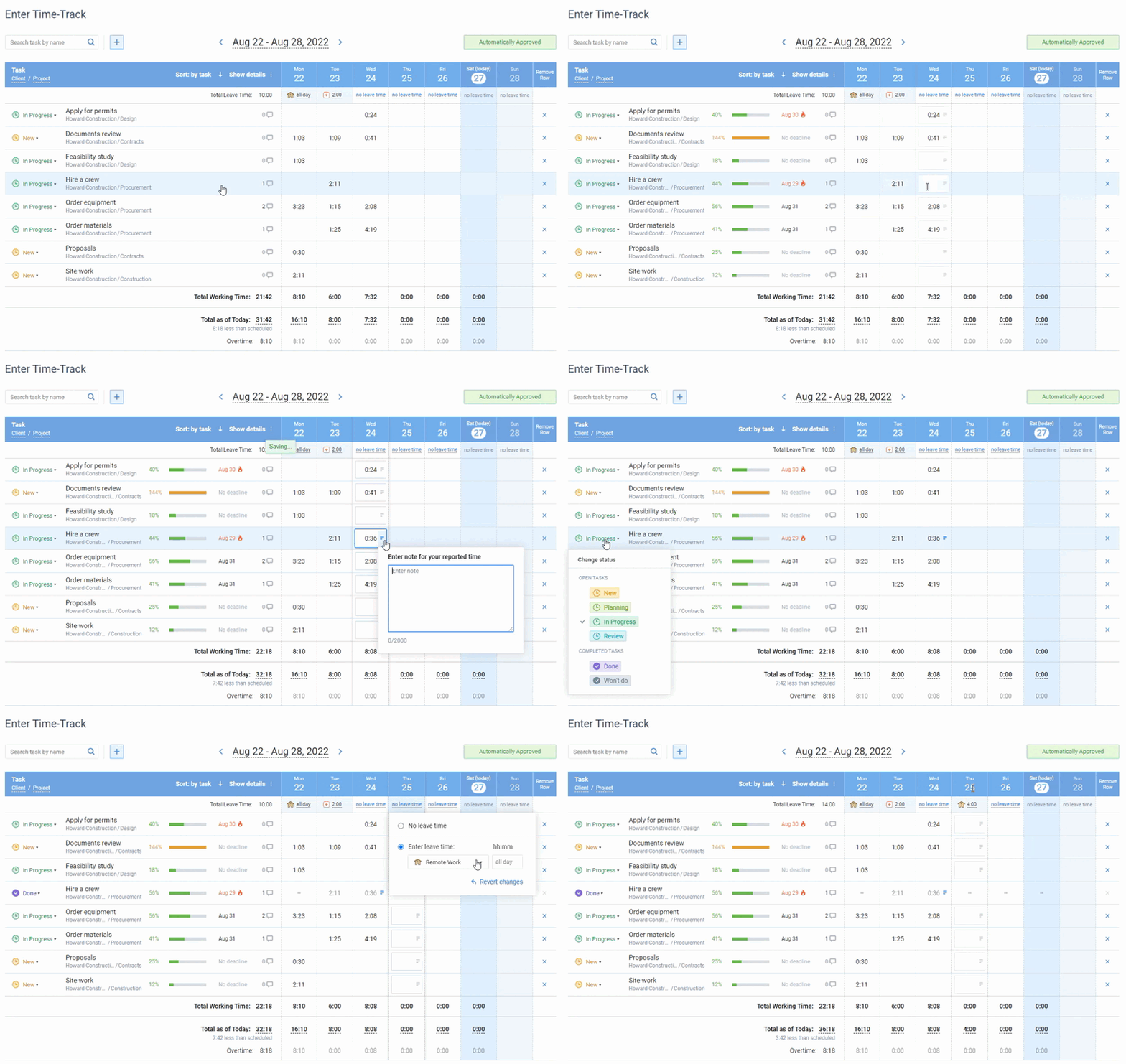
actiTIME gives you three independent budget types, cost, billing, and time, and each can sit at the sponsor, study, or activity level. A progress bar turns red once a budget is exceeded, and admins can get an email the moment a project passes its budget rather than finding out at quarterly review. That is what clinical trial cost management looks like day to day, a live number you check as you go, not a spreadsheet reconciled once a quarter. When a study closes, the budget picture is a live record, not a post mortem.
3. Meeting tight deadlines
Sponsors want their drugs to reach the market as fast as competition and patient need allow, so CROs work under tight timelines and usually run several studies in parallel. Missing a deadline damages the relationship and the CRO’s reputation, which is what brings in the next contract.
actiTIME keeps timelines visible. You set task estimates and deadlines with reminders, track progress through custom workflow statuses, and switch to a Kanban board to spot where a study is stalling. Because estimated and actual time sit side by side, a slipping task shows up while there is still time to act on it.
4. Coordinating many specialized teams
Clinical research runs on a mix of specialists: clinical operations, data management, biostatistics, medical writing, quality assurance, and regulatory affairs, plus the IT, HR, and finance staff that keep the company running. Each group has different skills and its own workload, and delivering a study on time means coordinating all of them without overloading anyone.
actiTIME makes that coordination manageable. Work assignments control who sees which sponsor and study, departments group people by team, and you can rename the default Customer, Project, and Task levels to match your own structure, such as Sponsor, Study, and Activity. Staff performance and workload reporting then show who is carrying too much and where capacity is free. For CROs running trials across several countries, corporate calendars and per-user work schedules account for local holidays and working hours, so a coordination view doesn’t mistake a public holiday in one office for an idle day somewhere else.

actiTIME enables us to balance workload better
I found in actiTIME all the requirements I was looking for. We are getting a lot of benefits – the tool enables us to better balance workload, have a constant view of what people are doing. I really recommend it, I evaluated a lot of tools, also had an in-house development before which demanded a lot of maintenance, and actiTIME solved all problems with no hassle.
5. Billing sponsors accurately
Billing disputes usually start with hours a sponsor cannot verify: time logged in bulk, work that is not tied to a specific activity, or effort that never made it onto a timesheet. For a CRO that runs on billable labor, every unrecorded hour is revenue given away.
In actiTIME, each type of work carries its own billing rate, so data management, monitoring, and medical writing can each bill differently. Tracked time flows into the Billing Summary Report and into PDF invoices generated directly from the hours, and the Time-Track in Detail Report gives you entry-level backup for every line, complete with the comment the person wrote at the time. When a sponsor questions an invoice, the answer is already in the system.
Not every contract runs on a straight hourly rate. Some CROs, monitoring work especially, are paid per completed task or resolved query rather than time spent. Tracking the actual hours behind each billed unit still matters here: if resolving a query is consistently taking twice as long as the unit price assumes, that is exactly the kind of variance that should inform the next bid, even though the invoice itself is not hourly.
6. Knowing which studies are profitable
A CRO can hit every deadline and still lose money if it does not know which contracts actually pay. Hours and invoices on their own do not answer that question, because the useful number is whether a study earned more than it cost to run.
actiTIME answers it with the Profit/Loss Report, which compares billable amounts against staff cost by sponsor, study, or activity. Set cost of work rates on your people and billing rates on your types of work, and the report does the arithmetic, showing you which relationships are worth renewing and which need renegotiating.
7. Doing more with a stretched team
Trained clinical research staff are hard to hire, and studies do not wait for headcount to catch up. In practice, the gap gets absorbed as unpaid overtime rather than dropped work: a CRA already covering two protocols picks up a third, and nobody notices until burnout turns into a resignation, which only makes the shortage worse.
Overtime Registration calculates overtime per user automatically, and that cost flows into the Cost of Work Report instead of disappearing into a spreadsheet. The Time Balance and Overtime Report lines up worked hours against scheduled hours for the whole team, so the person quietly absorbing a third protocol shows up on a report instead of in an exit interview.
8. Protecting sponsor and study data
Even the operational layer of a trial carries information a CRO cannot afford to leak: sponsor contract terms, protocol details, site assignments, and scheduling data tied to real patients and investigators. A breach here damages the sponsor relationship as surely as a breach of the clinical data itself.
actiTIME Online covers the basics: two factor authentication, password and lockout rules you set yourself, and backups running daily in the background. If the data has to stay entirely on infrastructure you control, actiTIME Self-Hosted is a one time purchase rather than a subscription. None of this replaces a validated audit trail for regulated trial records, that is what a CTMS or eTMF is for, but it does mean the day to day operational layer is not the weak link.

Where operations meet clinical and regulatory work
The operational challenges above sit alongside a set of clinical and regulatory ones that are just as real. CROs have to follow standard operating procedures and Good Clinical Practice, keep trial data clean and auditable, protect sensitive patient and study data, and satisfy the requirements of each region they operate in. Those are demanding, and they are not problems a time tracking tool solves.
For clinical data, patient randomization, and regulated records, a CRO needs a dedicated clinical trial management system or electronic data capture platform – see our roundup of the best clinical trial software by category if you’re still choosing one. actiTIME does not replace those, and it does not provide a validated audit trail. What it does is handle the operational layer they were never built for: the time, cost, billing, and resource questions that decide whether a study is delivered on budget. Used alongside your clinical systems, it fills the gap between the science and the business.
CRO challenges FAQ
How can a CRO tell its team is overstretched before it starts costing studies?
A few signals tend to show up before a resignation or a missed deadline does: overtime concentrated in one or two people rather than spread across the team, task estimates that keep running behind actual hours on the same type of work, a screening or query backlog that keeps sliding into next week instead of shrinking, and repeated turnover in the same specialist role. None of these are dramatic on their own, which is exactly why they get missed – they only add up to a pattern once you are tracking hours and estimates consistently enough to compare week over week.
Where should a CRO start if it isn’t tracking any of this today?
Start with billable time capture, since everything else here is built on it: cost estimates, budgets, and profitability reports all use logged hours as their raw material. Get types of work and billing rates set up, run for a month or two to see what a normal week actually looks like, then add budgets once you have a real baseline instead of a guess, and layer in profitability reporting once those budgets are holding. Setting budgets before you have baseline data just moves the guesswork one step later instead of removing it.
Can time tracking software replace a CTMS for a CRO?
No. A clinical trial management system runs the trial itself, handling protocol data, site management, and regulatory records. Time tracking software runs the business behind the trial, recording who worked how many hours on which study, what those hours cost, and what they should bill. Most CROs need both, because a CTMS will confirm that a monitoring visit happened and will not tell you it cost more in unbilled staff time than the contract allowed for.
Solve the operational side with actiTIME
A reliable CRO keeps to the budget, meets deadlines, and delivers quality work. The clinical systems handle the science. For the operational side, actiTIME gives you the time tracking, cost calculation, budgeting, billing, and resource visibility that keep studies profitable and sponsors confident.
Create projects, break them into tasks, and let your team record time through timesheets, a browser extension, or the mobile app. Turn that data into cost and profit reports, invoice sponsors from tracked hours, and connect actiTIME to your other tools through Zapier for a more transparent workflow.
Try actiTIME during a free 30-day trial, no credit card required, or request a live product demo today.