Search for geofencing software and you get three different industries on one page: location SDKs for app developers, ad platforms that target phones near a store, and fleet telematics for trucks and excavators. This guide covers a fourth use, the one field and construction teams actually buy: the geofence time clock, which uses a virtual boundary around a job site to remind, restrict or automatically clock in the people who work there.
We read the help center of every tool below rather than its homepage, because the details that decide whether your hours are right live there: the smallest radius you can set, whether the fence can follow the shape of the site, what happens when someone punches from the parking lot, and whether the app keeps collecting location after the shift ends. We care about one outcome here: accurate hours on the right job. Where people go after work is none of the clock’s business.
- What geofencing software does in a time clock
- Why fence size matters more than the feature list
- Geofence specifics compared
- 9 geofence time clocks checked against vendor docs
- Where actiTIME fits after the punch
- Where geofence time tracking breaks
- Location consent and privacy by country
- Best pick by situation
- FAQ
- Conclusion
What geofencing software does in a time clock
Geofencing software for time tracking draws a virtual boundary around a work location and ties clock events to it. When an employee’s phone crosses the boundary, the app does one of three things, depending on how you set it up:
- Reminds. The phone shows a notification to clock in on arrival or clock out on departure. The worker still taps the button.
- Restricts or flags. A punch from outside the boundary is either refused or allowed with a flag (and sometimes a required note) that a manager reviews.
- Automates. The app clocks the person in when they enter and out when they leave, with no tap at all.
Two settings sit underneath those modes and matter just as much. The first is the shape and size of the fence: most tools draw a circle from a center point with a minimum radius somewhere between 50 and 300 meters, while a few let you trace a polygon along the property line. The second is when the app collects location at all. Some apps only read it at the moment of a punch, some sample it every few minutes while the person is on the clock, and automatic modes need the phone’s location permission set to “always” so the app can notice the crossing before anyone opens it.
For a broader look at mobile clocks that use location, including tools without geofences, see our guide to clock in clock out apps.
Why fence size matters more than the feature list
A geofence only proves that a phone was inside the circle you drew. If the circle is much larger than the site, it also includes the coffee shop, the gas station and the parking garage next door, and a punch from any of them looks valid. The arithmetic below uses an illustrative midblock lot of 180 by 90 feet and the radius minimums that vendors publish (100 meters is the floor in QuickBooks Time, ClockShark and Timeero; Jibble asks for at least 300 meters before it will clock people in automatically).
Move one input and the result moves with it. If the crew punches only 3 minutes early, the figure falls to $5,040 a year; at 10 minutes it rises to $16,800. On time and materials work the same minutes also show up on the client invoice, so a loose fence can inflate a bill as well as payroll. This is why a polygon fence, or the smallest circle your tool reliably supports, is worth more than a long feature list.
Geofence specifics compared
Every cell below comes from the vendor’s own help center or pricing page. Where a vendor does not state something plainly, the cell says so.
| Tool | What happens at the boundary | Radius, shape and plan |
|---|---|---|
| Workyard | Automatic clock in on entry (Autopilot and Enterprise plans), reminders, optional restriction to the geofence | Polygon or circle; radius minimum not stated in the docs we read; plans from $6 per user per month billed annually |
| Timeero | Reminders in and out; outside punches flagged by default, optional block on clock in; clock out always allowed but flagged | Circle from 100 m or custom polygon; Pro plan and above |
| Connecteam | Punches limited to the site; on exit: do nothing, remind, or clock out automatically | Circle set with a slider; 10 sites on Advanced, unlimited on Expert |
| Jibble | Automatic clock in and out when crossing the border; geofences can also restrict punches | Circle; 300 m minimum for automatic clocking; free plan includes geofencing |
| Hubstaff | On arrival: start timer, remind, or nothing; on departure: stop timer, remind, or nothing | Circle, 50 m minimum on imported sites; Locations add-on on Team and Enterprise |
| QuickBooks Time | Reminders; outside punch offers “clock me in once I arrive” or “clock in now” with a required note | Circle, 100 to 1,000 m; Elite tier |
| ClockShark | Reminders; admin alert on punches outside the fence; optional out of bounds alert | Circle, 100 m to roughly 1 mile across; location not tracked off the clock |
| busybusy | Reminders on approach and exit; on site verification blocks punches outside the fence; no automatic punches | Circle only, accuracy within 100 m; reminders free, verification on Pro and Premium |
| Buddy Punch | Punches outside the fence refused with a map; no automatic punches | Circle, 50 to 1,500 m; Pro plan and above |
9 geofence time clocks checked against vendor docs
The tools are ordered by how precisely they can describe a job site, from polygon fences down to fixed circles. Prices are the lowest published rate for the tier that includes geofencing, taken from each vendor’s own pricing page.
1. Workyard
Workyard is built for contractors, and of the construction geofencing software we checked it makes the strongest case against circular fences. Its geofencing page explains that a circle “bleeds onto adjacent properties” and offers polygon fences that trace the lot, including L-shaped parcels, trench corridors and separate staging areas on one project. The automatic clock in rule is documented in detail: once it is on, a worker who enters a geofenced project is clocked in, but the time card is only kept if they stay inside for more than 5 minutes, so a drive past the gate does not create a shift. Automatic clocking needs an active internet connection; without one, the worker clocks in by hand. A separate rule restricts punches to the geofence, and the pricing page lists automatic trimming of clock out times based on the last visited geofence.
The limitation is cost transparency. Plans start at $6 per user per month billed annually, but automatic clock in sits on the Autopilot and Enterprise plans, whose prices the page does not publish.
Best for: general contractors and trades with irregular sites who want punches to happen without a tap.
2. Timeero
Timeero combines a polygon option with a policy that suits crews working in patchy coverage. Its help center puts the minimum circle at 100 meters, which it says follows Apple and Google recommendations for accuracy, and lets you click points on the map to draw a custom shape instead. By default nothing is blocked: a punch from outside the fence simply flags the timesheet so a manager can look at it. If flags are not enough, one company setting requires users to be inside the fence to clock in. Clocking out is never blocked, only flagged, which avoids the worst outcome of a strict geofence: a worker who cannot end a shift because their phone lost the signal.
The help article describes reminders on arrival and departure rather than automatic punches, so someone still has to tap. Geofencing starts on the Pro plan at $7.50 per user per month billed annually, or $9 billed monthly.
Best for: landscaping, agriculture and service crews who want a shaped fence with flags rather than hard blocks.
3. Connecteam
Connecteam treats the geofence as a gate on its time clock and puts most of its automation on the exit side. For each site you choose what happens when a clocked in user leaves: nothing, a reminder to clock out, or an automatic clock out. Its auto clock out article is unusually specific about how it avoids false exits. The buffer zone grows with GPS uncertainty, 50 meters at accuracy of 10 meters or better and 100 meters between 10 and 300 meters, and readings worse than 300 meters are ignored. The shift only ends when the whole accuracy circle sits outside the buffer, and the timesheet marks the automatic clock out with a reason such as leaving the zone or turning off GPS.
Geofencing starts on the Operations Advanced plan, $49 per month for the first 30 users billed yearly ($59 monthly), with up to 10 geofence sites; Expert at $99 removes the cap. Connecteam also offers all features free for up to 10 users.
Best for: hourly teams of up to 30 people who want forgotten clock outs closed automatically.
4. Jibble
Jibble is the cheapest way to get fully automatic geofence punches, since its geofencing page lists the feature on a free plan for unlimited users. The help article on automatic clocking is honest about the conditions. Each fence must have a radius of at least 300 meters (1,000 feet), location access must be set to “always allowed”, Android battery saving must be off for the app, and iOS keeps only 20 geofences active at once. When the rules fire, automation wins over everything else: selfie and face checks, enforced projects and early start restrictions from work schedules are skipped. Entries are created only when someone crosses the border, breaks are not covered, and a worker already clocked in is not clocked in again at a second site.
That 300 meter floor has a price. In a dense city it covers whole blocks, so automatic punches suit large or isolated sites better than a lot squeezed between neighbours.
Best for: small teams on big, spread out sites who want automation at no cost.
5. Hubstaff
Hubstaff calls its geofences job sites and gives each one separate arrival and departure rules. On arrival the app can start the timer, send a reminder, or do nothing; on departure it can stop the timer, remind, or do nothing. You can also pick which project the time lands on, so hours recorded at a site go straight to that job. For companies with many locations, sites can be imported in bulk from a spreadsheet with names, addresses, assigned staff and a radius, and imported sites get a 50 meter radius by default, which ties with Buddy Punch for the smallest minimum in this list.
Hubstaff started as a monitoring product for remote computer work, and the rest of the platform shows it. If all you need is a field clock, you will be paying for features you will switch off. Geofencing comes through the Locations add-on on the Team and Enterprise plans. Team costs $10 per seat per month with a 2 seat minimum, and the add-on price is not shown on the pricing page.
Best for: mixed teams where some people work on computers and others move between sites.
6. QuickBooks Time
QuickBooks Time uses geofences mainly as reminders, with one clever detail. The clock in or out time recorded is the moment the worker crossed the fence, not the moment they opened the notification, so a crew that taps the reminder five minutes late still gets the right start time. If someone tries to clock in from outside, they choose between “clock me in once I arrive”, which starts the shift automatically on entry, and “clock in now” with a note explaining why they are off site. You enter company work hours so nobody gets reminders on a Sunday, and workers only get notifications for jobs they are assigned to.
Fences are circles from 100 meters (the default and minimum) to 1,000 meters. The help article places geofencing in the Elite tier, which the pricing page lists at $40 per month plus $12 per user per month at the regular rate.
Best for: companies already running payroll and invoicing in QuickBooks.
7. ClockShark
ClockShark keeps the geofence simple: it reminds employees to clock in and out at the job, and alerts admins when someone clocks in from outside the fence. An optional out of bounds alert fires when a worker leaves the fence. Fences run from 100 meters up to roughly a mile across. The part I would print out for a crew is ClockShark’s privacy FAQ. Its GPS FAQ says location is captured at clock in, clock out, the start and end of a break and job switches; with GPS tracking enabled it adds a point every 15 to 30 minutes while the person is clocked in; and it does not track anyone off the clock. The geofence reminder itself does not share location with ClockShark.
There is no automatic punching, and pricing includes a base fee: the Standard plan, which the pricing page describes as including geofencing, costs $42 per month plus $9.50 per user per month.
Best for: trades businesses that want reminders plus a clear, written location policy.
8. busybusy
busybusy is a construction time tracker that separates two jobs a geofence can do. Reminders prompt a worker to clock in as they approach a project and to clock out or switch jobs as they leave. On site verification, when it is turned on, means the worker must be inside the fence to clock in at all, and it can apply to subprojects too. The help center is direct about the limits: geofences do not clock anyone in or out automatically, they are circles only, and their accuracy is within 100 meters.
The pricing is friendly to crews that want to start small. Location reminders are on the free plan with unlimited users, while on site verification sits in “Enhanced GPS” on Pro, at $9.99 per user per month billed annually ($11.99 monthly) plus a $40 admin license that includes the first user. busybusy also tracks equipment hours and cost codes, which helps when labor and machine time are costed to the same job.
Best for: civil and heavy construction crews that cost labor and equipment together.
9. Buddy Punch
Buddy Punch uses the geofence as a hard rule. Its help center says a punch from outside an assigned geofence is refused with an error showing a map of the employee’s position and the fence, and this applies to every punch, lunches and breaks included. The only exception is an IP address lock, which lets you approve a known network such as the office Wi-Fi as a second valid location. The radius slider runs from 50 to 1,500 meters, so you can set a tight circle on a small site. Buddy Punch does not punch anyone automatically; its help center answers that question with “not currently”.
Geofencing starts on the Pro plan at $6.99 per user per month billed annually ($7.99 monthly) plus a $19 monthly base fee. The strict model works well for fixed locations such as clinics, shops and warehouses, but crews that move between sites during the day will need several fences assigned to each person.
Best for: businesses with several fixed locations that want to stop off site punches outright.
Where actiTIME fits after the punch
actiTIME has no GPS tracking and no geofencing, and we would rather say so than list it among the tools above. It sits on the other side of the punch. A geofence time clock answers “was this person at the site”, while actiTIME answers “which job, which task, and what can we bill for it”. Workers log hours against customers, projects and tasks in the iOS or Android app, with a timer or manual entry, and the same week appears in the web timesheet. A timesheet can also carry a Location entry, a custom setting such as office, remote or field work, and the Locations Report shows how much time went to each one.
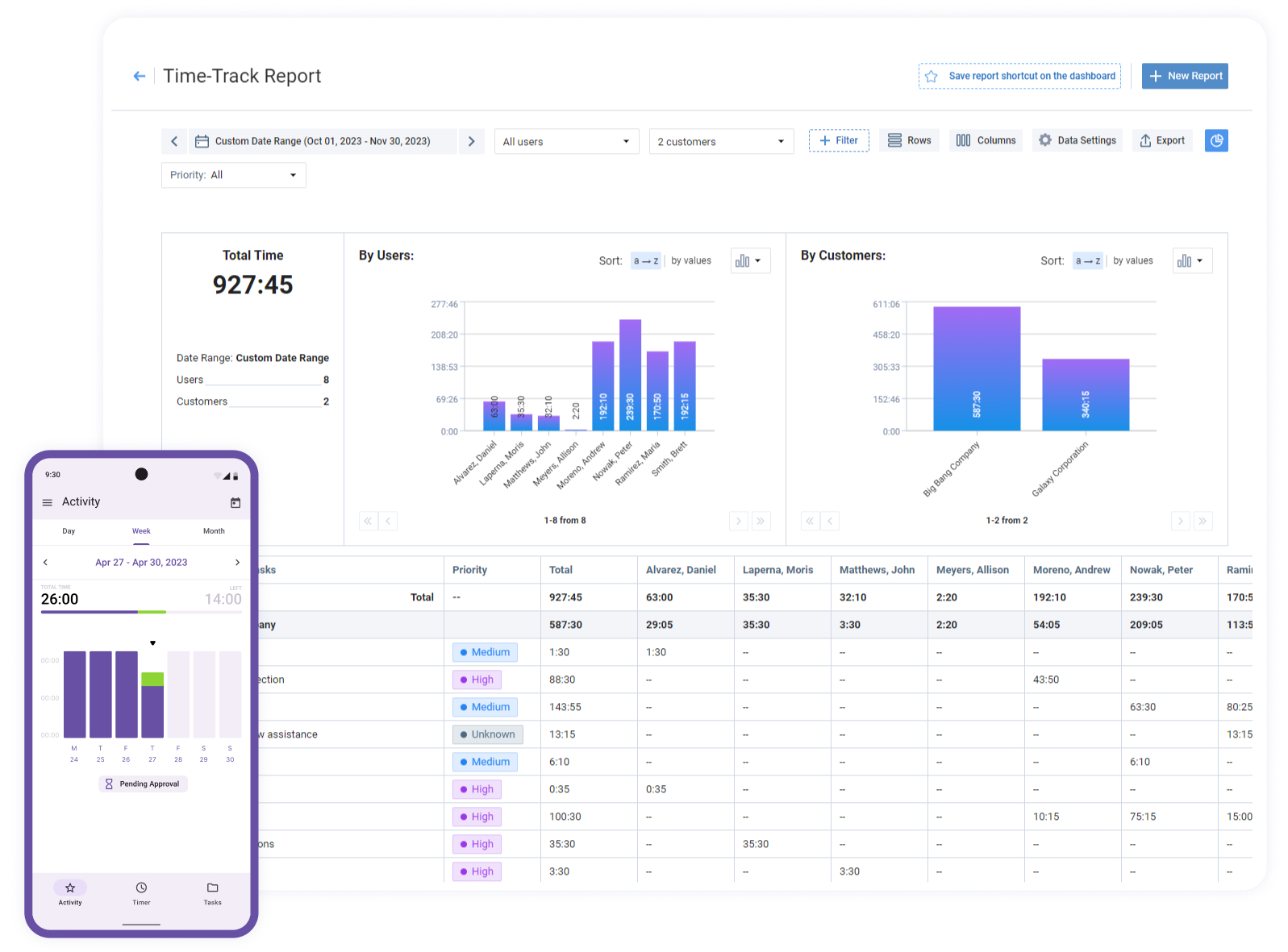
From there the hours turn into money. Each project bills either by type of work rates or by individual user billing rates, and the Billing Summary Report and PDF invoices follow that choice. Cost of work rates, including overtime rates, feed the Cost of Work Report, budgets turn red when exceeded, and the Estimated vs. Actual Time Report shows which tasks ran over. Managers approve timesheets and can lock them once invoiced.
actiTIME is free for up to 3 users, and paid use starts from $5 per user per month.

We reduced payroll processing to 45 minutes per week
actiTIME is very robust, integrated well into your business process, and most important, helps you focus on your business instead of monkeying around with technology. actiTIME has reduced our payroll processing from 4-6 hours per week to 45 minutes per week.
Where geofence time tracking breaks
Geofencing fails in predictable ways. Most of them show up in the first month, and each has a fix.
-
The fence is bigger than the site.
As the calculation above shows, a 100 meter circle is about 21 times a small city lot. Use a polygon where your tool supports one, set the smallest reliable radius, and review the first two weeks of flagged punches before trusting the data.
-
Automatic clock in misses paid time before the fence.
In the US, travel from job site to job site during the day counts as hours worked, and so does travel after reporting to a yard to pick up tools, under 29 CFR 785.38. A clock that only starts at the site boundary will leave that time off the timesheet unless someone clocks in at the yard.
-
Phones quietly break automation.
Automatic modes depend on “always” location access, background permissions and battery settings, and Jibble notes that iOS keeps only 20 geofences active at once. Check every new phone during onboarding, not after the first missing shift.
-
A lost signal ends a shift.
Connecteam clocks people out when they turn off GPS or location permission, and marks the reason on the timesheet. That is the right behaviour for honest data, but someone has to review those marks before payroll so a dead battery does not cost a worker an hour.
-
Location collection runs past the shift.
Apps differ on what they collect off the clock. Pick one that, like ClockShark, documents that it stops tracking when the person clocks out, and put that in writing for your crew.
-
Presence is mistaken for productivity.
A geofence proves someone was on site. It says nothing about what they did there. The useful question is how many hours went to each task against its estimate, which is what the timesheet behind the clock should show.
Location consent and privacy by country
Geofencing employee tracking collects location data from workers’ phones, so privacy law applies in most places you operate. The short version: tell people what you collect and why, collect it only during working time, and use it for hours on jobs rather than for watching where people go. Our separate guide to employee monitoring laws by country covers the full picture; the points specific to geofencing are below.
- United Kingdom. The ICO lists processing that tracks an individual’s geolocation among the triggers for a data protection impact assessment, and its DPIA guidance explains that employees can count as vulnerable because a power imbalance means they cannot easily consent or object. Its guidance on monitoring workers sets out what employers must and should do.
- European Union. Under the GDPR, Recital 43 says consent is not a valid basis where there is a clear imbalance between the person and the organisation, which is usually the case at work, and Article 88 lets member states set more specific rules for employee data. In practice employers rely on another lawful basis and keep collection proportionate.
- United States, California. The California Privacy Protection Agency confirms that CCPA rights apply to employees and job applicants who live in California. The statute treats precise geolocation, data that places someone within a circle with a radius of 1,850 feet, as sensitive personal information. Every geofence in this article is far tighter than that.
- Canada, Ontario. Employers with 25 or more employees on January 1 of a year must have a written electronic monitoring policy that says how, when and why they monitor; the province gives GPS tracking as an example.
This is general information, not legal advice. Rules also exist in other states, provinces and countries, so check the ones where your crews work.

Best pick by situation
- Irregular construction sites in a city: Workyard, because a polygon fence is the only real fix for the neighbouring lot problem, and it can clock people in automatically.
- Crews in areas with weak coverage: Timeero, which flags rather than blocks by default and never blocks a clock out.
- Forgotten clock outs are the main problem: Connecteam, whose automatic clock out is documented down to the GPS buffer.
- Automation on a zero budget: Jibble, as long as your sites are large enough for a 300 meter fence.
- You already run QuickBooks: QuickBooks Time, for reminders that record the actual crossing time.
- Fixed locations where off site punches must stop: Buddy Punch.
- You need the hours to become invoices: pair the clock you choose with actiTIME, or look at our wider roundups of construction time tracking software and field service time tracking.
FAQ
Do PEOs offer geofence clock in?
A professional employer organization runs payroll, benefits and HR compliance, and geofencing usually comes from the time clock that feeds it. Before signing, ask the PEO which time clocks it integrates with, then check that clock’s help center for the radius minimum, whether it can block or only flag outside punches, and whether it clocks people in automatically.
How accurate is geofence time tracking?
Expect a margin of tens of meters. busybusy states its geofence accuracy is within 100 meters, and Timeero sets 100 meters as its minimum radius, citing Apple and Google guidance. Connecteam ignores GPS readings with an accuracy worse than 300 meters when deciding on automatic clock outs. Plan fences with that margin in mind.
Is geofencing the same as GPS tracking?
No. A geofence reacts to one event, a phone crossing a boundary, while GPS tracking records a series of positions during the shift (ClockShark, for example, adds a point every 15 to 30 minutes when tracking is on). You can use geofence reminders or restrictions with breadcrumb tracking turned off, which collects much less data and is easier to justify to employees.
Conclusion
Judge geofencing time tracking by the fence before the features: polygon support, the smallest radius it handles reliably, and whether it reminds, blocks or automates. Then decide what happens to the hours after the punch. Start a free trial of actiTIME with full features for 30 days to log those hours against tasks and turn them into billing summaries and invoices. After the trial, teams of up to 3 users can keep using it for free.