
A construction timesheet template has two jobs at once. Payroll needs to know how many hours each worker put in and how many of them were overtime. The estimator and the client need to know which job and which cost code those hours belong to. Most free sheets handle the first and skip the second, so a contractor often learns that a job lost money after the final invoice has gone out.
Our free construction timesheet template records every entry against a job number and an operation (cost code), with start and end times, and works out both the labor cost and the billing amount of each line. Below the download form you will find what the sheet contains, which columns to add, and a worked week for one carpenter whose overtime falls across two jobs. After that come the certified payroll rules for US public works, a note for UK contractors and the mistakes that cost the most.
- What the free construction timesheet template includes
- What a construction timesheet must capture
- How to fill in the template
- Worked example: one carpenter, two jobs, 48 hours
- Certified payroll on US public works
- Outside the US: the UK Construction Industry Scheme
- Common construction timesheet mistakes
- When to move from a spreadsheet to an app
- FAQ
What the free construction timesheet template includes
The template is a Google Sheets file for one worker, with one row per block of work, so a person who moves between jobs during the day gets a line for each.
- Header: the employee’s name, the project manager’s name and the worker’s pay rate per hour
- Date of each entry
- Job No, so hours from different sites never mix
- Operation, written as a cost code and a short name, for example “45, Cabling” or “98, Insulation”
- Work Rate, the rate you bill the client for that operation
- Start Time and End Time, with Task Time worked out automatically
- Work Cost (task time multiplied by the worker’s pay rate) and Billing Cost (task time multiplied by the work rate)
- Totals for hours, labor cost and billing, and signature and date lines for the employee and the supervisor
Because each line carries both a cost and a billing amount, you can see what margin a worker’s day produced on each job, which most timesheets cannot show. What it does not do out of the box is split overtime, deduct breaks or record equipment and per diem. The next section shows which columns to add and when you need them.
What a construction timesheet must capture
A small residential crew needs fewer columns than a subcontractor on a federally funded school. This table lists the fields we recommend and whether our template already has them.
| Field | Why it matters | In our template |
|---|---|---|
| Job or site, with job number | Keeps labor cost on the right project when a crew moves between sites | Yes (Job No) |
| Cost code and task | Ties hours to an estimate line such as framing or drywall, so you can compare estimated and actual labor | Yes (Operation) |
| Crew or foreman | Shows who supervised the work and who to ask when a number looks wrong | Project manager in the header; add a foreman line for crew sheets |
| Start time, end time and unpaid breaks | Hours worked are the time between start and end minus unpaid breaks; recording the clock times makes disputes easy to settle | Start and end yes; add a break column if lunch is not split into separate rows |
| Regular and overtime hours | Payroll pays them at different rates, and the overtime premium has to be charged to some job | Add two columns, or mark overtime rows |
| Equipment hours | Owned equipment such as a lift or an excavator is a job cost too, and often billed by the hour | Add a column with the equipment ID and hours |
| Per diem and travel | Out of town allowances belong to the job that required the travel and are kept apart from wages | Add a column per day |
| Work classification (trade) | Required on prevailing wage jobs, where the rate follows the work actually performed | Add a column on public works only |
| Worker and foreman signatures | The worker confirms the hours, the foreman confirms the job and cost code | Yes (employee and supervisor) |
Keep the cost code list short and identical to the codes in your estimate. A foreman will pick the right code from 10 to 15 options at the end of a long day; from 200 options he will pick the first one that looks close. If you need daily notes on weather, deliveries and delays as well, keep them in a construction daily report rather than crowding the timesheet.
How to fill in the template
- Copy the template into your own Google Sheets file and make one copy per worker per week, named with the worker and the week ending date.
- Fill in the header with the worker, the project manager and the hourly pay rate payroll actually uses, because Work Cost is calculated from it.
- Enter one row for every block of work. When a worker switches job or cost code, even for an hour, start a new row. Lunch can be handled by ending one row before the break and starting the next row after it.
- Type the job number and operation code exactly as they appear in your estimate, put the billing rate in Work Rate and record start and end times on the day. Task Time, Work Cost and Billing Cost fill in by themselves.
- At the end of the week, mark the hours that are overtime under the rule that applies to you (see the worked example), add equipment and per diem if you track them, and get both signatures.
- Copy the week’s rows into a master sheet and filter by job number to see labor cost and billing per job. This is the step that turns timesheets into job costing.
Worked example: one carpenter, two jobs, 48 hours
The figures below are illustrative. Say a carpenter paid $30 an hour spends one week on two jobs: a house renovation (Job A) where he frames and then does finish carpentry, and a warehouse fit out out of town (Job B) where he hangs drywall. The contractor bills framing at $55, finish carpentry at $62 and drywall at $50 an hour, and pays a $40 per diem for each night away on Job B. The job is in a US state that follows the federal weekly overtime rule.
| Day | Job and cost code | Hours worked (breaks deducted) |
|---|---|---|
| Monday | Job A, 200 Framing | 9.0 |
| Tuesday | Job A, 200 Framing | 9.5 |
| Wednesday | Job B, 500 Drywall (per diem $40) | 8.0 |
| Thursday | Job B, 500 Drywall (per diem $40) | 9.0 |
| Friday | Job A, 600 Finish carpentry | 8.5 |
| Saturday | Job A, 600 Finish carpentry | 4.0 |
| Total | Job A 31.0 h, Job B 17.0 h | 48.0 |
Under the US Fair Labor Standards Act, overtime is due for hours over 40 in a fixed workweek at no less than one and a half times the regular rate, and hours cannot be averaged across weeks (DOL Fact Sheet 23). So 8 of the 48 hours are overtime. Here is how the week turns into payroll, job cost and billing.
Payroll is the same either way. What changes is which job looks profitable. If the premium follows the clock, the renovation absorbs all of it, even though the carpenter only went past 40 hours because he spent two days at the warehouse. If the premium is spread by share of hours, Job B’s labor margin drops from $260 to $217.50, a 16% difference on one worker in one week. Pick one method, write it down and apply it to every job, or your job cost reports will not be comparable from one month to the next.
Two sensitivity lines are worth knowing. Every $1 change in the base rate moves gross pay by $52 for this week (48 straight hours plus 8 half time hours), so a raise from $30 to $32 costs $104 a week before taxes and insurance. And if Saturday had not been worked, total hours would fall to 44, overtime to 4 hours and the premium to $60. The per diem stays out of the overtime calculation only while it reasonably matches the travel expenses it covers; an allowance that is disproportionately large becomes part of the regular rate under 29 CFR 778.217.
State rules can change the overtime count. California, for example, requires time and a half after 8 hours in a workday and double time after 12, on top of the weekly rule (California Labor Commissioner). If a worker does two kinds of work at different pay rates in one week, the regular rate for overtime is the weighted average of those rates (29 CFR 778.115). Our overtime calculation guide walks through both cases.
Certified payroll on US public works
The Davis-Bacon and Related Acts cover contractors and subcontractors on federally funded or assisted contracts over $2,000 for the construction, alteration or repair of public buildings or public works, and require them to pay at least the locally prevailing wages and fringe benefits (US Department of Labor). There the timesheet feeds a weekly certified payroll.
- Weekly filing. Contractors submit certified payrolls for each week in which covered work is performed, and the prime contractor is responsible for the submissions of all its subcontractors (29 CFR 5.5).
- Form WH-347 is optional, the content is not. The payroll can be sent on Form WH-347 or in any other format, but each one must come with a signed Statement of Compliance.
- What the records must show: each worker’s classification of work actually performed, hourly rates including fringe benefits, daily and weekly hours worked in total and on each covered contract, deductions and actual wages paid. The certified payroll itself carries only an identifying number such as the last four digits of the Social Security number, never the full number.
- One row per classification. If a worker does two trades in the same week, the hours go on separate rows, each paid at least the rate for that classification.
- Retention. Payrolls and basic records are kept for at least 3 years after all the work on the prime contract is completed.
- Federal overtime on larger contracts. On prime contracts over $100,000, the Contract Work Hours and Safety Standards Act also requires time and a half for hours over 40 in a workweek.
For the template, add a classification column, start a new row whenever the classification changes, and keep covered and private jobs apart. Many states also run their own prevailing wage programs, so check with your state labor department.
Outside the US: the UK Construction Industry Scheme
In the UK, the main construction specific rule concerns payments to subcontractors rather than employees’ hours. Under the Construction Industry Scheme, contractors deduct 20% from payments to registered subcontractors, 30% for unregistered ones and nothing for those with gross payment status; the deduction is worked out on the invoice after taking away VAT and materials the subcontractor paid for. Contractors file a monthly return by the 19th and keep records of gross payments, deductions and materials costs for at least 3 years after the end of the tax year they relate to (HMRC guidance on GOV.UK).
For a labor only subcontractor, the weekly timesheet is what supports the labor part of the invoice, so ask subcontractors to record their hours by job and keep materials on a separate line. In other countries, check overtime and record keeping rules with the local labor authority before adapting the template.
Common construction timesheet mistakes
- Filling in the week on Friday. Hours reconstructed from memory drift toward round numbers and the “usual” job, and every job cost and invoice built on them inherits the error.
- One line per day, no cost code. Payroll still works, but you can no longer compare actual labor against the estimate line by line, and codes that do not match the estimate have the same effect. That is how the next bid gets priced wrong.
- No rule for the overtime premium. As the worked example shows, the same week can show a 16% different margin on a job depending on the method. If nobody picks a method, each person who closes the books picks their own.
- Breaks and travel with nowhere to go. If the sheet has one start and one end time per day, a lunch break, a trip to the supplier or a drive between sites is either silently paid or silently unpaid. Give each its own row.
- Signatures as a formality. A foreman who signs 15 sheets on Monday morning is not checking job and cost code. Review on the day the work was done.
- Editing after approval. Once a week is signed and paid, corrections should go in as a visible adjustment in the next period, not as a quiet change to last month’s file.
When to move from a spreadsheet to an app
A spreadsheet is fine for a few workers on one or two jobs. It starts to cost more than it saves when:
- Someone spends hours a week retyping sheets into payroll or a master file
- Crews move between several jobs in a week and you need job cost reports more often than at closeout
- You bill clients by the hour and invoices depend on hours being coded correctly
- You need approvals that cannot be changed afterwards
actiTIME covers most of what this template does by hand. Work is organized as Customer, Project and Task, and the level names can be changed to match your vocabulary, for example Client, Job and Cost code. Workers log time in a weekly timesheet, a calendar view with start and end times, or the iOS and Android app (an internet connection is required). Billing rates are set on types of work (or per user, chosen for each project), cost rates are set per user with separate regular, overtime and leave rates, and the Cost of Work, Billing Summary and Profit/Loss reports turn the hours into labor cost, billable amounts and margin by customer and project. With Overtime Registration turned on, overtime is calculated automatically or entered manually, and Time-Track Approval with Lock Time-Track keeps approved weeks from being edited.
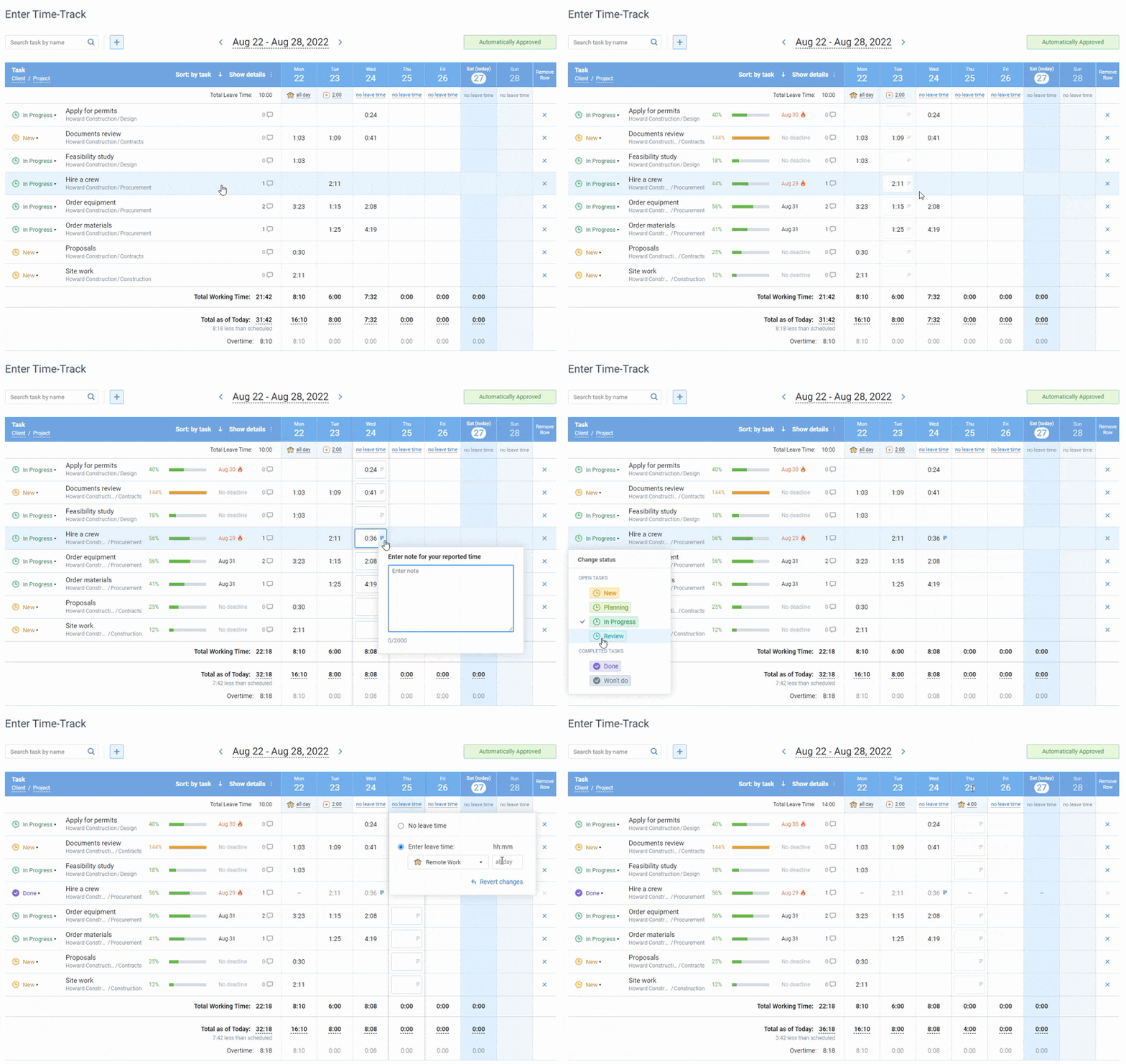
There are limits. actiTIME tracks people’s hours, not equipment hours or per diem, so those stay in your equipment log or expense system. It does not produce Form WH-347, although report data can be exported to CSV for the payroll provider that prepares it. actiTIME is free for up to 3 users, and paid options start from $5 per user per month. For a comparison of apps built for field crews, see our roundups of time trackers for construction companies and construction time tracking software, and for the setup inside actiTIME read actiTIME for construction workers.

We reduced payroll processing to 45 minutes per week
actiTIME is very robust, integrated well into your business process, and most important, helps you focus on your business instead of monkeying around with technology. actiTIME has reduced our payroll processing from 4-6 hours per week to 45 minutes per week.
FAQ
Is a construction timesheet the same as a construction time card?
They record the same thing, but the terms usually describe different scopes. A time card is often one worker’s clock in and clock out record for a week, while a construction timesheet adds the job, the cost code and the rates, so it can feed job costing and billing as well as payroll. Our template works as a construction time card template too: one worker per sheet, with each row coded to a job and an operation.
Can I use the construction timesheet template in Excel?
Yes. Copy the template into your Google Sheets account and use File, Download, Microsoft Excel to save it as an .xlsx file. The calculated columns for task time, work cost and billing cost are formulas, so check that they still calculate after you add overtime, break or equipment columns.
Do subcontractors need a separate contractor timesheet template?
Yes, keep their sheets separate, but use the same job numbers and cost codes so subcontracted labor shows up in the same job cost report. Employees’ timesheets feed payroll and overtime, while a subcontractor’s hours support an invoice, and on US public works or under the UK Construction Industry Scheme the two follow different rules.
Track construction hours with actiTIME
A construction timesheet pays off when every hour lands on the right job and cost code and the overtime premium follows a rule you chose. For a small crew, the template is enough. When the sheets pile up, actiTIME keeps the same structure and does the arithmetic. More free sheets for estimates, invoices and daily reports are collected in our construction templates.
Start a free trial of actiTIME with full features for 30 days. After the trial, teams of up to 3 users can keep using it for free.