

A foreman logging crew hours on-site, a surveyor billing time and materials by job, an accountant running certified payroll on a prevailing-wage job, and a fleet manager tracking excavator hours all need something different from their software – a tool that’s great at one job often isn’t built for the others.
That’s why construction time tracking software means something different depending on who’s asking, and why this guide isn’t one ranked list. Instead, it’s organized by the specific task you’re trying to solve: project management, attendance and time clock, payroll, invoicing and billing, certified payroll compliance, and equipment hour tracking. Find your use case, and you’ll find the tools built for it – plus a section at the end on what to do if you need more than one.
- Types of construction timesheet software
- Time tracking with project management
- Time tracking with attendance and time clock
- Time tracking with payroll
- Time tracking with invoicing and billing
- Time tracking with certified payroll and compliance
- Time tracking with equipment and asset hour tracking
- How to choose based on your needs
- FAQ
Types of construction timesheet software
Every entry in every list below starts the same way: someone – or something – logs hours. A worker clocks in, a foreman fills out a timesheet, a sensor records how long an excavator ran. What actually separates the six categories isn’t how those hours get captured – it’s what happens to the number afterward.
In a project management tool, an hour becomes a data point against a task estimate. In payroll, it becomes part of a paycheck. In certified payroll, it becomes a line on a government compliance form. In invoicing, it becomes a dollar amount on a client’s bill. In equipment tracking, it triggers a maintenance countdown instead of feeding anyone’s pay at all.
That’s why a tool built for one destination rarely does another well – the data model, the reports, and the integrations are all shaped by where the hours are supposed to end up, not by how they were logged in the first place.

Time tracking with project management
Timesheet software built for project management ties hours directly to tasks, budgets, and deadlines – not just to a paycheck. If you need productivity tracking to know whether a phase is on schedule or which task is eating more hours than estimated – on a new build, a renovation, or anything in between – this is the category to look at.
1. actiTIME
Key features:
- Overtime tracking
- Expense tracking
- Performance reports
- Payroll
- Leave tracking
- Billing & invoicing
- Mobile app
actiTIME is an online construction time tracking software that covers most management and accounting needs.
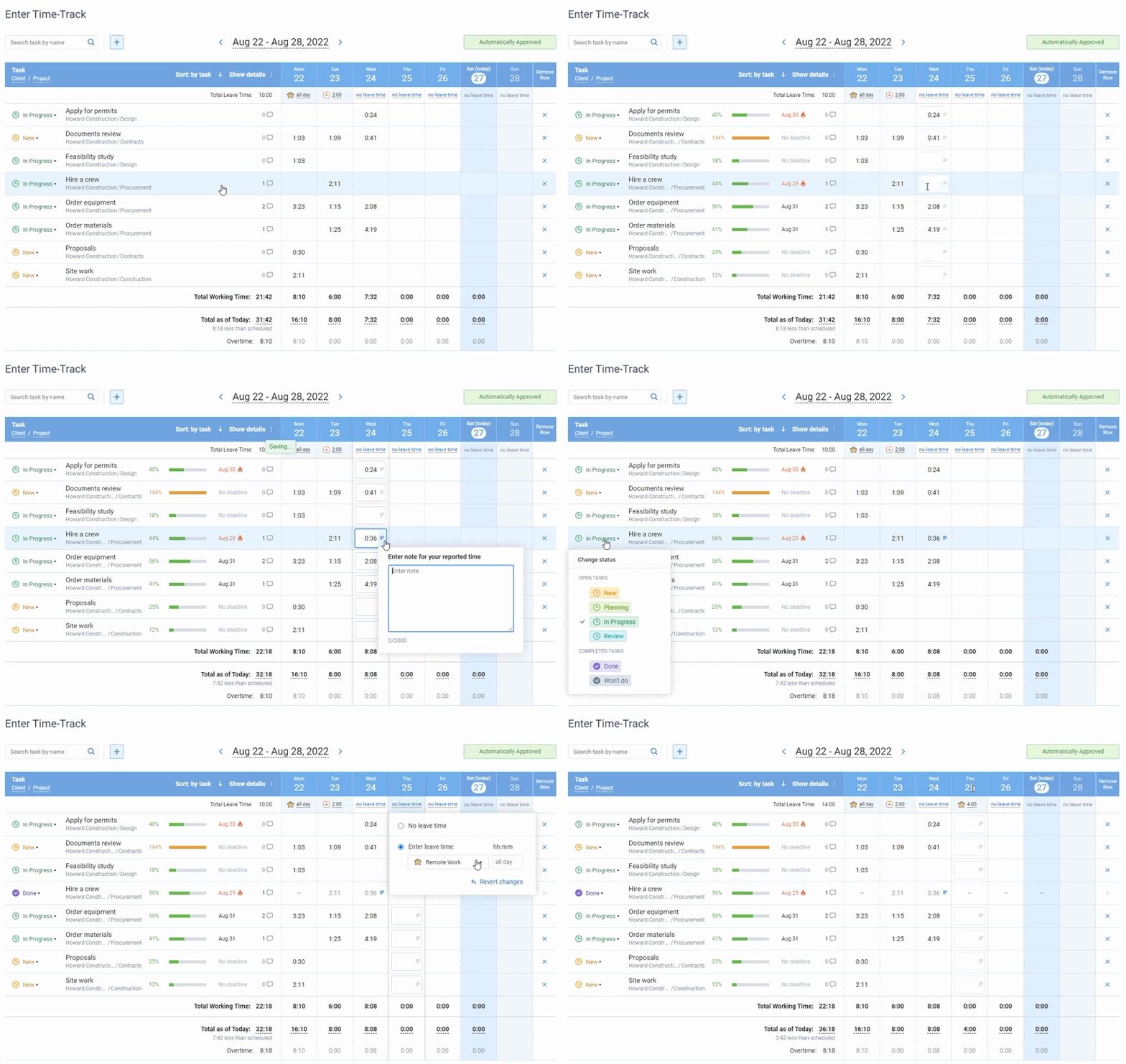
actiTIME’s timesheet view lets users select task parameters they want to see in their timesheets and switch between the views.
First of all, actiTIME is a powerful time tracker with built-in data analytics and reports. Charts, reports and real-time widgets will keep you informed about time and cost expenses, employee productivity, project profitability, profits, and losses. All analytics is available for download in CSV and PDF formats.
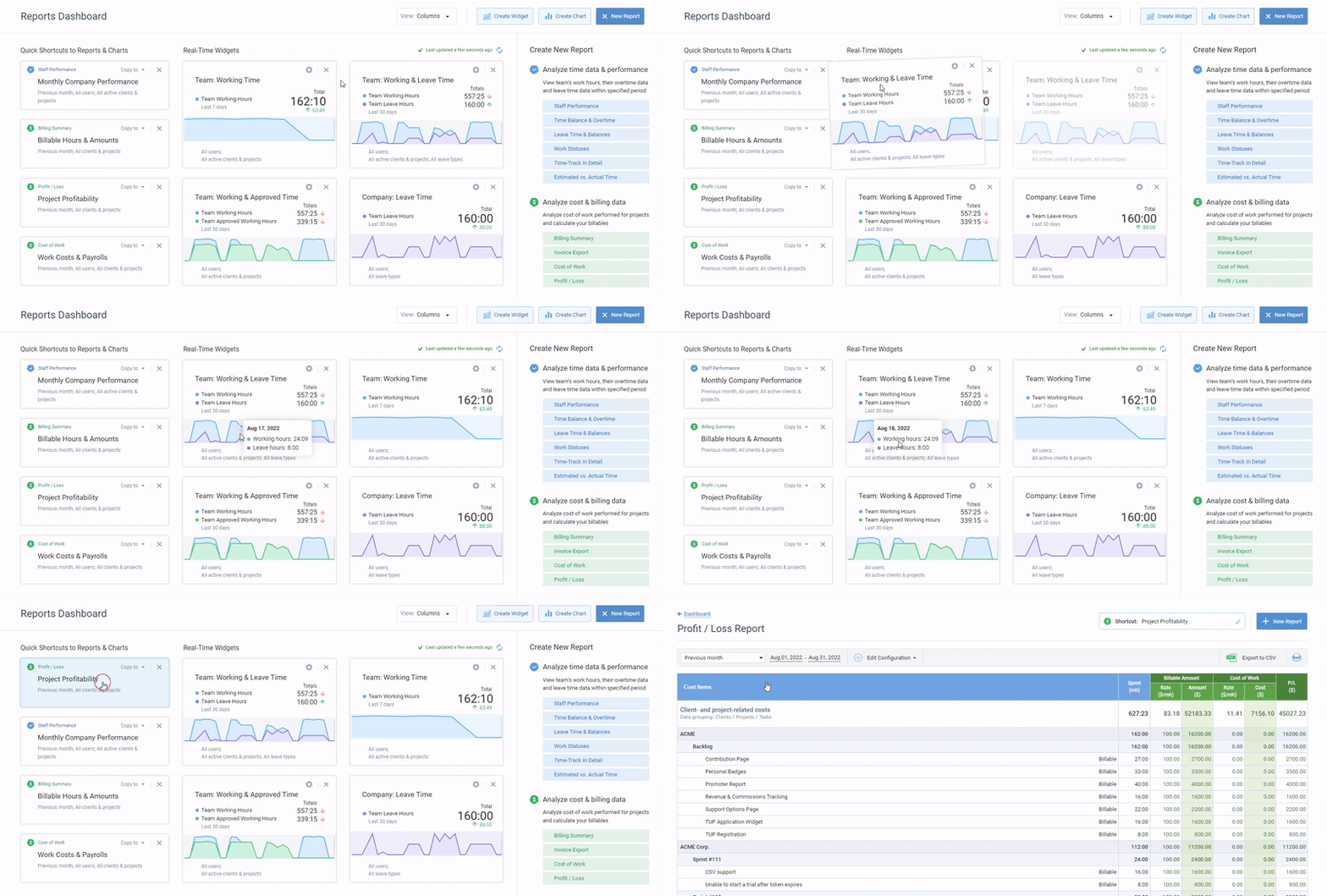
The reports dashboard allows you to set up real-time data widgets and add report shortcuts for quick access.
There’s also a handy mobile timesheet tool available for Android and iOS. Employees can start timers or manually submit work and leave time, manage tasks, and review timesheets. All data is securely stored and synchronized with your corporate actiTIME account.
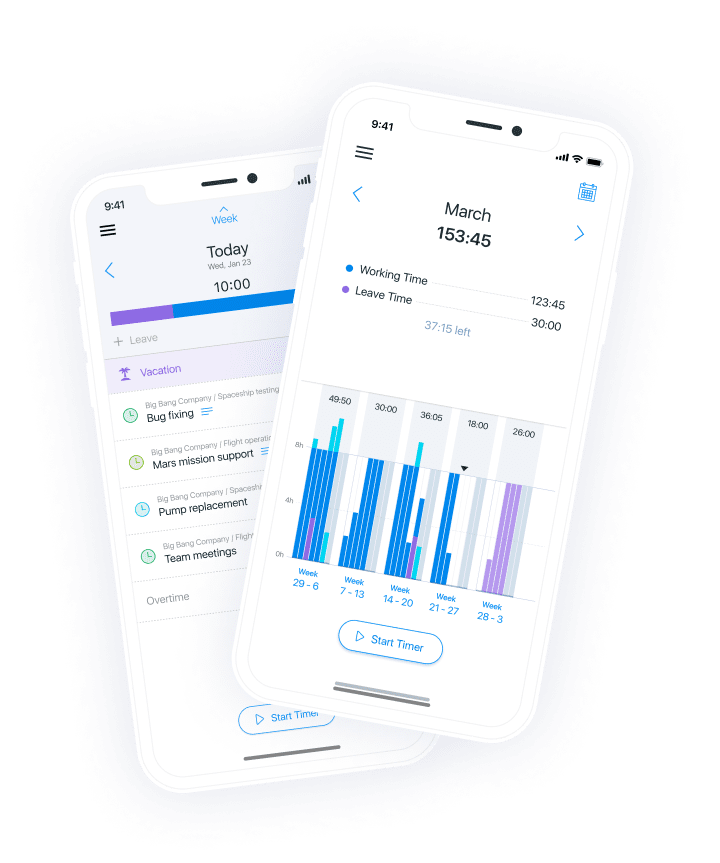
Managers can set up workflow according to the company’s needs. Customize the work level structure, add task estimates and deadlines, assign tasks to team members according to their responsibilities, and use statuses to monitor the work process and identify roadblocks early on.
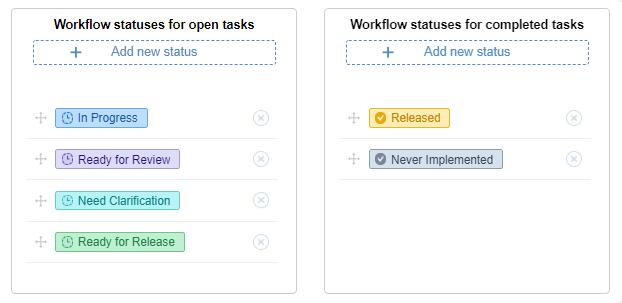
Use actiTIME’s flexible configuration to create any number of workflow statuses and track task progress with their help.
Accountants and HR teams are required to make a one-time setup to automate their weekly and monthly routines. They can build payroll reports, automate leave management and accrual calculations, calculate project costs and invoice the clients.
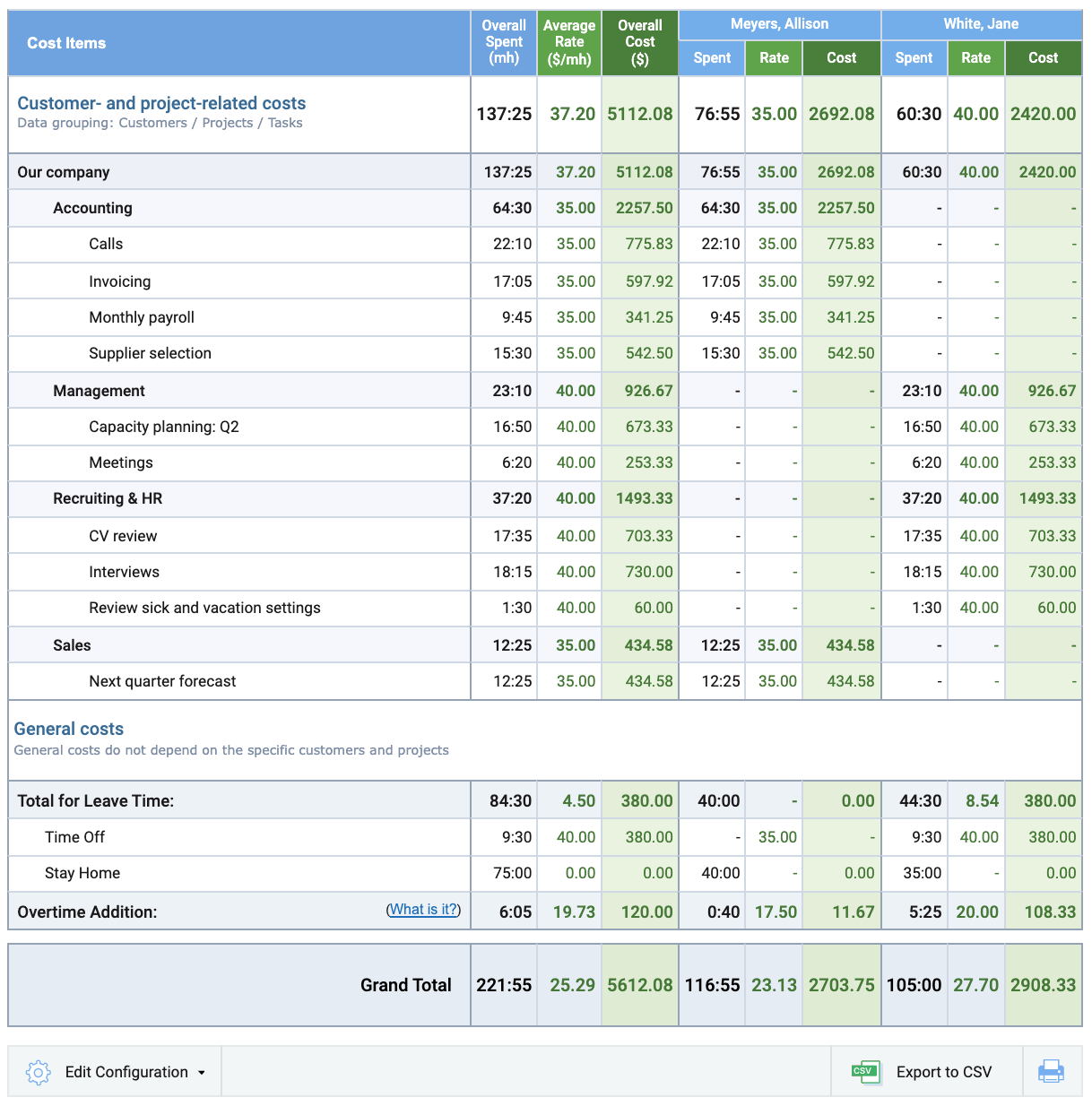
actiTIME’s client billing feature calculates staff-related expenses based on the set hourly rates and displays results in the Cost of Work report.
Best for: Construction crews and firms that want time tracking tied directly to task budgets and client billing in one system.
Pricing: Free for 1–3 users; Online from $6 per user per month for 1–40 users, $5 per user per month for 41–200 users, billed annually; Self-Hosted $120 per user, one-time payment.
Free trial: 30 days, no credit card required.
Rating: Capterra 4.6 (111 reviews).
Pros:
- Free version has no time limit, unlike most competitors’ trial-only free tiers
- Ties time tracking directly to task budgets and client billing, not a separate connected app
Cons:
- Not built for certified payroll or equipment hour tracking – pair it with a specialist tool from those categories if you need them

We reduced payroll processing to 45 minutes per week
actiTIME is very robust, integrated well into your business process, and most importantly, helps you focus on your business instead of monkeying around with technology. actiTIME has reduced our payroll processing from 4-6 hours per week to 45 minutes per week.
2. Raken
Key features:
- Progress tracking
- Document management
- Safety & quality management
- Messaging
Raken software is a multifunctional solution for construction project management, featuring tools for daily reporting, time tracking, and communication.
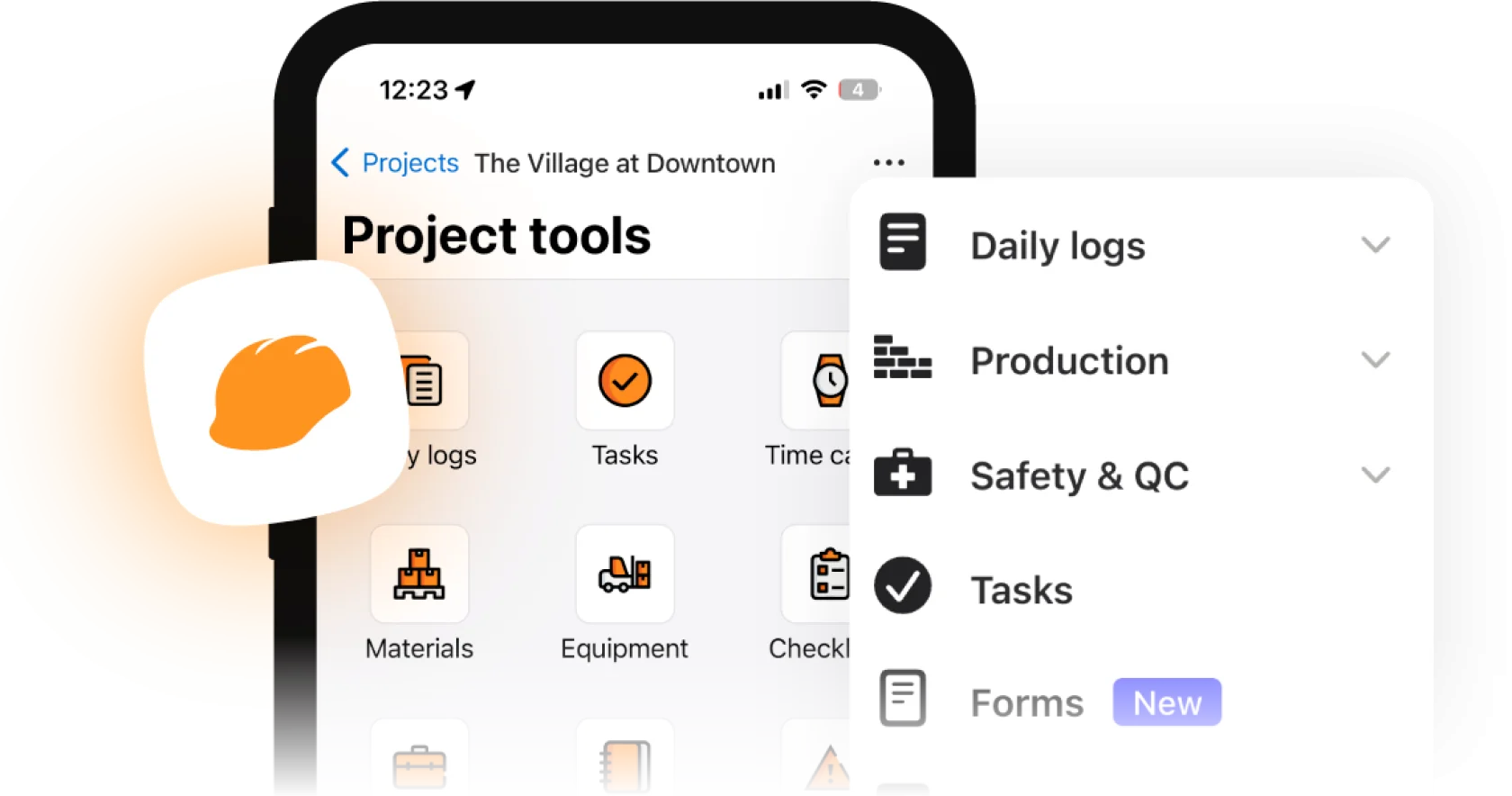
Here are some of the most prominent things Raken can do:
- Checklists: These digital to-do lists allow team members to streamline their daily tasks, ensuring all essential activities are covered. Whether it’s safety inspections or equipment checks, you can customize the lists to fit the specific needs of your project.
- Daily progress reports (with photo documentation): This feature helps capture the day’s achievements visually. It lets your workers document progress comprehensively and share vivid snapshots with stakeholders who want to see how things are shaping up. It fosters transparency and keeps everyone in the loop, all while making project updates engaging.
- Equipment management: You can track usage, maintenance schedules, and even assign equipment to specific crew members or jobs. This level of oversight helps prevent costly downtime and ensures that every piece of gear is accounted for and ready when needed.
Best for: Field-heavy crews that want daily reporting and photo documentation alongside time tracking.
Pricing: Not publicly listed – contact sales for a quote.
Free trial: Available, length not publicly stated.
Rating: Capterra 4.6 (248 reviews); G2 4.6 (99 reviews).
Pros:
- Strong daily-reporting and photo-documentation feature set, beyond plain time tracking
- Large, consistently positive review base across both Capterra and G2
Cons:
- No public pricing – you won’t know the real cost until you talk to sales
3. Pacific Timesheet
Key features:
- Progress tracking
- Safety checks
- Job expenses
- Payroll integration
Pacific Timesheet allows construction businesses to effortlessly keep track of their team’s productivity while saving valuable time and resources.
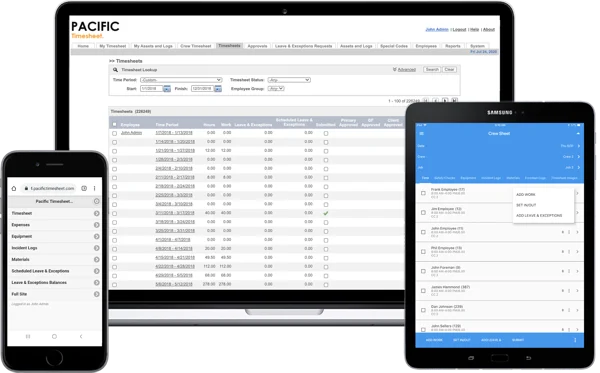
Here’s how this construction timesheet software helps:
- Online and offline timesheets: Whether your crew is deep in the woods or working on a busy city block, they can log their hours right from their mobile devices. No Wi-Fi? No problem! The offline feature allows workers to input their time, which syncs up once they’re back online.
- Production and idle time tracking: This feature lets you easily distinguish between productive work hours and downtime. It helps to identify bottlenecks, streamline processes, and maintain a sharp focus on productivity. You’ll gain valuable insights into where improvements can be made, ultimately driving better results on your projects.
- Foreman logs and safety checks: Document daily progress and activities effortlessly. Coupled with built-in safety checks, this feature ensures that all health and safety protocols are followed, helping to foster a culture of safety. It’s not just about compliance – it’s about creating a work environment where everyone goes home safe and sound.
Best for: Crews working in remote or low-connectivity locations who need reliable offline timesheets.
Pricing: Base plan around $250/month for the first 10 users, per Pacific Timesheet’s own help center – confirm current figures directly, as the main pricing page itself doesn’t list numbers.
Free trial: Available, length not publicly stated.
Rating: Capterra 4.7 (3 reviews) – too small a sample to treat as a reliable signal.
Pros:
- Genuine offline timesheet support for crews working without a signal
- Production-vs-idle time tracking gives a clear productivity signal beyond raw hours
Cons:
- Pricing is only partially public, and the review base is too thin to judge real-world satisfaction from
4. WorkMax TIME
Key features:
- Budget-vs-actual dashboard
- Task-based time allocation
- Multi-jobsite dashboard
- Job-cost and payroll integration
WorkMax TIME (by AboutTime Technologies, part of Foundation Software) is built around a budget-tracking dashboard rather than a daily attendance log – it compares logged hours per task against the budgeted hours and flags tasks trending over before they blow the budget entirely.
- Budget-vs-actual dashboard: Visualizes completed hours against budget and remaining hours in real time, flagging tasks trending over or under budget – the clearest tie between hours and task budgets in this category.
- Task-based time allocation: Workers log hours against specific jobs and cost codes, and can switch tasks mid-shift, so time rolls up to the task level instead of sitting as one daily clock-in/out entry.
- Job-cost and payroll integration: Syncs with Foundation Software and QuickBooks, so tracked hours feed directly into job costing rather than staying a standalone attendance record.
Best for: Contractors who want a live budget-vs-actual view baked into daily time tracking.
Pricing: Starts around $6–$11/user/month plus a base fee, depending on plan and modules – largely quote-based, confirm exact figure with sales.
Free trial: Not publicly advertised – confirm directly.
Rating: Capterra 4.2 (137 reviews); G2 4.5 (26 reviews, listed as “WorkMax Complete Suite”).
Pros:
- Real-time budget-vs-actual dashboard tied to task-level time entries, not a separate report
- Syncs with Foundation Software and QuickBooks for job costing
Cons:
- Pricing is largely quote-based, so advertised per-user figures may not reflect your final cost
Time tracking with attendance and time clock
This category is about one question: who was on site, and when. A construction time clock (digital timecard, GPS clock-in, or both) replaces the paper sign-in sheet, and these tools lean on geofencing and clock-in/clock-out records rather than task-level project data – a good fit if your main pain point is labor tracking and verifying hours and location, not managing project budgets.
1. Arcoro Time (formerly ExakTime)
Key features:
- GPS tracking
- Cost code tracking
- Meal break notifications
- Time off management
ExakTime was acquired by Arcoro and now operates as Arcoro Time, though the product itself is largely unchanged – construction time tracking software tailored for construction and field-based industries.
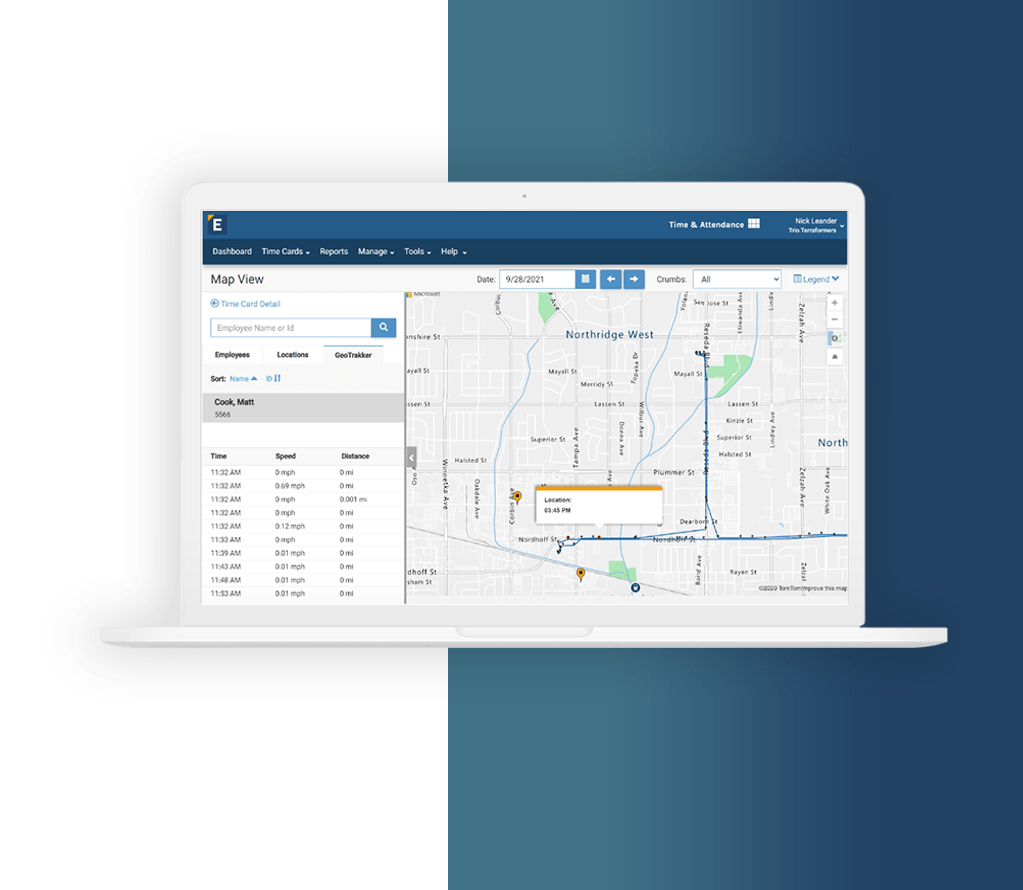
This construction timesheet solution uses cloud sync to share data between the cloud software and the time tracking & scheduling app. Admins and managers can log in and view time records and activities by employee or location. ExakTime shows all the GPS time punches on the map and allows you to edit time in bulk, set up policies, and shifts, and create reports.
The software is also compatible with a portable weatherproof time clock specially designed for construction and job sites. It’s completely wireless and made to send worker’s time and activities to the cloud every hour.
The mobile app supports GPS tracking, photo verification, digital notes, shifts and task assignments, and crew and job site tracking. It also provides equipment tracking so that you always know which employee used the equipment, when, and for how long.
Best for: Field-based crews that need GPS verification and a physical time clock option on site.
Pricing: Time Essential $9/employee/month, Time Professional $11/employee/month, Time + Payroll $19/employee/month (annual billing).
Free trial: Not advertised as a standalone free trial – confirm directly.
Rating: Capterra listings are fragmented since the Arcoro rebrand, with conflicting review counts across duplicate profiles – confirm directly on arcoro.com/exaktime before citing a specific number.
Pros:
- Purpose-built portable time clock hardware for job sites, not just a mobile app
- Established GPS and photo verification, refined over years as ExakTime before the rebrand
Cons:
- Time off management is only on the Professional and Time + Payroll tiers, not the entry plan
- Review data is currently hard to pin down post-rebrand
2. Connecteam
Key features:
- GPS tracking
- Automatic shift scheduling
- Time clock kiosk
- Payroll integration
Connecteam is an employee app with construction time tracking, job scheduling, and communication features.
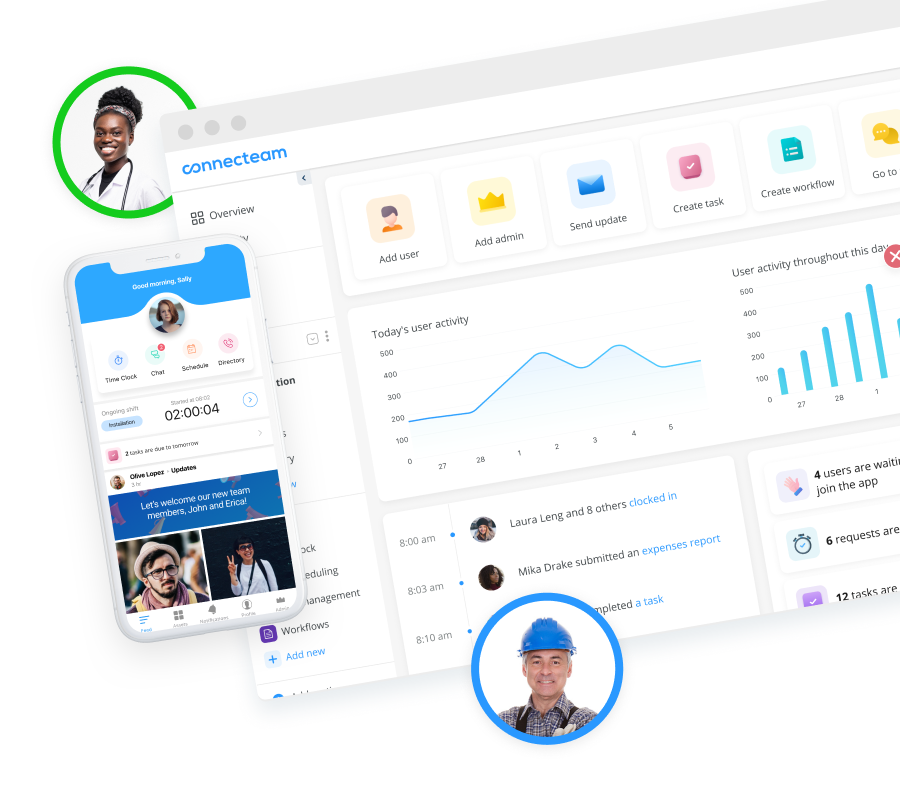
The app provides powerful scheduling features and allows you to set up individual and team shifts, assign projects and tasks, register job locations, manage notes, customer details, equipment, and more. The app is GPS-powered and allows employees to update their job statuses.
The app takes safety seriously and allows you to add regulations, and safety documentation with images, videos, and PDFs. To make day-to-day processes even more automated, it offers online checklists and forms to prepare inspection and training manuals.
Best for: Small crews that want a genuinely free option before paying for anything.
Pricing: Free for up to 10 users; paid tiers start at $29/month.
Free trial: Available on paid tiers – length not stated on the pricing page.
Rating: Capterra 4.6 (5,308 reviews).
Pros:
- Free for up to 10 users, not just a time-limited trial
- Huge, strongly positive review base
Cons:
- Per-user costs beyond 30 users scale up depending on which hub features you add
3. Timeero
Key features:
- Mileage tracking
- Time off tracking
- Scheduling
- Integrations
Timeero is a construction time tracker and attendance management platform that offers accurate GPS time tracking with geofencing, mileage tracking, employee scheduling, and much more. With Timeero’s easy-to-use admin dashboard and mobile app, employers can track locations and keep account of their timesheets with no difficulty.
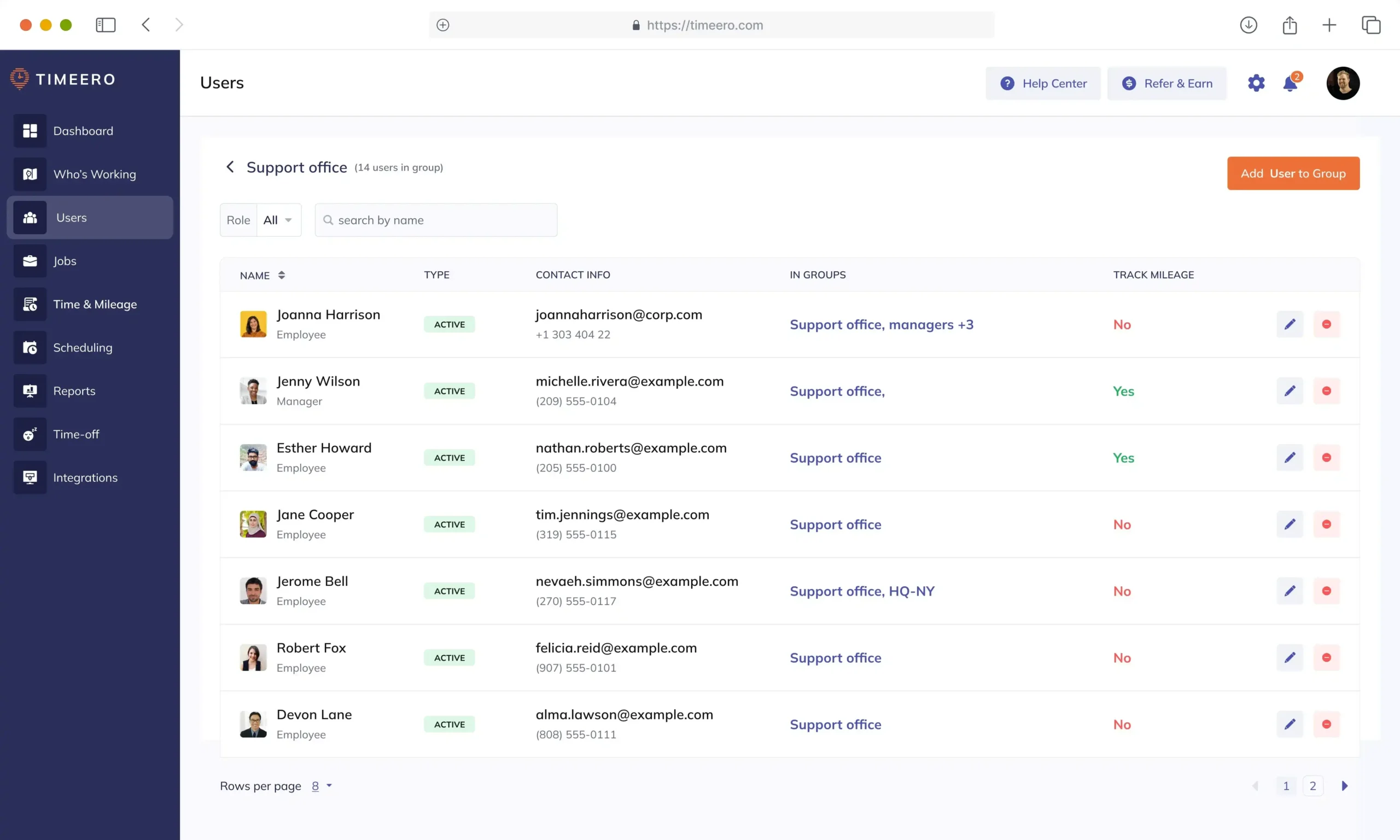
Geofencing allows employers to create a radius around a job site where employees are required to clock in and out. This helps companies hold their employees accountable for their location and hours while on the job.
Plus, Timeero collects all the information and gathers them into reports. These reports are simple and easy to export to your third-party payroll system. Timeero integrates with ADP, QuickBooks, Rippling, and Gusto.
Best for: Crews that need mileage tracking alongside time and location.
Pricing: Basic $5/user/month, Pro $7.50/user/month, Premium $10/user/month (annual billing; monthly billing runs $1–2 higher per tier).
Free trial: 14 days, no credit card required.
Rating: Capterra 4.5 (134 reviews).
Pros:
- Mileage tracking built in, unusual among the other tools in this category
- Broad payroll integrations, including ADP, QuickBooks, Rippling, and Gusto
Cons:
- Priced per user with no flat or unlimited-user option, so cost scales directly with headcount
4. Hubstaff
Key features:
- Time clock
- Visual reports
- Geofencing
- Overtime tracking
Hubstaff is construction time tracking software with powerful functionality for employee monitoring.
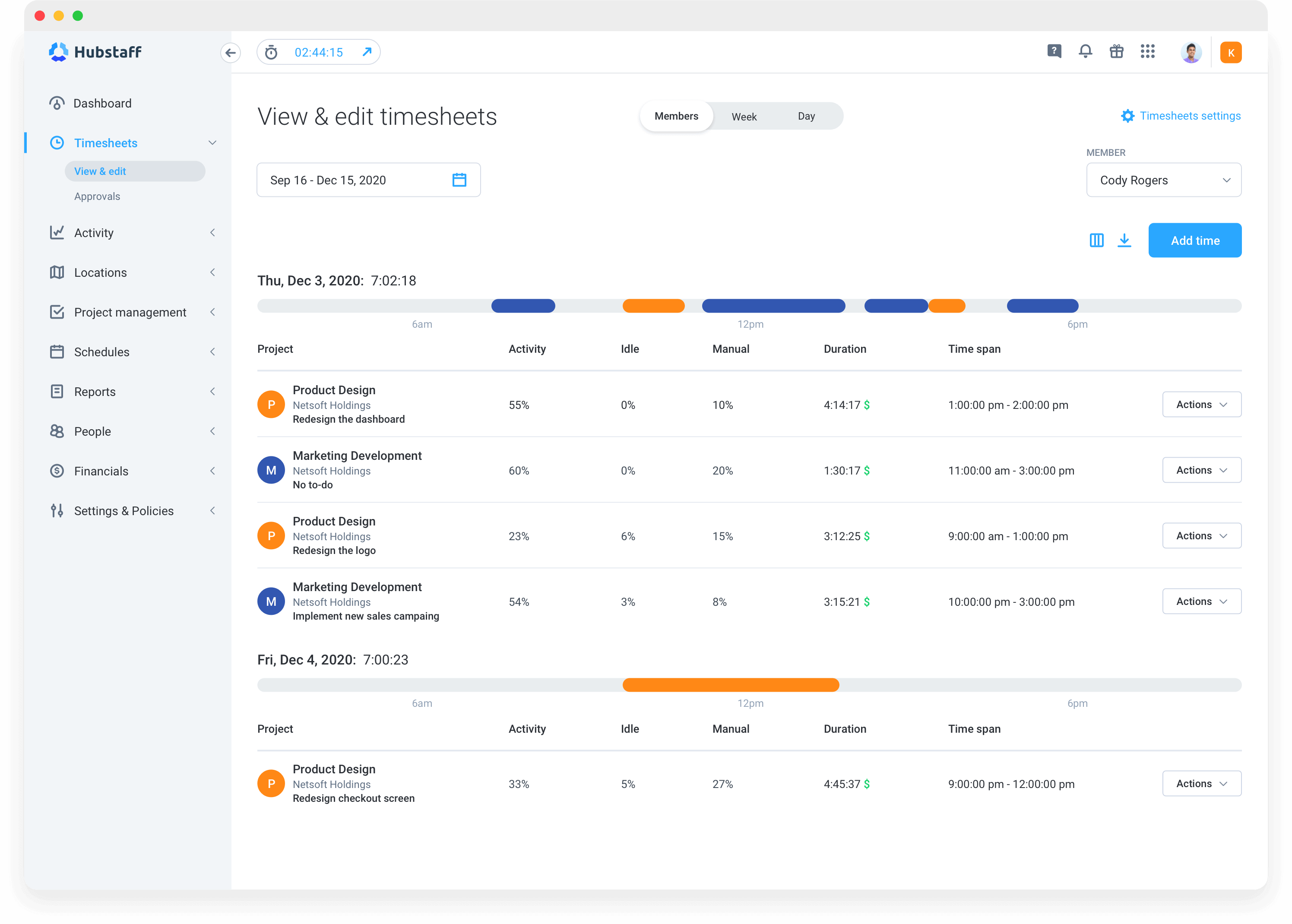
The algorithm behind it is simple:
- Crew members track their time via the mobile app.
- Then, accountants pay the crews and send client invoices based on tracked time and bill rates.
Hubstaff uses geofences to create job sites and GPS tracking to monitor time on site. Managers can see the location of their crew members in real time.
Best for: Teams that want detailed visual reports alongside basic time-clock functionality.
Pricing: Starting at $4.99/user/month (annual billing).
Free trial: 14 days, plus a money-back guarantee.
Rating: Capterra ~4.5–4.6 (~1,600 reviews) – sources gave slightly different exact figures, confirm directly before publishing.
Pros:
- Broad OS support across Windows, Mac, Linux, Android, and iOS
- 14-day free trial backed by a money-back guarantee
Cons:
- 2-seat minimum on paid plans, so it doesn’t scale down to a true single-user cost
Time tracking with payroll
Payroll software calculates what people are actually owed – wages, overtime, tax withholding – and moves the money, instead of just handing hours off to someone else to process. If you need multi-state tax handling, union wage rules, or job-costed labor baked directly into pay runs, this is the category built for it, not time tracking with attendance and time clock tools that only capture the hours.
1. Payroll4Construction
Key features:
- Multi-state payroll processing
- Certified payroll reports
- Union and fringe benefit tracking
- Job-costing integration
Payroll4Construction (by Foundation Software) is a hosted payroll service built specifically for construction – it handles multi-state and union payroll, and includes certified payroll reporting as part of the same run rather than as a bolt-on step.
Best for: Contractors who want certified payroll and multi-state payroll handled by the same service in one run.
Pricing: Not publicly listed – custom quote based on employee count, pay frequency, and prevailing-wage complexity.
Free trial: Not advertised – this is a hosted service, confirm directly with sales.
Rating: Capterra 4.6 (109 reviews).
Pros:
- Certified payroll reporting is part of the same payroll run, not a bolt-on step
- Strong review base for a fairly niche, construction-specific service
Cons:
- No public pricing – cost depends on your specifics and is confirmed only via quote
2. Rippling
Key features:
- Multi-state tax filing
- Job costing by project/site
- Accounting integrations
- HR and benefits
Rippling isn’t construction-specific, but it allocates labor costs to specific projects and job sites and syncs with QuickBooks, Sage Intacct, and NetSuite – a reasonable fit for contractors who’ve outgrown a construction-only payroll tool and want payroll bundled with broader HR.
Best for: Contractors who’ve outgrown a construction-only payroll tool and want payroll bundled with broader HR.
Pricing: Not publicly listed for the payroll tier specifically – modular, quote-based pricing.
Free trial: Not publicly listed – confirm directly.
Rating: Capterra 4.9 (4,600+ reviews); G2 4.8 (10,000+ reviews).
Pros:
- Allocates labor costs to specific projects and job sites, not just a flat payroll run
- Massive, strongly positive review base across both Capterra and G2
Cons:
- Not construction-specific, so union and prevailing-wage handling isn’t as deep as a dedicated construction payroll tool
3. Sage 100 Contractor
Key features:
- Built-in payroll module
- Mobile time entry feeding payroll
- Job costing
- Certified payroll reporting
Sage 100 Contractor bundles payroll into the same system as job costing and project accounting, rather than treating it as a separate connected app – useful if you want one system of record instead of payroll data flowing between two platforms.
Best for: Firms that want payroll, job costing, and project accounting in one system of record.
Pricing: Not publicly listed – third-party estimates put small teams (3–5 users) around $300–$600/month, but confirm directly before budgeting around this figure.
Free trial: Not publicly listed – confirm directly.
Rating: Capterra 4.1 (405 reviews).
Pros:
- Payroll is a native module, not a separate connected app, and includes certified payroll reporting
- One system of record for payroll, job costing, and project accounting together
Cons:
- Desktop software, not cloud-native – deployment and updates work differently than a pure web app
4. QuickBooks Payroll
Key features:
- Automated tax filing
- Multi-state tax support
- Time-tracking integration
- Direct deposit
QuickBooks Payroll is the most accessible option here, especially if you already use QuickBooks for accounting. The trade-off: several independent reviewers note its job costing is fairly manual and it’s not built for union or prevailing-wage complexity the way the construction-specific tools above are.
Best for: Contractors already on QuickBooks for accounting who want payroll in the same ecosystem.
Pricing: Plans from roughly $3.50–$24/month at introductory rates – Intuit changes these often, confirm current pricing directly.
Free trial: Not consistently advertised – confirm directly, as introductory pricing changes often.
Rating: Capterra 4.5 (994 reviews).
Pros:
- The most accessible, transparently-priced option in this category
- Direct deposit and automated tax filing included
Cons:
- Job costing is fairly manual, and it’s not built for union or prevailing-wage complexity
Time tracking with invoicing and billing
These tools are built to turn tracked hours and expenses into a client-ready invoice with as little manual work as possible – a good fit for time and materials billing, where the invoice has to itemize actual hours and costs rather than a flat quote. Useful if your billing currently means re-typing timesheet data into a separate invoicing tool by hand.
1. KYRO
Key features:
- Time clock
- Team communication
- Document management
- Invoicing
KYRO enhances the way you track tasks with a sleek interface that turns mundane time logging into an engaging experience.
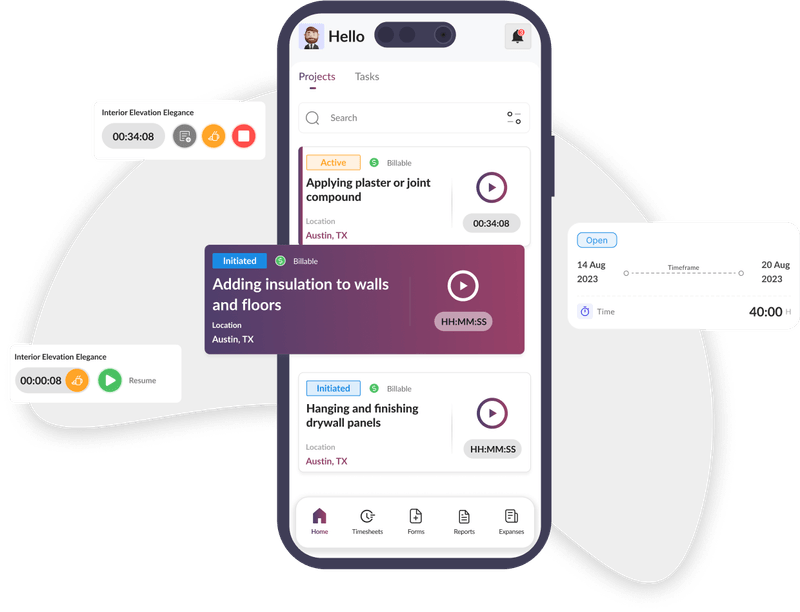
- Built-in Optical Character Recognition (OCR) system: It allows users to effortlessly scan and extract text from invoices and receipts. Simply snap a photo of your document, and watch as KYRO transforms it into digital data you can manage with ease.
- Expense and mileage tracking: Track your costs in real time, categorize them by project, and ensure every penny is accounted for. Plus, with mileage tracking, you won’t have to worry about underreporting those long drives to job sites.
- Integrations: Seamlessly link your favorite software with KYRO to streamline your workflow. This feature ensures that financial data effortlessly syncs across platforms, giving you crystal-clear insights into your projects’ financial health. You’re not just invoicing – you’re managing your entire project ecosystem like a boss!
Best for: Firms that want time tracking, invoicing, and receipt scanning bundled in one flat-fee module.
Pricing: No free tier – flat $500/month per module (e.g. Construction Management), unlimited users; Enterprise custom.
Free trial: None – KYRO offers live webinars instead of a trial.
Rating: Capterra 5.0 (3 reviews) – too small a sample to treat as a reliable signal.
Pros:
- Flat per-module pricing with unlimited users, rather than per-seat costs that scale with team size
- AI-powered invoice and receipt scanning built in
Cons:
- No free trial and no free tier at all – the pricing model was recently overhauled, so double-check current terms directly
2. Buildern
Key features:
- Client portal
- Change orders
- To-dos
- Budget management
Buildern helps you monitor progress in construction projects and provides insightful analytics that makes work management feel like a breeze.
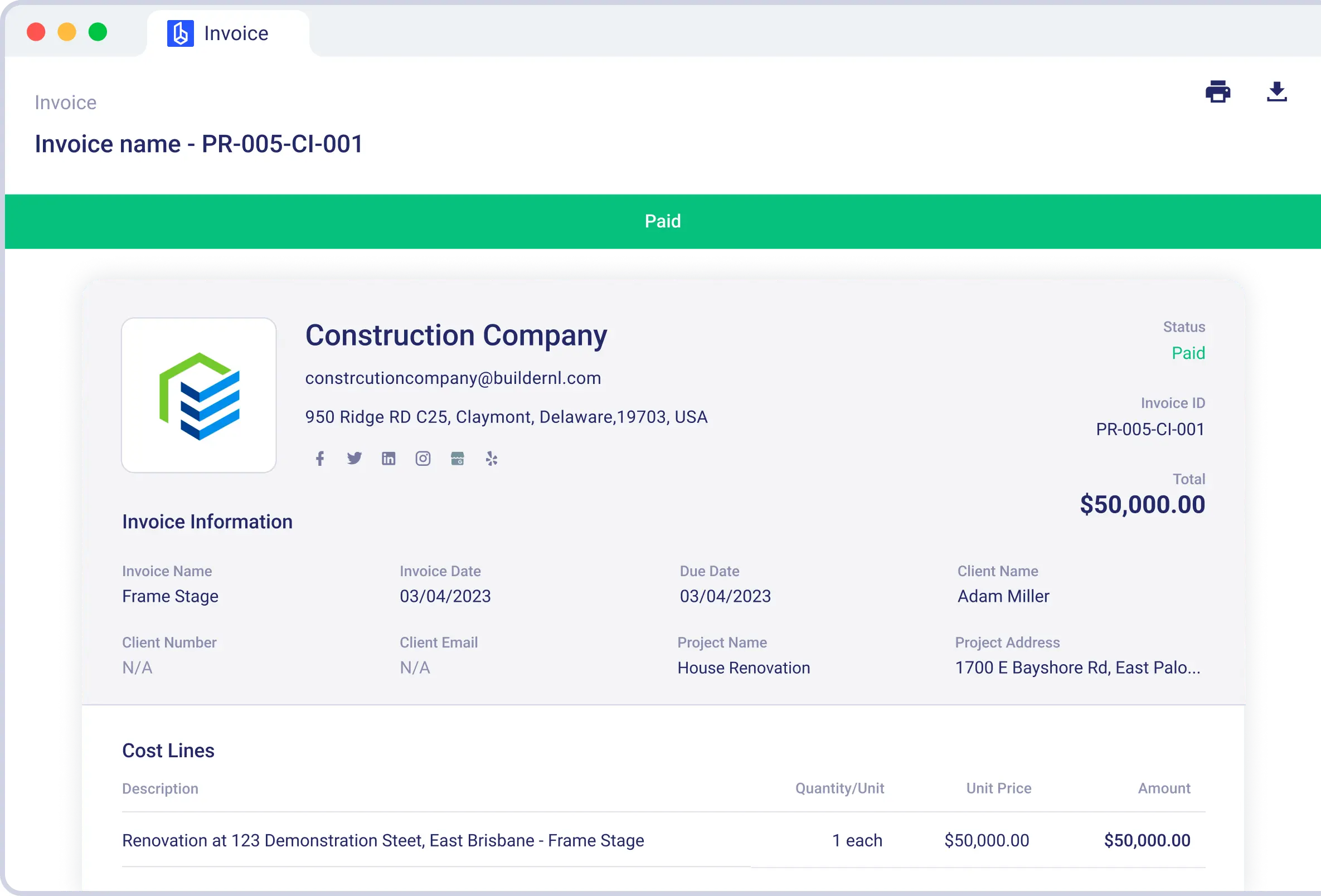
Here’s how this time tracker helps to manage the financial side of your projects:
- Automated invoices: You can easily generate professional invoices with just a few clicks. The system pulls data from your project progress, ensuring that every detail is accurate and up-to-date.
- Integration with online payment platforms: Your clients can pay their invoices quickly and conveniently, helping you accelerate cash flow. Imagine receiving payments faster as clients can click a button to settle their bills – no more waiting for checks in the mail!
- Budgeting: With features that allow you to set budgets, monitor expenses, and forecast future costs, you’ll have a complete picture of your project’s financial health. This insight lets you make informed decisions and prevent cost overruns.
Best for: Firms that want budgeting and client-facing invoicing tied to the same project record.
Pricing: Paid plans start at $250/month.
Free trial: Available – length not stated on the pricing page.
Rating: Capterra 4.9 (23 reviews).
Pros:
- Budgeting features tied directly to invoicing, catching cost overruns before they’re billed
- Online payment integration lets clients pay invoices directly, speeding up cash flow
Cons:
- Entry plan includes only 2 seats – additional seats add to the base monthly cost quickly
3. Bill4Time
Key features:
- Client portal
- Cost tracking
- Billing & invoicing
- Reports
This construction time tracking tool is meant to help you streamline your workflows, manage client projects, and effortlessly turn those hours worked into professional invoices.
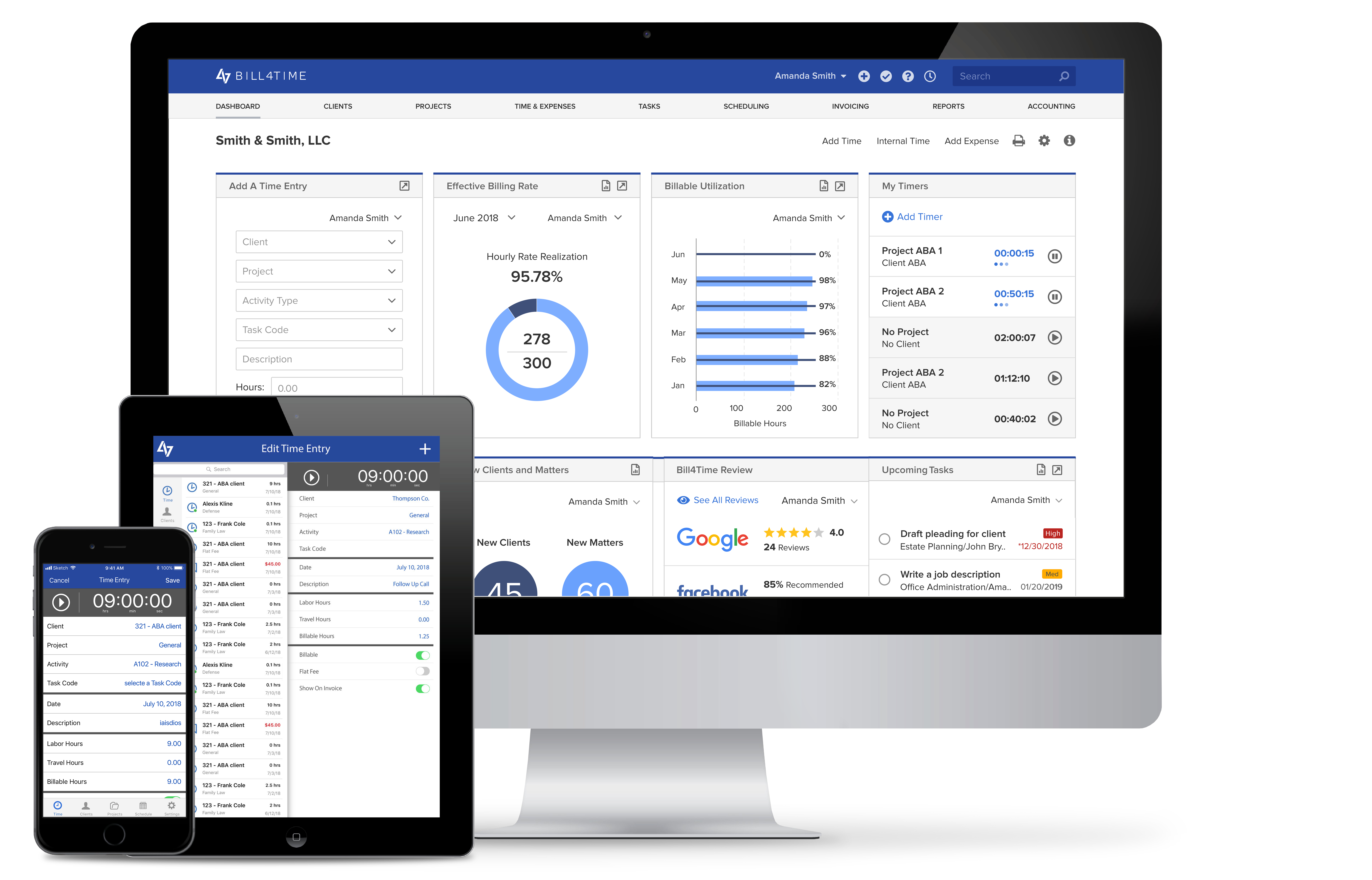
Here’s what Bill4Time offers:
- Time and expense tracking: Whether you’re on-site or working from the office, you can effortlessly log hours and expenses directly through the app. This means no more lost receipts or forgotten billable hours – just a seamless way to ensure every dollar spent and every minute worked is accounted for.
- Invoice templates: Bill4Time provides customizable invoice templates that allow you to add your company logo and specific project details. This personal touch not only enhances your brand’s image but also makes it easy for clients to understand their charges. Plus, with automated calculations, you can say goodbye to manual math errors!
- QuickBooks integration: If you’re already using QuickBooks for your accounting, you’re in luck! Bill4Time lets you sync your accounts to keep track of your finances without double entry. You can easily pull in your client information, expenses, and invoices to make accounting as smooth and efficient as possible.
Best for: Firms that bill by time and expense rather than a flat project quote.
Pricing: Plans start at $39/user/month billed annually ($49/user/month billed monthly).
Free trial: Available – length not stated on the pricing page.
Rating: Capterra 4.8 (210 reviews).
Pros:
- Customizable, brandable invoice templates with automated calculations
- Native QuickBooks sync avoids double data entry
Cons:
- Monthly billing costs noticeably more than the advertised rate, which is only for annual billing
4. BuildOps
Key features:
- Scheduling
- Quotes & proposals
- Invoicing
- Accounting integrations
BuildOps streamlines construction operations, making it easier for contractors to manage everything from project planning to finances, all while getting real-time insights that can turn a good construction project into a great one.
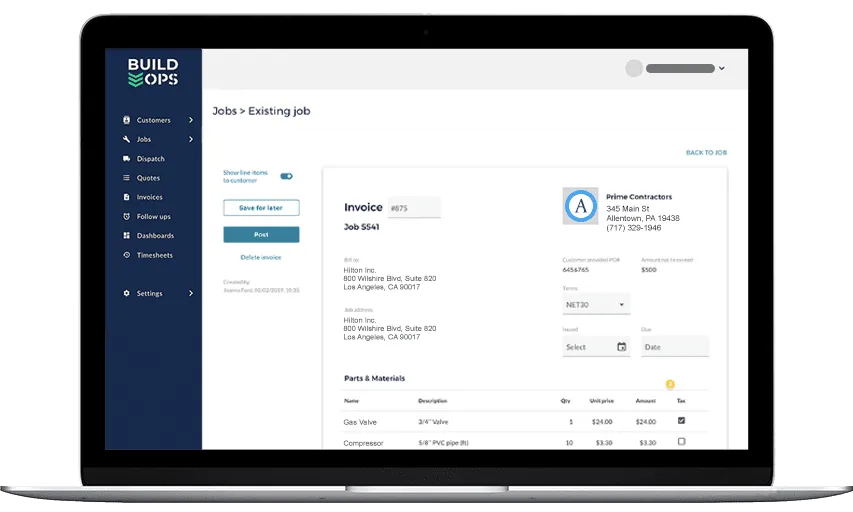
Here’s what it has to offer:
- Invoicing automation: Generate and send invoices in just a few clicks. Whether it’s a simple service charge or a detailed project bill, BuildOps streamlines the creation process, reducing errors and saving you precious time.
- Time and expense reports: You can easily capture time spent on each project and record all expenses on the go. BuildOps makes it effortless to compile reports and ensure you’re billing accurately for all your hard work.
- Accounting integration: Connect your account with popular accounting software to make sure that every invoice you create and every payment you receive is automatically updated in your financial records. This not only enhances your accounting workflows but also gives you an accurate overview of your project’s financial health.
Best for: Commercial service contractors (HVAC, electrical, plumbing) rather than general construction.
Pricing: Not publicly listed – BuildOps says pricing is tailored per contractor, quote required.
Free trial: Not publicly listed – confirm directly.
Rating: Capterra 4.4 (177 reviews).
Pros:
- Deep accounting integrations, including QuickBooks, Sage Intacct, and NetSuite
- Strong, sizable review base
Cons:
- No public pricing at all, and it’s built for commercial service trades specifically, not general contracting
Time tracking with certified payroll and compliance
If any of your work is on a government or prevailing-wage job, certified payroll reporting (WH-347 forms and state-specific wage compliance) usually isn’t optional – and general time tracking with payroll tools often handle it as an afterthought, if at all. These tools are built around that specific compliance requirement.
1. LCPtracker
Key features:
- WH-347 form generation
- Prevailing wage rate database
- Apprentice ratio tracking
- State-specific XML exports
LCPtracker focuses specifically on certified payroll compliance, including a California-specific wage database with automatic checks against state wage determinations.
Best for: Firms with California-specific prevailing wage compliance needs.
Pricing: Plus plan from $145/month (up to 5 projects) or $12/report; Professional plan $1,900–$18,200/year by project volume; custom quote for unlimited projects.
Free trial: Not advertised – confirm directly.
Rating: No public Capterra or G2 listing found – can’t cite a review count.
Pros:
- Built-in database of state wage determinations with automatic compliance checks
- State-specific XML exports beyond just California
Cons:
- No public review record to verify real-world satisfaction, and pricing scales sharply with project volume
2. Points North
Key features:
- Multi-state prevailing wage engine
- ADP, Paycor, and UKG integrations
- Optional managed reporting service
- ACA compliance tracking
Points North plugs into a payroll system you already run and layers certified payroll and prevailing wage compliance on top, rather than replacing your payroll processor – including an option to have their staff prepare and submit the reports for you.
Best for: Firms that already run payroll elsewhere and just need a compliance layer on top.
Pricing: From $125/user/month (Capterra-listed Basic plan); the vendor’s own site separately cites $175+/month plus $995–$4,995 setup fees – the two figures don’t reconcile, confirm directly before budgeting.
Free trial: Not advertised – confirm directly.
Rating: Capterra 3.0 (2 reviews) – too small a sample to treat as a reliable signal.
Pros:
- Optional managed service where their staff prepares and submits reports for you
- Plugs into ADP, Paycor, or UKG rather than requiring a payroll switch
Cons:
- Only 2 reviews on Capterra, and its own pricing pages don’t agree with each other
3. eMars
Key features:
- Automatic WH-347 generation
- Real-time error detection
- 18 state-specific report formats
- Time-clock upload with auto-matching
eMars generates WH-347 forms immediately after payroll sign-off and flags roughly 30 distinct error types on screen before submission, with dedicated formats for California, Oregon, Washington, New Jersey, and New York.
Best for: Multi-state contractors needing certified payroll reports across several state formats at once.
Pricing: Not publicly listed – quote-based, scaled by employee/job/state count.
Free trial: Not advertised – confirm directly.
Rating: No public Capterra or G2 listing found – can’t cite a review count.
Pros:
- Covers 18 state-specific report formats, not just one or two
- Flags roughly 30 distinct error types automatically before submission
Cons:
- No independent review record and no public pricing to compare against alternatives
4. Sunburst Software Solutions
Key features:
- QuickBooks integration
- State-specific prevailing wage reports
- EEO and work-utilization reports
- California DIR module
Sunburst’s certified payroll add-on is built specifically to sit on top of QuickBooks Pro, Premier, or Enterprise, which makes it a fit if you’re already running payroll through QuickBooks and just need the compliance layer, not a full replacement system.
Best for: QuickBooks users who need certified payroll without switching their whole payroll system.
Pricing: Not publicly listed – setup/transfer fee plus a monthly subscription, quote required.
Free trial: Not advertised – confirm directly.
Rating: No public Capterra or G2 listing found – can’t cite a review count.
Pros:
- Purpose-built to sit directly on top of QuickBooks Pro, Premier, or Enterprise
- Includes EEO and work-utilization reports beyond just certified payroll
Cons:
- Windows add-on only, not a standalone cloud product, and no independent review record
Time tracking with equipment and asset hour tracking
Tracking how long a piece of equipment has run is a different job from tracking how long an employee worked – it feeds maintenance schedules and utilization decisions, not payroll. None of the categories above track this well, because it isn’t what they’re built for.
1. Tenna
Key features:
- GPS and IoT asset tracking
- Usage-based maintenance scheduling
- Asset records and warranty tracking
- Fleet-wide utilization view
Tenna tags and tracks equipment in real time and triggers maintenance reminders based on actual usage hours rather than a fixed calendar schedule.
Best for: Fleets that want maintenance reminders triggered by actual equipment usage, not a fixed calendar.
Pricing: Not publicly listed – custom quote.
Free trial: Not advertised – confirm directly.
Rating: G2 4.4 (53 reviews); Capterra satisfaction score 4.6 (exact review count not confirmable).
Pros:
- GPS/IoT asset tracking plus usage-based maintenance scheduling in one system
- Fleet-wide utilization view across all tagged equipment
Cons:
- No public pricing, and the exact Capterra review count isn’t independently confirmable
2. HCSS Telematics
Key features:
- Cross-brand telematics aggregation
- Engine/usage hours feed maintenance scheduling
- Geofencing
- Utilization insights
HCSS Telematics pulls OEM telematics data from brands like John Deere, Cat, Komatsu, and Volvo into one dashboard and feeds those hours into HCSS Equipment360 for preventive maintenance.
Best for: Fleets running mixed-brand equipment (John Deere, Cat, Komatsu, Volvo) that want one dashboard instead of several OEM apps.
Pricing: From roughly $11/month per the vendor’s base tier – multiple plan tiers exist for different asset types, confirm which one this covers.
Free trial: Not advertised – confirm directly.
Rating: Capterra 3.5 (2 reviews) – too small a sample to treat as a reliable signal.
Pros:
- Aggregates cross-brand telematics data that other tools leave siloed by manufacturer
- Feeds directly into HCSS Equipment360 for preventive maintenance scheduling
Cons:
- Only 2 reviews on Capterra, and multiple plan tiers make the advertised starting price hard to compare directly
3. Fleetio
Key features:
- Maintenance scheduling by meter reading
- Customizable inspections
- Parts and inventory management
- Work order tracking
Fleetio isn’t construction-exclusive (it reports around 16% of its user base in construction), but it publishes clear per-asset pricing and ties maintenance schedules directly to hour or mileage meter readings.
Best for: Fleets that want transparent, published per-vehicle pricing rather than a quote process.
Pricing: Essential $4/vehicle/month; Professional $7/vehicle/month; Premium $10/vehicle/month.
Free trial: Available – confirm current length directly.
Rating: Capterra 4.7 (246 reviews).
Pros:
- Clear, published pricing tiers instead of a custom-quote process
- Large, strongly positive review base
Cons:
- Not construction-exclusive, so some features are built for general fleets rather than job-site-specific workflows
4. T3 by EquipmentShare
Key features:
- Cross-manufacturer telematics
- Predictive maintenance alerts
- Fuel and diagnostics tracking
- Utilization-intelligence reporting
T3 aggregates telematics across mixed-brand fleets and flags underused assets, aimed at contractors trying to decide whether to keep renting or buy more equipment.
Best for: Contractors deciding whether to keep renting equipment or buy more, based on real utilization data.
Pricing: Not publicly listed – third-party estimates suggest roughly $30–$70 per asset/month, unverified against an official source.
Free trial: Not advertised – confirm directly.
Rating: Review counts could not be reliably confirmed across Capterra and G2 – treat any rating you see elsewhere as unverified.
Pros:
- Flags underused assets across a mixed-brand fleet to support rent-vs-buy decisions
- Cross-manufacturer telematics in one dashboard, similar to HCSS but from a different vendor angle
Cons:
- Review counts couldn’t be reliably confirmed, and pricing is estimated by third parties rather than published officially
How to choose based on your needs
Picking a category above is the easy part. The harder question is what to do once you know which job you’re solving for – a few factors matter more than which tool is “best” in the abstract.
How many of these needs do you actually have at once?
Most construction businesses need more than one of these six things, and buying six separate tools means six logins, six data exports, and six places for numbers to disagree. Before shopping by category, check whether a tool from an adjacent category already covers a second need reasonably well – actiTIME, for example, covers project management and basic billing in one system, which can be worth more than a marginally better standalone tool in either category alone.
Does team size change what “good” looks like?
A small construction company running a 5-person crew and a 200-person general contractor are not shopping for the same thing, even within one category. A small crew usually cares more about ease of setup and per-user cost than depth of reporting; a large GC running multiple concurrent jobs needs consolidated reporting across projects and role-based permissions that a small-team tool often doesn’t bother building. Check a tool’s pricing tiers and minimum user counts before assuming it scales the way you need it to – some of the tools above are priced and built for one end of that range, not both.
Is compliance a hard requirement, or a nice-to-have?
If any share of your work is government or prevailing-wage, treat certified payroll capability as a filter you apply first, not a feature you compare last. A tool that’s otherwise perfect but can’t generate a WH-347 report will cost you more in manual workarounds than switching to one that handles it natively.
How much does field connectivity actually matter?
Office-based estimating and accounting teams rarely need offline support or GPS accuracy. Field workers on remote sites with poor signal do. Weight this factor by how much of your workforce is actually in the field versus at a desk, rather than assuming every construction tool needs to be built for a job site with no signal.
Construction time tracking made easy
The time tracking software market offers dozens of solutions, but it’s hard to find the one that is one-size-fits-all. That’s why you need to prioritize the essential features and narrow down your search up to a handful of options. Because only you know what’s best for your business, right?
Consider actiTIME – construction timesheet software with an established presence in the software market.
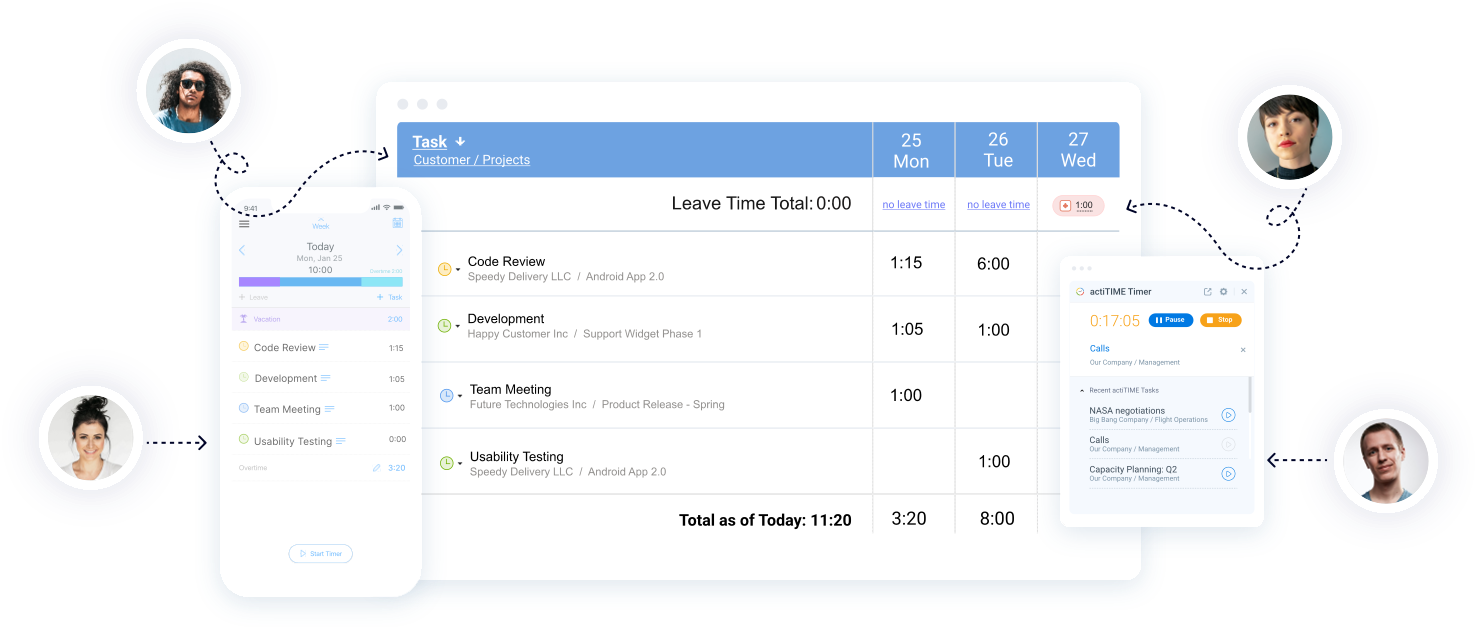
For its 15+ years of service, it has earned hundreds of construction businesses among its clients. With actiTIME, users can track time in three different ways, while managers can fine-tune it to their own business and workflow requirements. Give it a try and see for yourself – get your free 30-day actiTIME trial (no credit card required).
FAQ
Can I mix tools from different categories, or will they conflict?
Yes, and it’s common – most construction businesses end up running a project management tool alongside a payroll or certified payroll tool, not one system that does everything. The tools don’t conflict with each other; the only real risk is that data doesn’t sync automatically between them, so check the integrations below before assuming two tools will talk to each other.
Do tools from different categories actually integrate with each other, or do I have to move data manually?
Many do, especially where payroll and accounting are involved. Timeero syncs with ADP, QuickBooks, Rippling, and Gusto; several certified payroll tools (Points North, Sunburst) plug directly into ADP, Paycor, UKG, or QuickBooks; actiTIME and Bill4Time both connect to QuickBooks as well. Integration depth still varies a lot by vendor, though – check the specific integration list before assuming two tools will sync automatically, rather than discovering a manual export step after you’ve already committed to both.
Will one all-in-one platform eventually replace all six categories?
Unlikely to happen completely. Certified payroll and equipment hour tracking are narrow enough, regulation-driven or hardware-dependent niches that a general platform rarely does them well natively – that’s exactly why dedicated tools exist for them today. What’s more realistic is consolidation down to two or three tools instead of six, with project management, attendance, and invoicing increasingly handled by one system, while compliance and equipment tracking stay separate.