



Good time tracking software for freelancers should record your hours accurately enough to bill every one of them. It should also show whether a project paid what you expected. Most apps get the first part right. Far fewer help with the second, and that’s where freelancers tend to lose money without noticing.
We compared 12 time tracking apps for freelancers on what matters when you work alone or with a couple of subcontractors: whether invoicing is built in, how generous the free option is, whether paid tiers make you buy several seats, and how much setup the tool needs. Pricing below was checked on each vendor’s own pricing page on October 12, 2026.
Why freelancers track time: the math
Hourly freelancers track time to bill it. Freelancers on fixed fees often skip tracking, and that is where it matters most, because a fixed fee hides your real hourly rate until you measure the hours. Two quick examples with illustrative numbers show what tracking reveals.
Twelve extra hours of revisions and calls cut the real rate by more than a quarter, and without a timer running you would never see it. The next quote for that client should start from 42 hours, not 30.
The second leak is small work that never reaches an invoice. Twenty minutes a day of client emails, quick calls, and small fixes, five days a week for 48 weeks, adds up to 80 hours a year. At $75 an hour that is $6,000 of work done for free. Double it to 40 minutes a day and the gap is $12,000. A tracker with a one click timer or a quick manual entry is what turns those minutes into billable lines.
For the time management side of solo work, see our guide to common freelancer time management problems.
What to look for in time tracking software for freelancers
- Invoicing built in, or a clean export. If the app can turn billable hours into an invoice, you skip retyping hours into a separate tool. If it cannot, check that it exports to whatever you invoice from.
- A free option that fits one person. Free tiers vary widely. Some allow unlimited time tracking but no invoicing; others include invoicing but cap you at one client or two projects.
- No seat minimums. Several team tools sell paid tiers in blocks of two or five seats, which means a solo freelancer pays for colleagues they do not have. We left those tools off this list.
- The right way to capture time. A timer suits focused work sessions, manual entry suits people who log at the end of the day, and automatic activity tracking suits people who forget to start timers at all.
- Billable and nonbillable time. Tracking only what you bill hides the admin, sales, and learning time that determines your real hourly rate.
- Client facing reports. A clean report of hours by task helps when a client questions an invoice.
Quick comparison
The 12 time tracking apps for freelancers below differ most on two things: what you get for free, and what you pay before the app will invoice your hours.
| Tool | Free option | Lowest price with invoicing |
|---|---|---|
| actiTIME | Free version for up to 3 users | From $5 per user per month |
| Clockify | Free for up to 5 users, no invoicing | $5.49 per seat per month, billed annually |
| Toggl Track | Free for up to 3 users | Billable rates from $9 per user per month, billed annually |
| Harvest | 1 seat, 2 projects, invoicing included | Free, or $9 per seat per month billed annually |
| FreshBooks | 30 day trial only | $23 per month for 5 billable clients |
| Zoho Invoice | Free | Free |
| Bonsai | Trial only | $19 per user per month, billed annually |
| Moxie | Trial only | $10 per month, billed annually |
| TimeCamp | Free for unlimited users, no invoicing | $3.99 per user per month, billed annually |
| Paymo | 1 user, 1 client, 2 projects, invoicing included | Free, or $5.90 per month for the first 3 months |
| Kimai | Free to self host | Free self hosted, or €2.99 per user per month in the cloud |
| Timing | Not published | Via GrandTotal integration; app from €8 per month, billed annually |
12 best time tracking software for freelancers
1. actiTIME
Key features:
- Timesheet and calendar time entry
- Mobile timer
- Billing rates and invoices
- Profit and cost reports
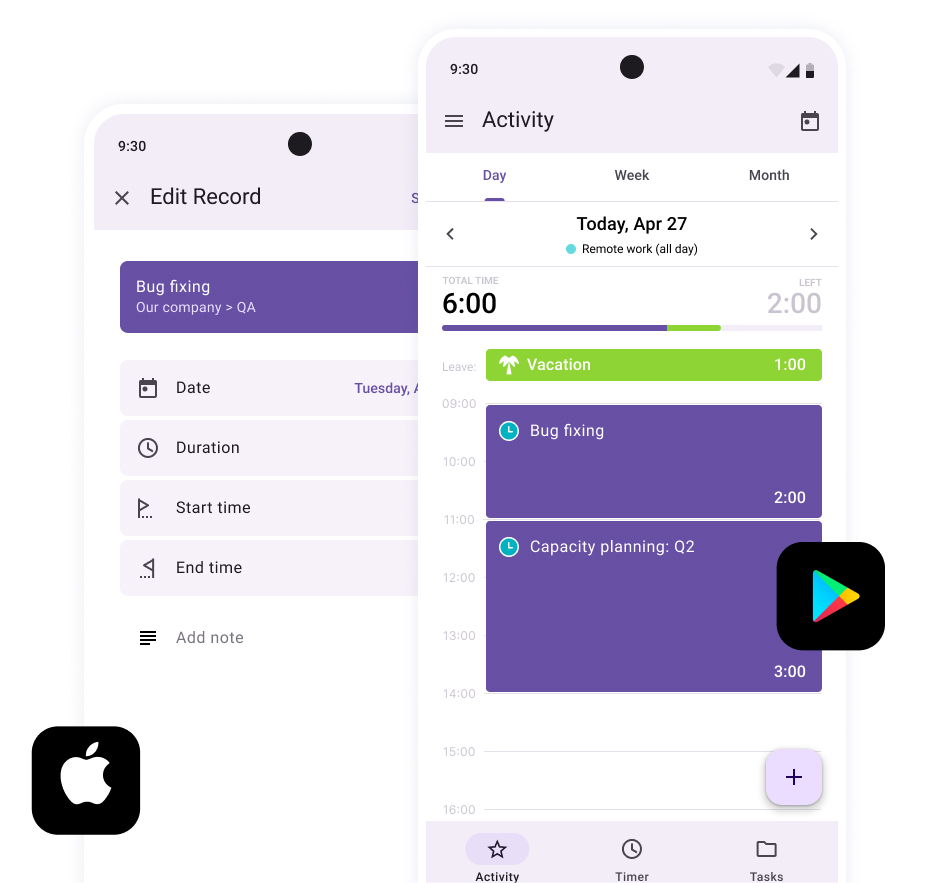
actiTIME suits freelancers who want to know what each client and project actually earns, not just how many hours went in. You log time in a weekly timesheet or a calendar view, or start a timer in the mobile app. Billing rates are set on types of work and applied to tasks, so different kinds of work (design versus consulting, for example) can carry different rates, and actiTIME turns billable hours into PDF invoices.
Where it goes further than most freelance timers is reporting. The Profit/Loss Report compares billable amounts with costs by customer, project, or task, which is useful once you bring in a subcontractor and need to see your margin on their hours. The Estimated vs. Actual Time Report shows which fixed fee jobs ran over. The optional Chrome extension adds automatic activity tracking for people who forget to start timers.
Limitation: actiTIME is built for project teams, so a solo user gets more structure than a bare timer, and some features (the Chrome extension, budgets, integrations) are not in the free version.
Pricing: free version for up to 3 users; paid version from $5 per user per month; free 30 day trial.

Time tracking became a breeze
With actiTIME’s mobile app, tracking time on the client’s side became a breeze. Now accountants simply switch on the timer on their phone as they start another task and get accurate time logs without taking notes.
2. Clockify
Key features:
- Unlimited free tracking
- Timer and timesheet
- Billable rates
- Invoicing on paid tiers
Clockify has a free tier that is hard to argue with: unlimited time tracking for up to 5 users. A solo freelancer can log every hour for every client and never pay.
The catch for freelancers is where invoicing sits. The free tier records hours but does not invoice them; invoicing starts on the Standard tier at $5.49 per seat per month billed annually, or $6.99 billed monthly. The cheaper Basic tier, at $3.99 per seat per month billed annually, does not include invoicing either. If you already invoice from accounting software and only need clean hour totals to copy across, the free tier may be all you ever need.
Limitation: profitability reporting is basic compared with tools built around project finances, and the most useful billing features sit behind paid tiers.
Pricing: free for up to 5 users; Basic $3.99, Standard $5.49, Pro $7.99 per seat per month, billed annually.
3. Toggl Track
Key features:
- One click timer
- Client and project reports
- Billable rates
- Free tier for 3 users
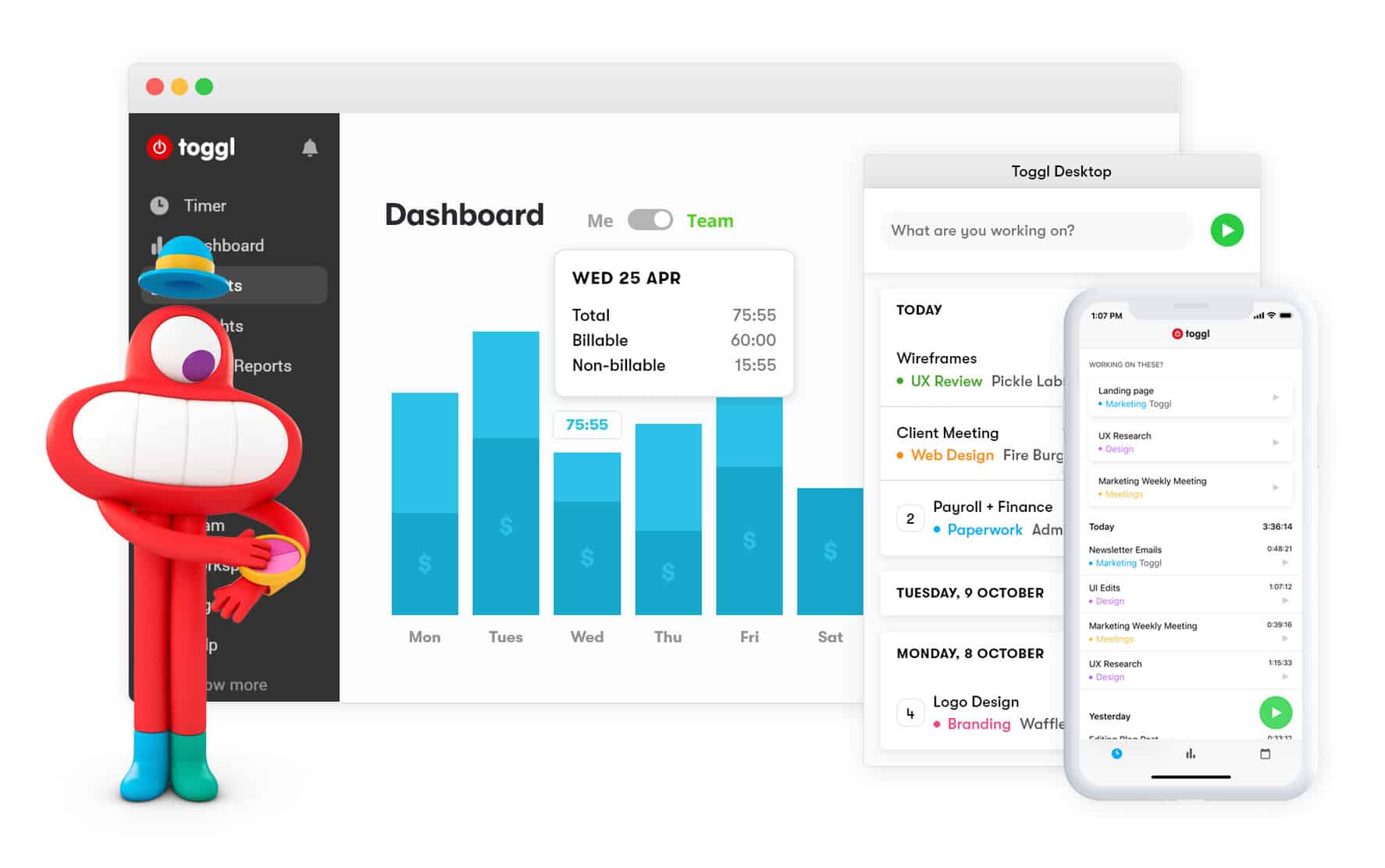
Toggl Track is built around a timer that takes a couple of clicks to start. You name the task, pick the client and project, and stop it when you’re done. The reports then break hours down by client and project, which is handy when a client asks where the time went.
The free tier covers up to 3 users with core tracking. Billable rates, which you need to turn hours into amounts, start on the Starter tier at $9 per user per month billed annually or $12 billed monthly, and Premium costs $16 per user per month billed annually. Toggl does not publish invoicing as a feature on its pricing page, so most freelancers pair it with separate invoicing or accounting software.
Limitation: you pay $9 or more a month before Toggl calculates billable amounts, and invoicing is not part of the product’s published feature set.
Pricing: free for up to 3 users; Starter $9 and Premium $16 per user per month, billed annually.
4. Harvest
Key features:
- Time to invoice in a few clicks
- Online payments
- Expense tracking
- Accounting integrations
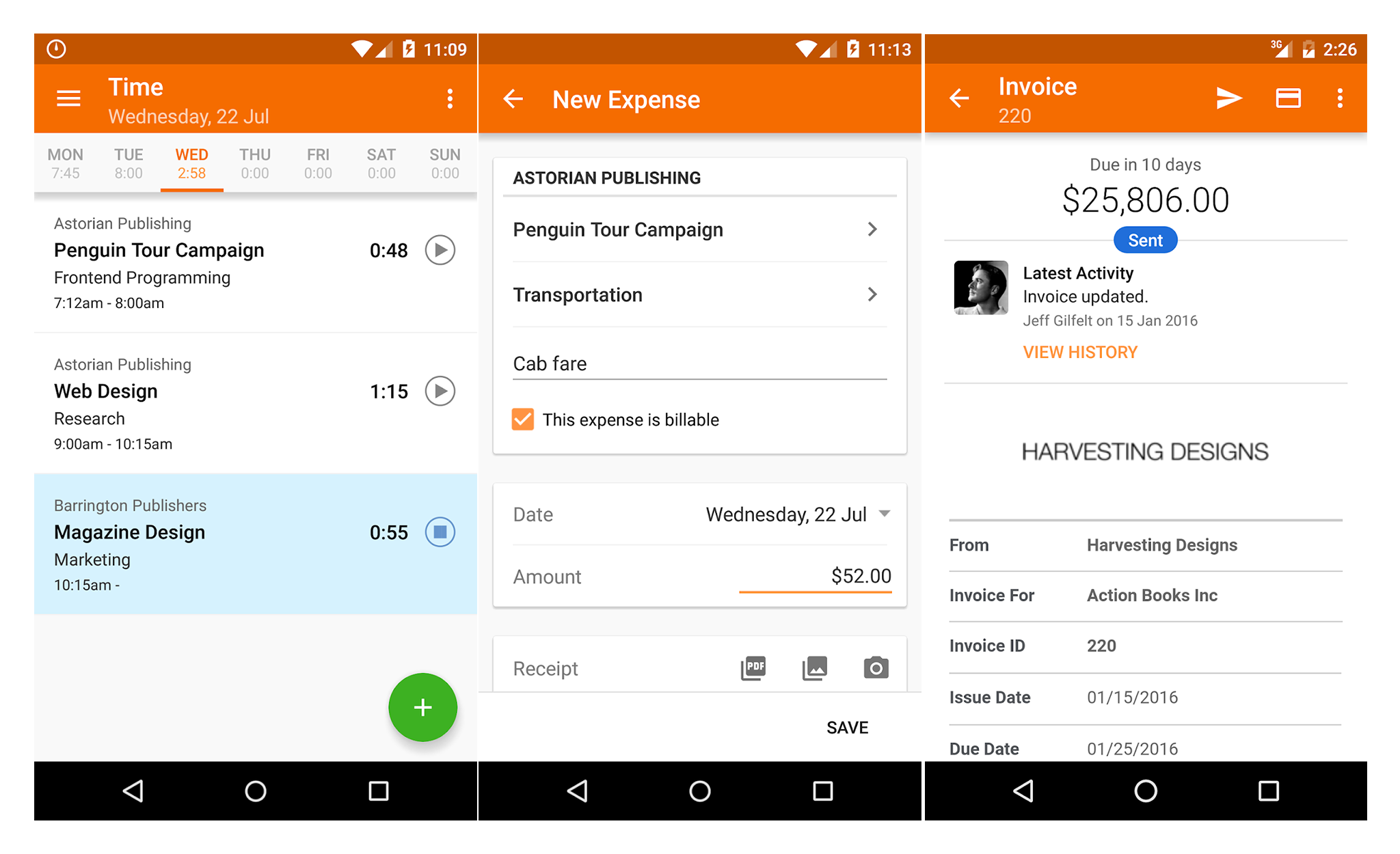
Harvest was built around the path from tracked hours to a paid invoice, and that is still what it does best. You track time with a timer or timesheet, log expenses alongside, and generate an invoice from the unbilled hours and expenses for a client. On paid tiers, invoices connect to payment and accounting tools, including Stripe, QuickBooks Online, and Xero, so clients can pay online.
For a freelancer just starting out, the free tier covers more than most: one seat and two projects, with invoicing included. Once you have more than two active projects you move to the Teams tier at $9 per seat per month billed annually ($11 monthly), which removes the free tier’s limits and adds the payment and accounting integrations. We cover more options in our roundup of Harvest alternatives.
Limitation: the two project cap on the free tier is tight for anyone juggling several clients at once.
Pricing: free for 1 seat and 2 projects; Teams $9 and Enterprise $14 per seat per month, billed annually.
5. FreshBooks
Key features:
- Accounting and invoicing
- Time tracking on every tier
- Expenses and receipts
- Online payments
FreshBooks is accounting and invoicing software with time tracking built in, rather than a timer with invoices added later. If you want hours, invoices, expenses, and bookkeeping in the same app, it can replace two or three tools. Tracked time flows straight onto invoices, and the same system records payments and expenses for tax time.
Pricing is set by the number of billable clients rather than by users. The Lite tier costs $23 per month for up to 5 billable clients, Plus costs $43 for up to 50, and Premium costs $70 for unlimited clients, with time tracking included on all of them. These are regular prices; FreshBooks often runs introductory discounts, so check the current offer.
Limitation: it is the most expensive option here if you only need time tracking, and the time tracking itself is simpler than in dedicated trackers.
Pricing: Lite $23, Plus $43, Premium $70 per month; 30 day free trial.
6. Zoho Invoice
Key features:
- Free invoicing
- Time logging by project
- Quotes and recurring invoices
- Client portal
Zoho Invoice is the best fully free option here if invoicing matters more to you than detailed time analysis. There’s no paid tier at all: you log time against projects, then bill it on invoices you can brand with your own template, with quotes, recurring invoices, automated payment reminders, expense recording, and a self service client portal included.
For a freelancer billing a handful of clients by the hour, that’s everything from logged hours to a paid invoice, with no subscription. It also connects with the rest of the Zoho suite, including Zoho CRM and Zoho Books, if you later need full accounting.
Limitation: time tracking is a supporting feature rather than the core of the product, so you get less in the way of timers, productivity insight, and time reports than in a dedicated tracker.
Pricing: free.
7. Bonsai
Key features:
- Proposals and contracts
- Time tracking
- Invoices and payments
- Client CRM
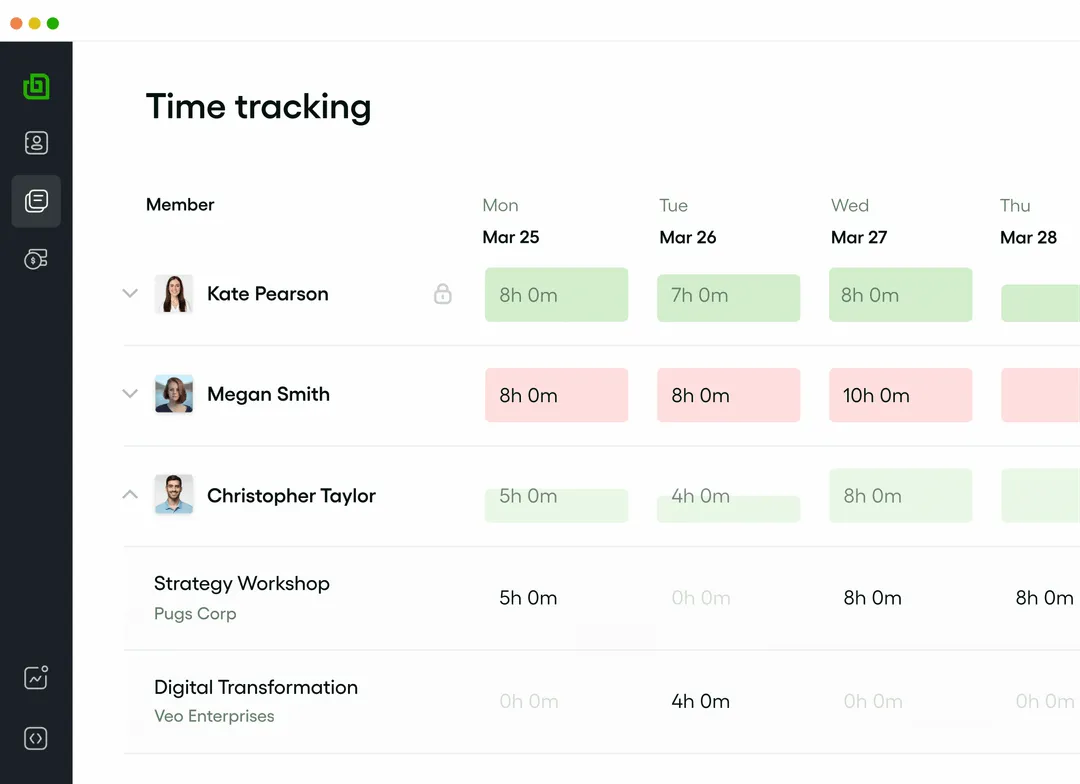
Bonsai is a client management suite for freelancers and small agencies, and it handles the admin around the actual work: proposals, contracts, a CRM, scheduling, a client portal, and invoicing, plus time tracking. A new client can go from proposal to signed contract to tracked hours to paid invoice without leaving the app.
Check which tier you’re buying. The Basic tier at $9 per user per month billed annually ($15 monthly) includes time tracking, tasks, and a CRM, but invoices, payments, proposals, and contracts start on Essentials at $19 per user per month billed annually ($25 monthly). Premium at $29 adds profitability reports and integrations with QuickBooks, Xero, and Zapier.
Limitation: the features most freelancers choose Bonsai for start at $19 a month, which is more than several tools here charge for time tracking with invoicing.
Pricing: Basic $9, Essentials $19, Premium $29 per user per month, billed annually; free trial.
8. Moxie
Key features:
- Timers
- Invoicing
- Client management
- Project collaboration
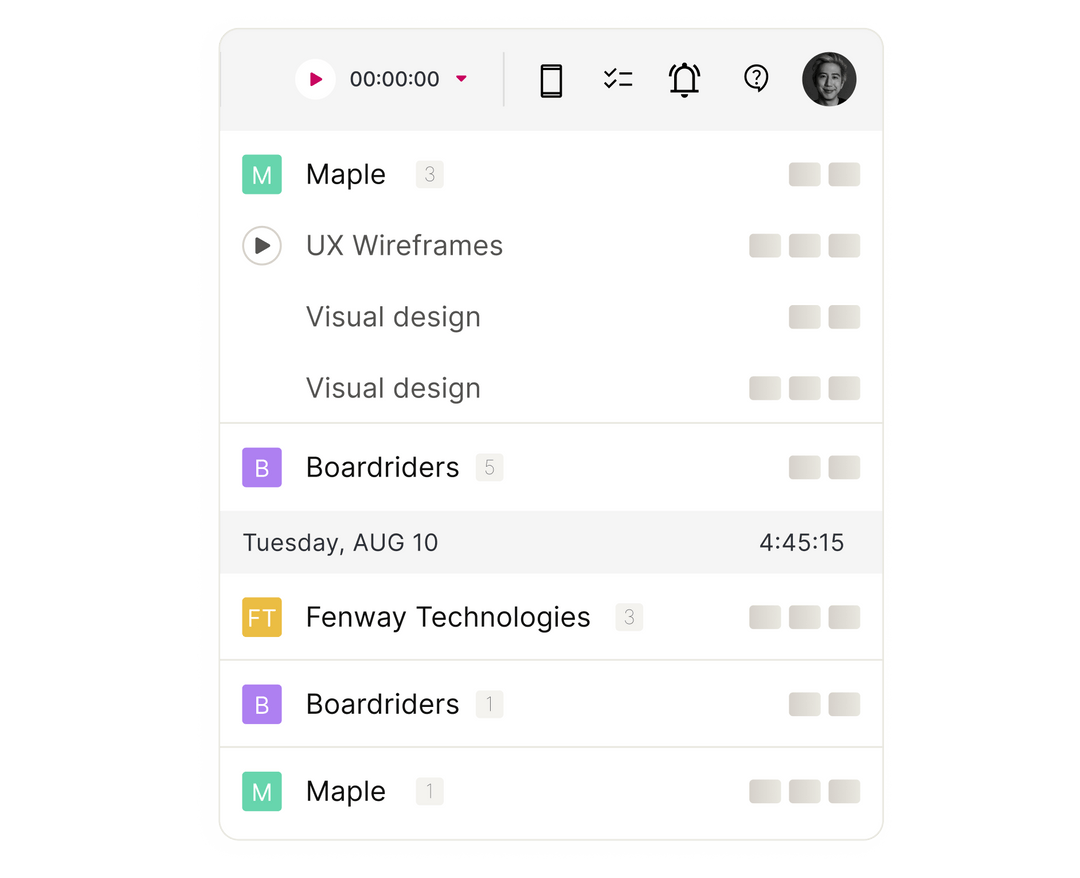
Moxie covers similar ground to Bonsai, a freelancer business tool combining client management, projects, time tracking, and invoicing, but at a lower entry price. Time tracking and invoicing are included from the cheapest tier, so the path from a running timer to a sent invoice is available for $10 a month billed annually, or $12 billed monthly.
The Pro tier at $20 per month (annual) adds unlimited project collaborators, which helps if clients or subcontractors need to see project progress. The Teams tier at $32 per month (annual) supports up to five team members. Moxie offers a 14 day free trial.
Limitation: it is a broad business suite, so if you only want a timer and invoices, much of what you pay for will go unused, and there is no permanent free tier.
Pricing: Starter $10, Pro $20, Teams $32 per month, billed annually; 14 day free trial.
9. TimeCamp
Key features:
- Free unlimited users
- Automatic tracking
- Invoicing
- Desktop and mobile apps
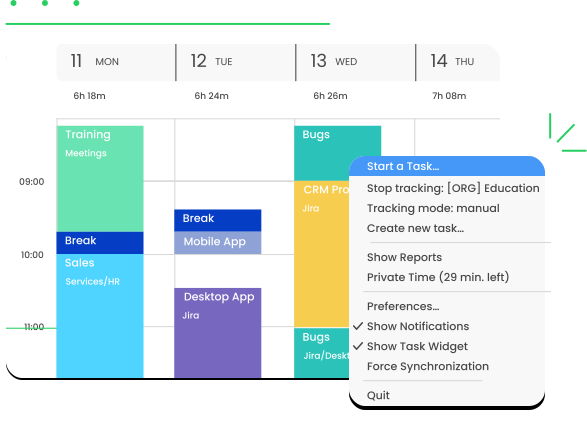
TimeCamp has one of the most generous free tiers here, with timesheets, desktop and mobile apps, unlimited projects, and unlimited users at no cost, plus an AI time tracker that records activity automatically for people who prefer not to run timers.
The paid tiers have a catch. Invoicing starts on the Starter tier at $3.99 per user per month billed annually ($5.49 monthly), which is one of the cheapest routes to invoices on this list. Billable rates, however, only appear on the Ultimate tier at $9.99 per user per month billed annually ($13.99 monthly). If you bill different rates for different kinds of work, budget for Ultimate rather than Starter.
Limitation: billable rates sit on the highest standard tier, so the cheap invoicing tier suits freelancers who bill one flat rate.
Pricing: free for unlimited users; Starter $3.99, Premium $6.99, Ultimate $9.99 per user per month, billed annually.
10. Paymo
Key features:
- Task management
- Unlimited time tracking
- Invoicing on the free tier
- Desktop and mobile apps
Paymo combines task management, time tracking, and invoicing, which suits freelancers who want to organize work as tasks and bill from the same place. Its free tier includes unlimited time tracking and unlimited invoices, along with desktop and mobile apps, but it is limited to 1 user, 1 client, and 2 projects.
That makes the free tier a good fit for someone with one main client. Once you add a second client you move to the Solo tier, which costs $5.90 per month for the first three months and $9.90 per month after that. The Plus tier, from $10.90 per user per month for three months and $15.90 after, adds features for small teams.
Limitation: the single client cap on the free tier is the tightest of any free option here, and the introductory discount means the real long term price is the higher figure.
Pricing: free for 1 user, 1 client, and 2 projects; Solo $9.90 per month after a $5.90 introductory price.
11. Kimai
Key features:
- Open source
- Self hosted or cloud
- Invoice templates
- E invoicing formats
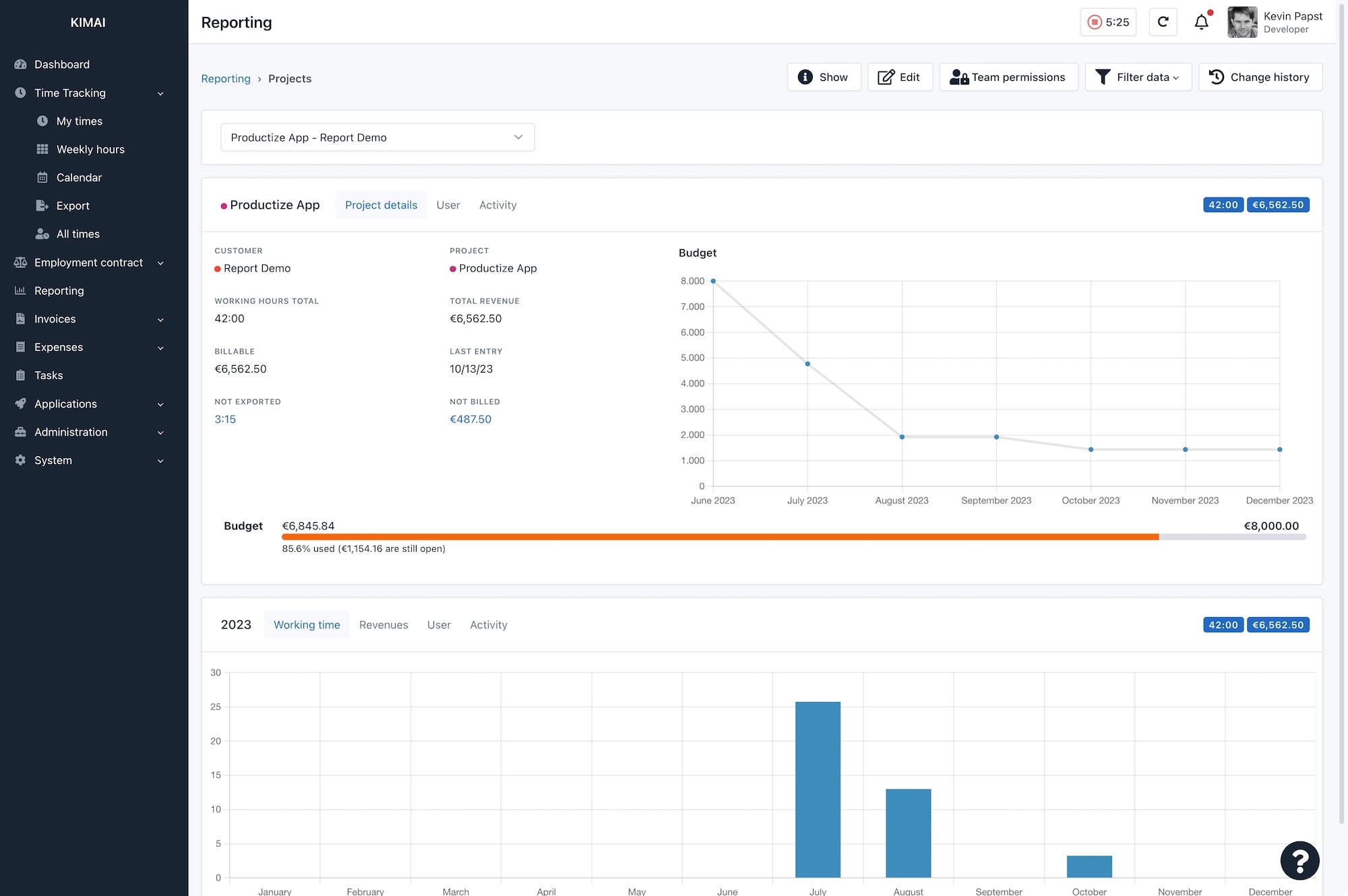
Kimai is open source time tracking software released under the AGPL 3 license, which you can install on your own server for free and keep full ownership of your data. It covers project time tracking, billable hours, configurable invoice templates, and data export, and it can generate e invoices in XML and PDF/A formats that comply with the European EN 16931 standard, which matters for freelancers billing clients in countries that require electronic invoices.
If you would rather not run a server, the hosted version starts at €2.99 per user per month for the Standard tier, which includes time tracking, billable hours, and invoicing, with a 30 day free trial. Hosting is in Germany.
Limitation: the self hosted version needs some technical comfort to install and maintain, and the interface is functional rather than polished.
Pricing: free to self host; cloud Standard €2.99 and Professional €3.99 per user per month, billed annually.
12. Timing
Key features:
- Automatic Mac tracking
- Timers and manual entries
- Billing status tracking
- Client reports
Timing is an automatic time tracker for the Mac, built for people who forget to start timers. It records which apps and websites you use throughout the day, and you assign those blocks to projects afterward. It also supports timers and manual entries, detects meetings automatically, and marks entries as billed or unbilled.
The Professional edition covers one Mac and includes reports you can send to clients. It costs €10 per month billed monthly or €8 per month billed annually, as shown on the pricing page when we checked. Invoicing happens through an integration with GrandTotal, a separate invoicing app, rather than inside Timing.
Limitation: it is Mac only, and invoices require a second app.
Pricing: Professional from €8 per month, billed annually; Expert and Connect editions cost more.
How to choose
The best time tracking app for freelancers is the one that matches how you bill. Use the situations below as a shortcut.
- You need invoices and do not want to pay: Zoho Invoice, Harvest’s free tier if you have two projects or fewer, or Paymo’s free tier for a single client.
- You only need accurate hours: Clockify or TimeCamp on their free tiers.
- You want contracts, proposals, and invoicing in one place: Moxie for the lower price, Bonsai for a broader client management suite.
- You want accounting too: FreshBooks.
- You keep forgetting to start timers: Timing on a Mac, or TimeCamp’s automatic tracker.
- You want to own your data: Kimai, self hosted.
- You want to see what each client and project earns, or you work with subcontractors: actiTIME.
If you are still choosing between a dedicated tracker and a broader freelance setup, our product page on time tracking for freelancers shows how actiTIME handles hours, rates, and invoices for solo work, and our list of the best free time tracking apps covers more free options.


FAQ
What is the best free time tracking app for freelancers?
It depends on whether you need invoices. For tracking hours only, Clockify is the strongest free choice, with unlimited tracking for up to 5 users. If you also need to send invoices without paying, Zoho Invoice is free in full, and Harvest’s free tier includes invoicing for up to two projects.
Should freelancers track time on fixed price projects?
Yes. On a fixed fee the client never sees your hours, but you need them to know your effective hourly rate and to price the next project. A $3,000 project planned at 30 hours earns $100 an hour; if it takes 42 hours, it earns $71.43, and only tracking shows you that.
How should freelancers round billable time?
Pick one increment, state it in your contract, and apply it consistently. Six minute increments (a tenth of an hour) are common in professional services, while 15 minute increments are simpler for clients to read. Most trackers on this list can round report totals so you do not have to adjust entries by hand.
Conclusion
The best time tracking app for freelancers depends on how you bill. If you invoice by the hour and want it free, start with Zoho Invoice or Harvest’s free tier. If you only need hours, Clockify’s free tier will probably do. If you have clients on fixed fees, or you work with subcontractors and need to know your margin, choose a tool that shows profit by client and project as well as hours.
To see your billable hours, invoices, and earnings per client in one place, start a free trial of actiTIME.