

A desktop time tracker runs on your computer rather than only in a browser tab, which lets it do things web apps cannot: record which apps and documents you use automatically, keep working when the connection drops, and, in some cases, keep every byte of data on your own machine. The main choice is between a timer or timesheet you control and an automatic tracker that logs everything for you.
Below are 9 computer time trackers you install to log work hours, split into timesheet apps and automatic trackers, with platforms and pricing from each vendor’s own site. Monitoring tools and time clocks have their own guides, linked further down.
Why use a desktop time tracker
- Automatic tracking. Only an app installed on the computer can see which application, window, or document is active. That is what makes automatic time logs possible.
- Working offline. Several desktop apps keep recording without an internet connection and sync later.
- Data control. Some trackers store data locally, and some business tools can be self hosted on your own servers, which matters for teams with strict security policies.
- One time pricing. A few desktop tools, such as WorkingHours Pro, are sold as a one time license instead of a subscription.
The tradeoff is installation and updates on every machine, and a different experience on Windows, Mac, and Linux. If you only need a timer, a browser app with a desktop widget may be enough. For platform specific lists, see our picks of time tracking software for Windows and timesheet apps for Mac.
What to look for
- Operating systems. Check Windows, macOS, and Linux support separately; not every app covers all three.
- Manual or automatic. Timers and timesheets record what you choose to log; automatic trackers record everything and leave you to sort it.
- Privacy model. Find out where data is stored, whether screenshots are taken, and what employees can see about their own data.
- What happens to the hours. Personal trackers stop at charts. Team tools turn hours into timesheets, approvals, invoices, and cost reports.
- Pricing model. Free, per user subscription, or one time license.
One time purchase vs. subscription
One time licenses look expensive at first and cheap later. Here is a worked comparison using actiTIME’s published prices, before counting any server or maintenance costs for the self hosted version.
If you already run servers and expect to keep the tool for years, a one time license usually wins; see actiTIME Self-Hosted for the details. If you would need to buy and maintain hardware just for the tracker, the subscription is often cheaper in practice.
Timer and timesheet apps
These record the time you choose to log, with a timer, a timesheet, or a desktop time tracking app, and are the most common kind of time tracker for PC and Mac teams that bill or pay by the hour.
| Tool | Platforms | Starting price |
|---|---|---|
| actiTIME | Web, iOS, Android, Chrome extension; self hosted option | Free version for up to 3 users; from $5 per user per month; self hosted $120 per user once |
| Clockify | Windows, Mac, Linux, web, mobile | Free for up to 5 users; from $3.99 per seat per month, billed annually |
| TimeCamp | Windows, Mac, Linux, web, mobile | Free for unlimited users; from $3.99 per user per month, billed annually |
| Harvest | Mac, Windows, web, mobile | Free for 1 seat and 2 projects; from $9 per seat per month, billed annually |
| Tyme | Mac, iPhone, iPad, Apple Watch | €4.99 per user per month, billed annually |
| WorkingHours | Windows, Mac, iOS, Android | Free version; Pro is a one time purchase per platform |
1. actiTIME
Key features:
- Weekly timesheet and calendar
- Chrome activity extension
- Cost and billing reports
- Self hosted version
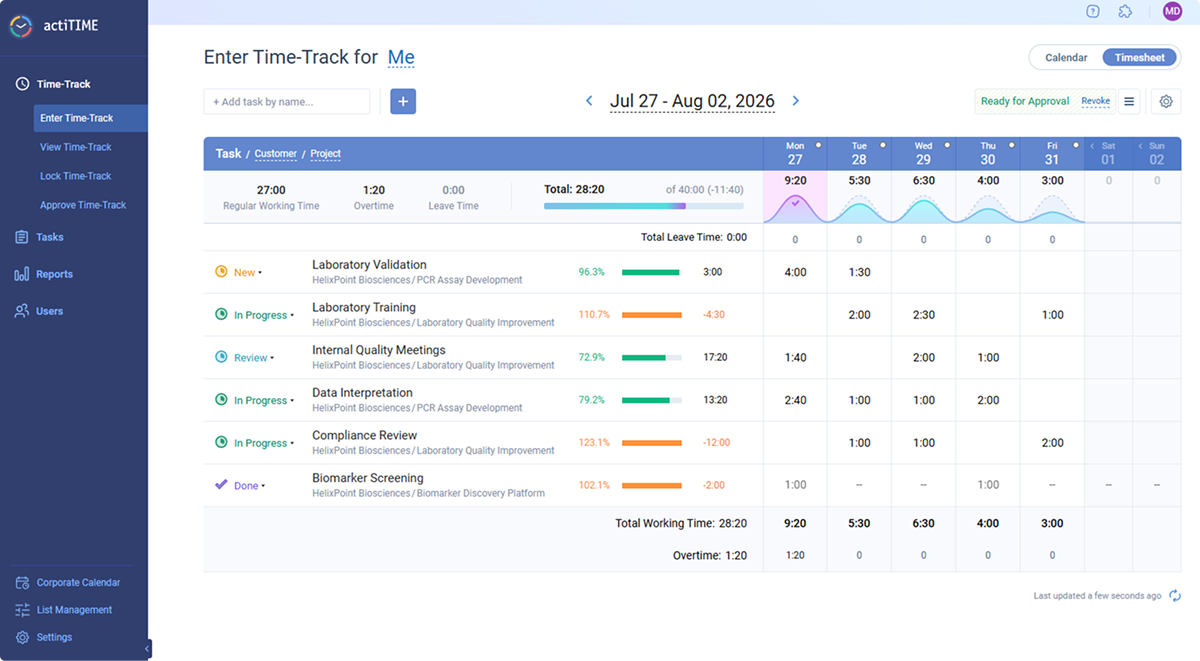
actiTIME is not an installable desktop app, and it leads this list because it is the option for teams whose hours need to turn into payroll, invoices, and project costs. People log time in a weekly timesheet or calendar view in the browser, use the mobile app on the go, or install the Chrome extension, which records browser activity automatically and syncs it to their timesheet.
For organizations whose security policies rule out cloud software, actiTIME Self-Hosted runs on your own servers with a one time license, while users still work through the browser. On the reporting side, actiTIME calculates overtime and leave costs, compares estimated with actual time, and shows profit by customer or project.
Limitation: there is no native Windows or Mac application and no automatic tracking of desktop apps outside the browser, so pair it with a tool like TimeCamp or ManicTime if you need that.
Pricing: free version for up to 3 users; online from $5 per user per month; Self-Hosted $120 per user, one time; free 30 day trial.

We reduced payroll processing to 45 minutes per week
actiTIME is very robust, integrated well into your business process, and most important, helps you focus on your business instead of monkeying around with technology. actiTIME has reduced our payroll processing from 4-6 hours per week to 45 minutes per week.
2. Clockify
Key features:
- Desktop apps for 3 platforms
- Idle detection
- Auto start and stop
- Offline mode
Clockify offers desktop apps for Windows, Mac, and Linux alongside browser extensions and mobile apps, all syncing to the same account. The desktop apps add features a browser timer cannot: idle detection, automatic start and stop, an offline mode, reminders, a default project, and a Pomodoro timer.
The free tier covers unlimited time tracking for up to 5 users. Basic costs $3.99 per seat per month billed annually, and Standard, where invoicing starts, costs $5.49.
Limitation: once a team grows past 5 users everyone needs a paid seat, and profitability reporting is basic.
Pricing: free for up to 5 users; Basic $3.99 and Standard $5.49 per seat per month, billed annually.
3. TimeCamp
Key features:
- Automatic activity tracking
- Keyword based timesheets
- Windows, Mac, Linux apps
- Free for unlimited users
TimeCamp combines a timesheet with a desktop app for macOS, Windows, and Linux that records activities such as documents, websites, and apps. You define keywords for each task, and TimeCamp detects them in window titles or URLs and assigns the time to the right project automatically, which fills timesheets with little manual work.
Its free tier covers unlimited users with timesheets and desktop and mobile apps. Invoicing starts on Starter at $3.99 per user per month billed annually, while billable rates require the Ultimate tier at $9.99.
Limitation: keyword rules take some setup before automatic assignment is reliable.
Pricing: free for unlimited users; Starter $3.99, Ultimate $9.99 per user per month, billed annually.
4. Harvest
Key features:
- Mac and Windows apps
- Keyboard shortcuts
- Idle time detection
- Invoices from tracked time
Harvest pairs its web app with desktop apps for Mac and Windows, so you can start and stop timers from the desktop instead of hunting through browser tabs. Keyboard shortcuts start timers faster, the Mac app lets you save frequent tasks as favorites, and idle time detection helps remove time when a timer was left running.
Tracked hours flow into Harvest’s invoicing, which is its main strength. The free tier covers one seat and two projects with invoicing included; the Teams tier costs $9 per seat per month billed annually ($11 monthly). There is a free 30 day trial.
Limitation: the desktop apps are timers only; there is no automatic activity tracking, and the free tier stops at two projects.
Pricing: free for 1 seat and 2 projects; Teams $9 per seat per month, billed annually; 30 day trial.
5. Tyme
Key features:
- Mac, iPhone, iPad, Apple Watch
- Projects and tasks
- Project budgets for teams
- Sync across devices
Tyme is a time tracking app built for the Apple ecosystem, with apps for Mac, iPhone, iPad, and Apple Watch and a web app in beta. It suits freelancers and small teams who want a native Mac experience, with projects, tasks, and, for teams, combined working hours, workloads, and project budgets.
Every plan includes all devices and sync. A user costs €4.99 per month billed annually (€59.99 a year) or €6.99 billed monthly, and there is a 14 day free trial.
Limitation: it is Apple only, so mixed Windows and Mac teams need another tool; for other Mac picks, see our timesheet apps for Mac.
Pricing: €4.99 per user per month, billed annually; €6.99 monthly; 14 day trial.
6. WorkingHours
Key features:
- One click timer
- Earnings and overtime
- Sync via your own cloud
- No account needed
WorkingHours is a personal time tracker for Windows, Mac, iPhone, iPad, and Android. You start, pause, and stop a timer in one click, organize time by client, task, hourly rate, and overtime, and export to Excel or CSV, or create PDF invoices through its companion app SubTotal.
It needs no account. If you want sync across devices, it uses your own storage (OneDrive, Google Drive, Dropbox, iCloud, or WebDAV) rather than its own servers. On Windows it offers an overlay timer window and desktop idle detection.
Limitation: it is built for individuals, with no team management or approvals.
Pricing: free version; Pro is a one time purchase per platform.
Automatic activity trackers
These record which apps, windows, and websites are active without any input, then let you sort that log into projects. This is the type most people mean by a computer time tracker. For a wider list that includes browser based tools, see our roundup of automated time trackers.
| Tool | Platforms | Starting price |
|---|---|---|
| ActivityWatch | Windows, Mac, Linux, Android | Free, open source |
| Timing | Mac only | From €8 per month, billed annually |
| ManicTime | Windows, Mac, Linux, Android, iOS | Cloud from $9 per month, billed monthly |
7. ActivityWatch
Key features:
- Automatic app and window tracking
- Browser extensions
- Data stays on device
- Open source
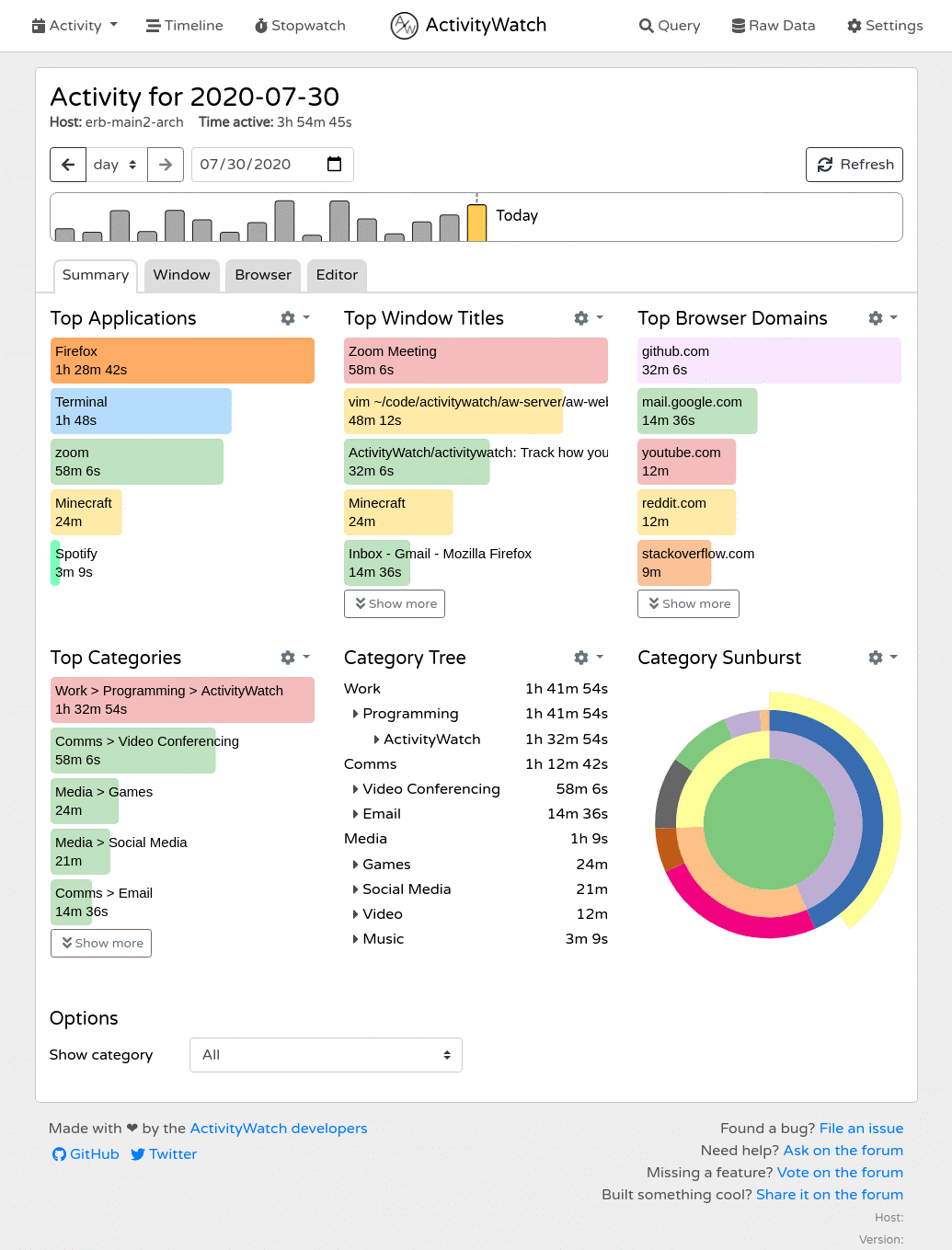
ActivityWatch is a free, open source time tracker that records computer activity, released under the MPL-2.0 license for Windows, macOS, Linux, and Android. Out of the box it records the active application and window title, and extensions for Chrome and Firefox add the active browser tab; editor plugins can also log time spent writing code.
All data stays on your own device, so nothing leaves your computer unless you choose to export it. For more free options of this kind, see our list of open source time tracking software. It is also extensible, so technically minded users can add their own watchers for other kinds of activity.
Limitation: it is a personal tool with no timesheets, invoicing, or team features, and the reports take some learning.
Pricing: free.
8. Timing
Key features:
- Automatic Mac tracking
- Timers and manual entries
- Meeting detection
- Client ready reports
Timing is an automatic time tracker built only for the Mac. It records the apps and websites you use, detects meetings, and lets you assign blocks of activity to projects afterward, alongside timers and manual entries. Entries can be marked as billed or unbilled, and reports can be sent to clients.
The Professional edition covers one Mac and costs €10 per month billed monthly or €8 billed annually, according to the pricing page we checked. Expert and Connect editions add filters, scripting, team features, and more devices. Our list of timesheet apps for Mac compares it with other Mac options.
Limitation: it is Mac only, and invoicing needs a separate app.
Pricing: Professional from €8 per month, billed annually.
9. ManicTime
Key features:
- Automatic tracking
- Tagging for billing
- Optional screenshots
- Cloud or self hosted server
ManicTime records computer use automatically and asks you to tag time afterward, for example marking a stretch away from the desk as a project discussion or as personal time. It runs on Windows, Mac, Linux, Android, and iOS, with multi device reports available through ManicTime Cloud or a self hosted ManicTime Server.
For individuals, the cloud Standard plan costs $9 per month billed monthly and covers 3 devices; Ultimate costs $11 and adds two more devices and screenshots in the cloud. Licenses are issued per user and work across multiple machines, and there is a 30 day free trial. Team and non cloud options are also available. It also appears in our roundup of time tracking software for Windows.
Limitation: tagging time is quick but still a daily habit, and the interface is dense for casual users.
Pricing: cloud Standard $9 and Ultimate $11 per month, billed monthly; 30 day trial.
What about employee monitoring and time clocks?
Two kinds of tools also run on the desktop but solve different problems. Employee monitoring software tracks time automatically on staff computers and adds app and website logs, screenshots, and activity levels; it suits remote teams that need proof of activity, and we compare those tools in our guide to the best employee monitoring software. Time clock software records attendance, when people start and stop work, rather than what they worked on; see our list of the best free time clock software.
If you are unsure which you need, ask what the hours are for. Billing and project costs call for a timesheet app, attendance and payroll for a time clock, and proof of activity for a monitoring tool.
FAQ
Is there a good desktop app for tracking time?
Yes. For a free personal tracker, ActivityWatch records computer activity automatically and keeps data local. For a team timesheet with desktop apps, Clockify and TimeCamp both have free tiers. For a native Mac timer, Tyme or Harvest. If hours need to become payroll, invoices, and project costs, actiTIME covers that through the browser and mobile apps.
How do you track screen time on a desktop computer?
Install an automatic tracker that records the active app and window. ActivityWatch does this for free on Windows, Mac, and Linux, and Timing does it on the Mac with project assignment built in. Both show daily and weekly charts of where your time went.
Does Microsoft have a time tracking tool?
Windows does not include a standalone time tracker for work hours. Most people install a third party app; WorkingHours, Clockify, TimeCamp, and Harvest all offer Windows desktop apps.
Conclusion
Choose a desktop time tracker or computer time tracker by what you want it to record. A timer or timesheet app logs the work you choose to track, and an automatic tracker logs everything and lets you sort it later. If the hours need to turn into payroll, invoices, and project costs, that last step matters more than how the time was captured.
To see how actiTIME turns tracked hours into cost and profit reports, start a free trial.