You plan the day, and by 11 a.m. the plan is gone: a meeting ran long, five chats need answers, and the report you meant to start is still a blank page. Most people blame themselves for this. More often, one or two specific time management problems are doing the damage, and each one has a fix.
The most common time management problems are poor prioritization, constant interruptions, unrealistic time estimates, procrastination, perfectionism, taking on too much and not knowing where your time actually goes. They usually come from unclear goals, a reactive work environment and the absence of any feedback on how time is spent.
Below you will find a quick diagnostic table, the causes and warning signs of poor time management, and 20 problems with practical solutions for each.
- Find your time management problem
- What causes poor time management
- Signs you have a time management problem
- 20 time management problems and solutions
- Being a perfectionist
- Not being able to concentrate
- Scheduling tasks ineffectively
- Not tracking time
- Lack of vision
- Never thinking about tomorrow
- No regular time review
- Not coping with stress
- Not practicing attention management
- Doing everything on your own
- Being bad at estimating time
- Being busy instead of effective
- Not mastering your skills and tools
- Not managing distractions
- Routines instead of habits
- Avoiding automation
- Not breaking down big projects
- Overloading your working memory
- Being unmotivated
- Not using technology well
- Time management problems in teams
- FAQ
Find your time management problem
Start with the symptom you notice most, then jump to the matching section. Most people recognize themselves in two or three rows; fix one at a time.
| If you notice this | The likely problem | First fix to try |
|---|---|---|
| You polish work long after it is good enough | Perfectionism | Agree on “done” before you start |
| You reread the same paragraph three times | Poor focus | One task, one tab, a timer |
| Your plan collapses before lunch | Ineffective scheduling | Plan six ranked tasks the evening before |
| You cannot say where last week went | Not tracking time | Track every task for one week |
| Your work feels pointless | Lack of vision | Link each task to a goal |
| Every day starts with a surprise | No forward planning | Seven minutes of planning each evening |
| The same mistakes repeat every month | No regular review | A 15 minute review every Friday |
| Deadlines make you freeze | Stress | Write down your stressors for two weeks |
| You are busy all day but never in flow | No attention management | Protect one focus block a day |
| Nothing moves unless you do it | Not delegating | Hand off one recurring task this week |
| Tasks always take longer than planned | Bad estimates | Calculate your estimate ratio |
| Inbox zero, but no progress | Busy, not effective | Pick three results for the week |
| Simple tasks take you ages | Weak skills or tools | Learn the shortcuts of your main tool |
| Colleagues and pings break up your day | Unmanaged distractions | Set fixed times for chat and email |
| Good routines last a week, then fade | Routines, not habits | Tie the routine to a fixed trigger |
| You do the same manual steps every day | Avoiding automation | Automate your most repeated task |
| A big project keeps getting postponed | Projects too big to start | Define a first step under 30 minutes |
| You keep forgetting small things | Working memory overload | Move every open loop into one list |
| You cannot make yourself start | Low motivation | Turn a vague goal into a specific one |
| Apps steal more time than they save | Poor use of technology | Keep one calendar and one task tool |
What causes poor time management?
Poor time management is rarely laziness. In most cases it comes from a handful of conditions that make good choices hard:
- Unclear goals. If you cannot say what this week is for, every request looks equally important.
- A reactive work environment. Microsoft’s 2025 Work Trend Index, based on Microsoft 365 usage signals, found that employees are interrupted every two minutes during core work hours, 275 times a day, by meetings, emails or chats. It also found that the average worker receives 117 emails a day.
- The pull of urgency. Experiments by Zhu, Yang and Hsee (2018) showed that people choose urgent but unimportant tasks over important ones with a better payoff, an effect they called the mere urgency effect.
- Optimistic estimates. People consistently underestimate how long their own tasks will take, which researchers call the planning fallacy.
- No feedback. Without data on how time was actually spent, you cannot see which habit costs the most.
- Personal factors such as stress, poor sleep, low motivation or, for some people, attention difficulties that deserve a conversation with a doctor rather than another productivity app.
The good news is that time management skills can be learned, and they matter. A 2021 meta-analysis of 158 studies with 53,957 participants found that time management is moderately related to job performance and wellbeing and has a moderate negative relationship with distress. Read more facts like this in our article on the importance of time management.
Signs you have a time management problem
If you are asking yourself “why is my time management so bad?”, check how many of these apply to you:
- You regularly miss deadlines or meet them by working late.
- You start the day without knowing your top three tasks.
- You spend more time reacting to messages than doing planned work.
- Your estimates are wrong in the same direction every time.
- You feel busy all week but struggle to name what you finished.
- Important but not urgent work (planning, learning, improving processes) never happens.
- You feel stressed on Sunday evening about the week ahead.
Three or more ticks usually point to one root problem that feeds the others. The sections below show how to fix each one.
20 time management problems and solutions
Each problem below comes with an explanation of why it happens and solutions you can test this week.
1. Being a perfectionist
Perfectionism cuts both ways. Perfectionists often produce careful, high quality work, but rigid standards and all or nothing thinking lead to stress and missed deadlines. The cost shows up as time: hours spent improving work that was already good enough.
Solutions:
- Define “done” before you start. Agree on the level of quality the task needs with whoever asked for it, then stop when you reach it.
- Ask yourself one question when you notice yourself polishing: “Will anyone notice the difference?” Several good enough tasks often bring more results than one perfect one.
- Review your work weekly. Which tasks could you have finished faster with no damage to the outcome? Which did you avoid because you were afraid of making a mistake?
- Show drafts early. Sharing work with your manager at 70% tells you whether the current quality is enough and saves you from polishing the wrong thing.
2. Not being able to concentrate and maintain focus
You read a paragraph three times and still cannot say what it says. You open the report, check a message, open the report again. Focus is now a scarce resource at work: UC Irvine researcher Gloria Mark has measured how long people stay on one screen before switching, and the average fell from two and a half minutes in 2004 to 47 seconds by 2020.
Solutions:
- Know what breaks your focus. For a few days, write down every time you switch tasks and why. Patterns appear fast: a specific chat channel, a habit of checking email after each paragraph.
- Use your peak hours for demanding work. Most people have a part of the day when thinking feels easier. Do not spend it on email.
- Single task. Close everything you do not need for the current task and start a timer; the timer is a small commitment to stay on one thing.
- Take real breaks. A short walk away from the screen resets you better than switching to social media.
- Set daily goals. Finishing a clearly defined goal gives you a sense of progress that makes the next one easier to start.
- Look after sleep and exercise. Both affect concentration, and no planning method makes up for chronic tiredness.
- Talk to a doctor if your concentration drops suddenly and stays low, you make far more errors than usual or routine tasks become hard. These can be signs of depression, anxiety or another health problem, and more time pressure will not fix them.
3. Scheduling tasks ineffectively
Effective scheduling is a large part of efficient time management. If you schedule the wrong things, or schedule the right things at the wrong time, the day fills with low value work and the important tasks slide to tomorrow.
Solutions:
- Try the Ivy Lee method. At the end of each day, write down the six most important tasks for tomorrow, rank them and work through them in order.
- Watch out for the mere urgency effect. Research shows people tend to pick urgent tasks with lower payoffs over important tasks with bigger long term consequences. Before you start a task, ask what it pays off.
- Sort your list with the Covey time management matrix: do the urgent and important tasks, schedule the important ones, delegate or limit the rest.
- Eat the frog. Do the hardest important task first thing in the morning, the one you are most likely to postpone and most likely to make a difference.
- Block time in your calendar. Time blocking turns a priority list into appointments with yourself.
For 10 methods with free worksheets, see our guide on how to prioritize tasks.
4. Not tracking time
You cannot improve how you use time if you do not know how you use it. Time tracking sounds tedious, but after a week or two it shows patterns you would never guess: how much of the day goes to calls, email, meetings and context switching.
Solutions:
- Pick a tool that fits how you work: a timesheet app, a mobile app, a browser extension or even a stopwatch.
- Choose software that does not overwhelm you. If logging time takes more than a minute or two a day, you will stop doing it.
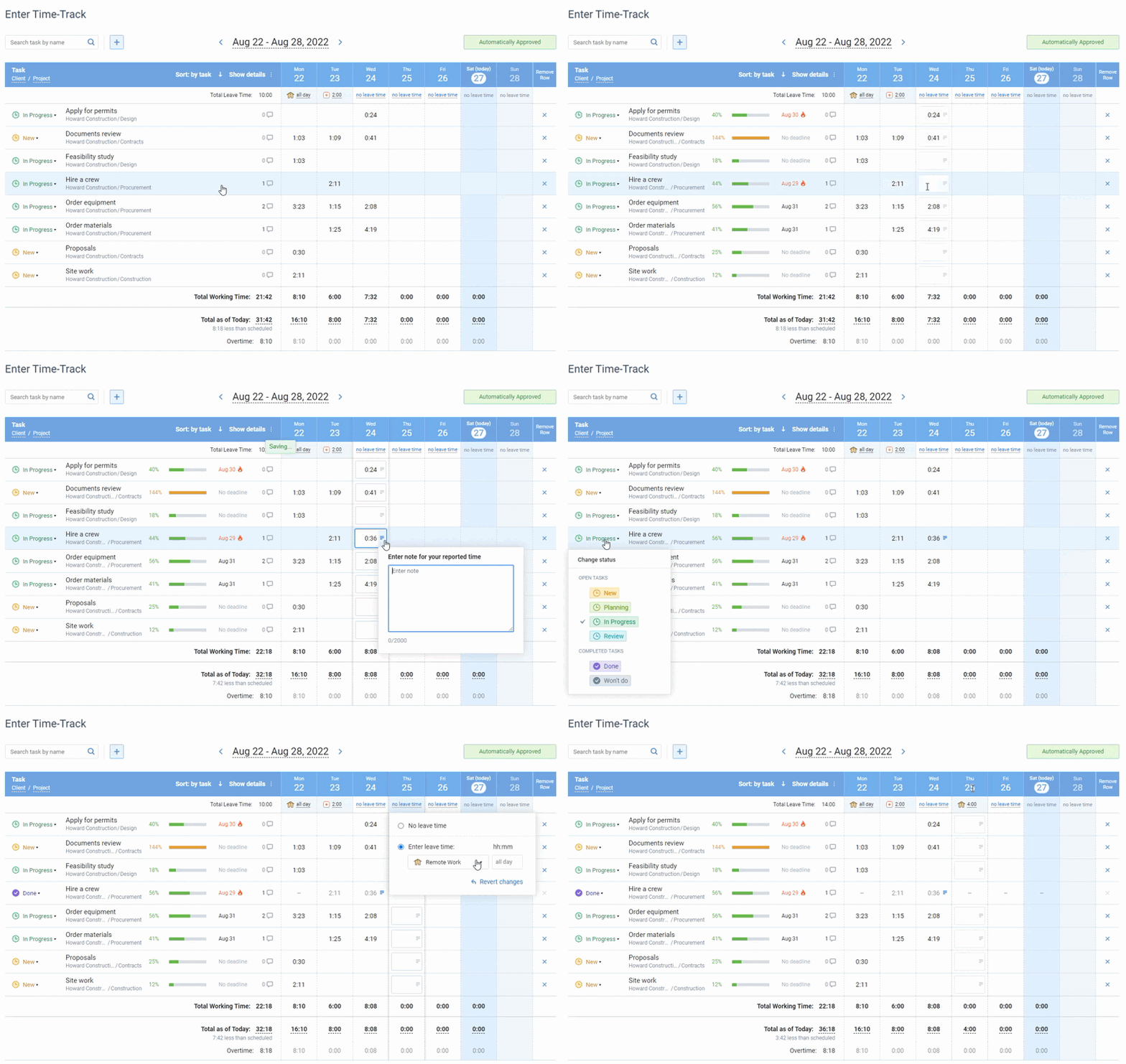
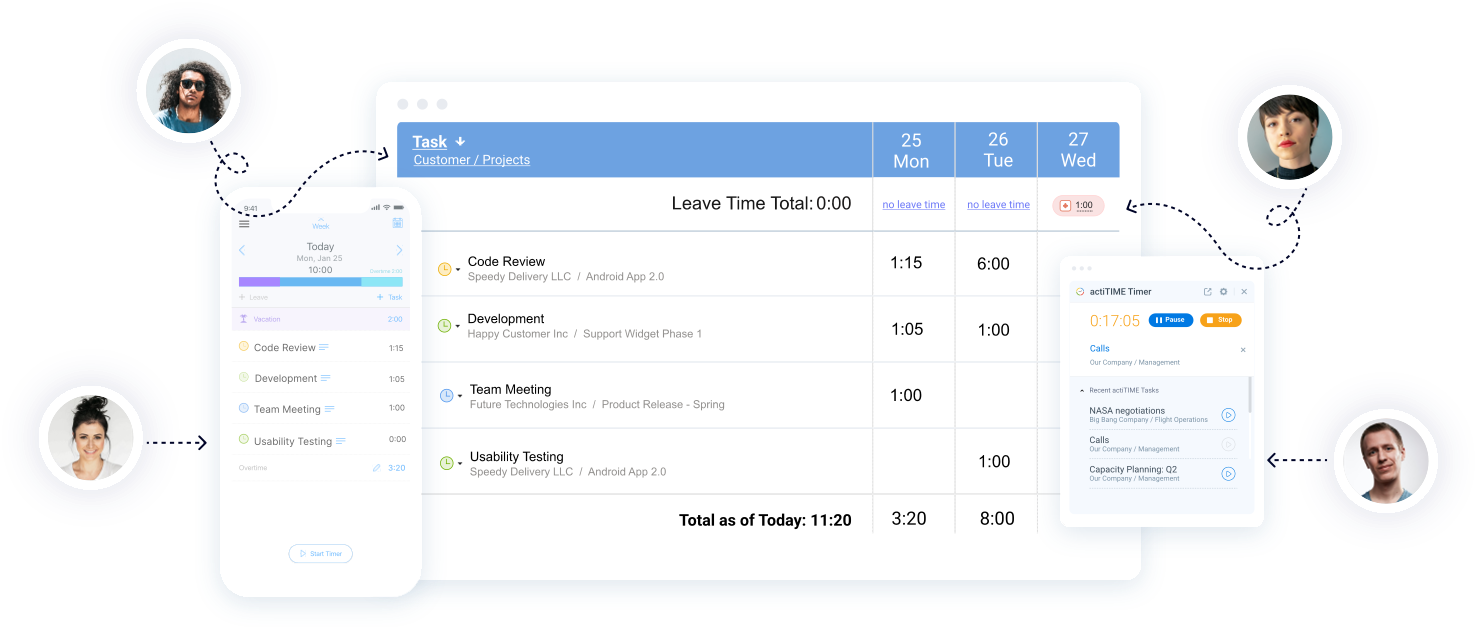
Online timesheet interface in actiTIME, where every user can select the task parameters they want to see in their timesheet
- Track the small things too: calls, meetings, breaks, time lost to distractions. They add up faster than big tasks.
- Review your data regularly. Excel, free timesheet templates or a time tracker with reports all work, as long as you look at the numbers once a week.
If you want a structured start, our guide on how to improve time management walks through a one week time audit.


5. Lack of vision
There is little point in mastering time management if you do not know where you are heading. When your tasks are not connected to anything you care about, every one of them feels like a chore, and chores are easy to postpone.
Solutions:
- Get the bird’s eye view. For each big task, write one line on how it supports a personal or team goal. If you cannot write that line, question the task.
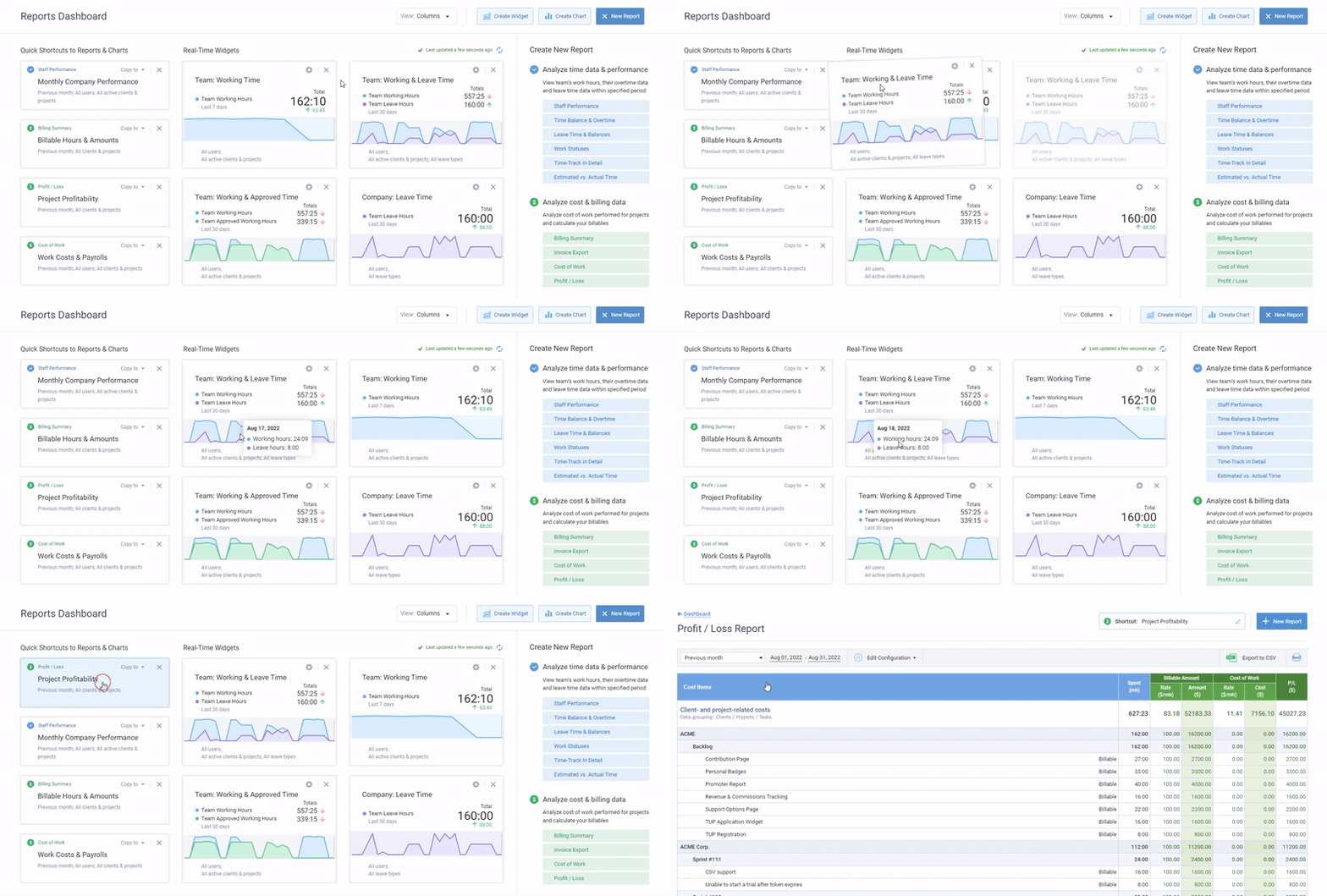
Reports dashboard in actiTIME: set up real time data widgets and add report shortcuts for quick access
- Find your time wasters. Compare how you spend your week with what you said matters. The gap is where your time leaks.
- Prepare a contingency plan. Things rarely go as expected, so think through a plan B for your most important work before you need it.
6. Never thinking about tomorrow
If every day starts with a surprise, you are only reacting. Thinking one day and one week ahead lets you see what is coming, prepare for it and work steadily instead of in bursts.
Solutions:
- Ask how today’s work affects tomorrow. Will today’s project tasks create work for next week? Adjust your plan when circumstances change.
- Break projects into tasks and track their progress with charts, reports or progress bars.
- Use the seven minute rule: seven minutes in the morning to plan the day and seven minutes in the evening to review it and prepare tomorrow.
- Learn from your past performance. Estimate tasks, set deadlines and track time against them. When a task is done, compare the plan with the result.
7. Lack of regular time management review
Whether you are working on personal goals or your efficiency at work, you need to look back regularly. Daily and weekly reviews catch small problems; monthly and half year reviews show trends you cannot see from inside a busy week.
Solutions:
- Watch for the sunk cost fallacy. Continuing a low value task because you have already invested in it is still a waste. When an activity takes more time than it is worth, stop and decide again.
- Take a future time perspective. Ask how your current activity will help or hurt your next steps.
- Review your schedule three times a day: five minutes in the morning, a quick check at midday and five minutes at the end of the day.
- Keep a personal development plan with your goals and the skills you want to build, and check it monthly.
8. Not being able to cope with stress
Stress and time management feed each other. Leave a task to the last minute and you feel stressed; feel stressed and you plan worse. Not all stress is bad, but constant stress harms both health and performance.
Solutions:
- Identify your stressors. Keep a short journal for two weeks: what happened, what you felt, how you reacted. Look for patterns.
- Choose healthier responses. Exercise, sleep, hobbies and time with people help more than junk food or alcohol.
- Set boundaries. Stick to your working hours, mute work notifications in the evening and leave work at work, whether that is an office or a kitchen table.
9. Not practicing attention management
Everyone gets the same 24 hours. What you can manage is where your attention goes. Attention management is the habit of noticing what state your mind is in and deliberately shifting into the state your current task needs.
Solutions:
- Control your environment. Set your chat status to “Do not disturb”, put on headphones or close the door, whatever signals “focus time” where you work.
- Review your attention stealing habits. Background TV while working from home and answering every notification at once are the usual suspects.
- Protect one focus block a day. Two hours without meetings or chat, at the same time every day, is easier to defend than random free slots.
10. Doing everything on your own
Employee, manager or business owner, you cannot do everything yourself. Pushing harder for longer leads to stress, mistakes and lower quality work.
Solutions:
- Outsource. If you run a business and bookkeeping eats your evenings, compare the cost of an accountant with the value of the hours you would get back.
- Automate management routines. If you spend hours collecting status updates and hours for billing, a time tracking tool with reports can do much of that collection for you.
- Delegate. A marketing manager buried in meetings, interviews and reports can hand the weekly report to a reliable team member. They learn a new skill, and the manager gets time back for work that needs them.
11. Being bad at estimating time
Most of us underestimate how long our own tasks will take. Psychologists call this the planning fallacy. In a 1994 study, Roger Buehler, Dale Griffin and Michael Ross asked students to predict when they would finish their theses; on average they expected about 34 days and needed about 56 (Journal of Personality and Social Psychology). The same research found that people were not overly optimistic when predicting how long other people would take.
Common reasons for bad estimates:
- Scope creep: the task grows after you estimate it.
- Ignoring past experience: you estimate from the plan, not from how similar tasks went last time.
- Natural optimism: you picture the task going smoothly, with no interruptions.
- Pressure: you give a short estimate because that is what the manager or client wants to hear.
- Limited self awareness about your own speed, which research suggests is less accurate than most people think.
Solutions:
- Calculate your fudge ratio. Estimate a batch of tasks, track the actual time, then divide total actual time by total estimated time. If the result is 1.4, multiply your next estimates by 1.4.
- Estimate from history, not from hope. Paper or spreadsheet timesheets make this slow. Time tracking software keeps the data in one place and builds the comparison in a few clicks.
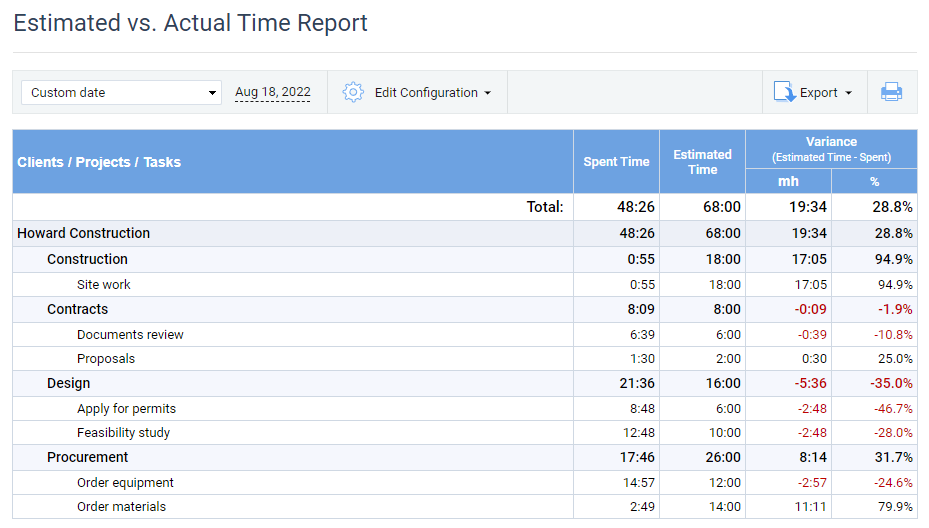
The Estimated vs. Actual Time report in actiTIME shows the variance between estimated and tracked time
- Plan for interruptions. Add a buffer for the meetings and questions that will come up, because they always do.
- Ask someone else to estimate. Since people judge other people’s tasks more realistically than their own, a colleague’s estimate is a useful check.
12. Being busy instead of effective
Being busy and being productive are different things. You can spend the whole day clearing your inbox and reshuffling your list and still finish nothing that matters. The usual causes are weak prioritization and too much planning in place of doing.
Solutions:
- Apply the Pareto principle as a rule of thumb: a small share of your tasks usually produces most of your results. Find those tasks and do them first.
- Use the 4Ds when something new lands on your desk: delete it, delegate it, defer it or do it now.
- Label tasks with the ABCDE approach: A for must do, B for should do, C for nice to do, D for delegate, E for eliminate.
- Choose three results for each day, week or month and judge yourself on those, not on hours worked.
- Try the 1-3-5 rule: one big task, three medium tasks and five small ones per day.
13. Not mastering your skills and tools
Time management advice only goes so far if the work itself takes you longer than it should. Professional skills, communication, problem solving and decision making all affect how much you get done in an hour.
Solutions:
- Review your professional skills twice a year. Which ones slow you down? Which new one would save the most time?
- Learn your tools. Email clients, task boards and industry software all have shortcuts most people never use. Even Google search tricks can save you time every week.
- Work on soft skills: taking feedback, handling conflict, adapting to change. They decide how quickly you learn everything else.
14. Not managing distractions
Distractions are not only social media and notifications. Often the biggest distraction is other work: an urgent call from a client, a colleague who needs an answer right now. You cannot block all of it without hurting the team, but you can manage it.
Solutions:
- Set boundaries. Reserve fixed times for calls and email, use chat statuses to show when you are available and schedule time for deep work.
- Hold short standups. A 10 to 20 minute daily meeting answers many of the questions that would otherwise arrive one by one.
- Learn to say no. Postpone low priority requests, explain why and offer an alternative time.
- Schedule work and personal time. Put fixed commitments (meals, commute, sleep), self care and free time in your calendar first, then fit work around them.
15. Doing routines instead of habits
Routines and habits are both repeated actions, but they cost different amounts of effort. A habit runs with little conscious thought: buying coffee on the way to work. A routine still needs willpower each time: going to the gym after work. Routines that never become habits tend to fade. You can turn routines into habits on purpose.
Solutions:
- Build a habit loop: a trigger, the routine and a reward. Example: after the 10 a.m. standup (trigger), turn off notifications and work on your hardest task (routine), then take lunch (reward). James Clear’s book Atomic Habits covers the approach in depth.
16. Avoiding automation
Almost every job has repetitive steps that software could do. If you copy the same data into three tools every week, that is time you will never get back.
Solutions:
- Improve routine tasks first. If email takes an hour a day, try templates, filters, a daily inbox cleanup and unsubscribing from newsletters in bulk. If prospecting is part of your job, an email finder removes the back and forth between LinkedIn, company sites and your CRM.
- Automate management routines. Time and project management tools can calculate billable amounts, prepare reports and keep track of absences, so the data lives in one place.
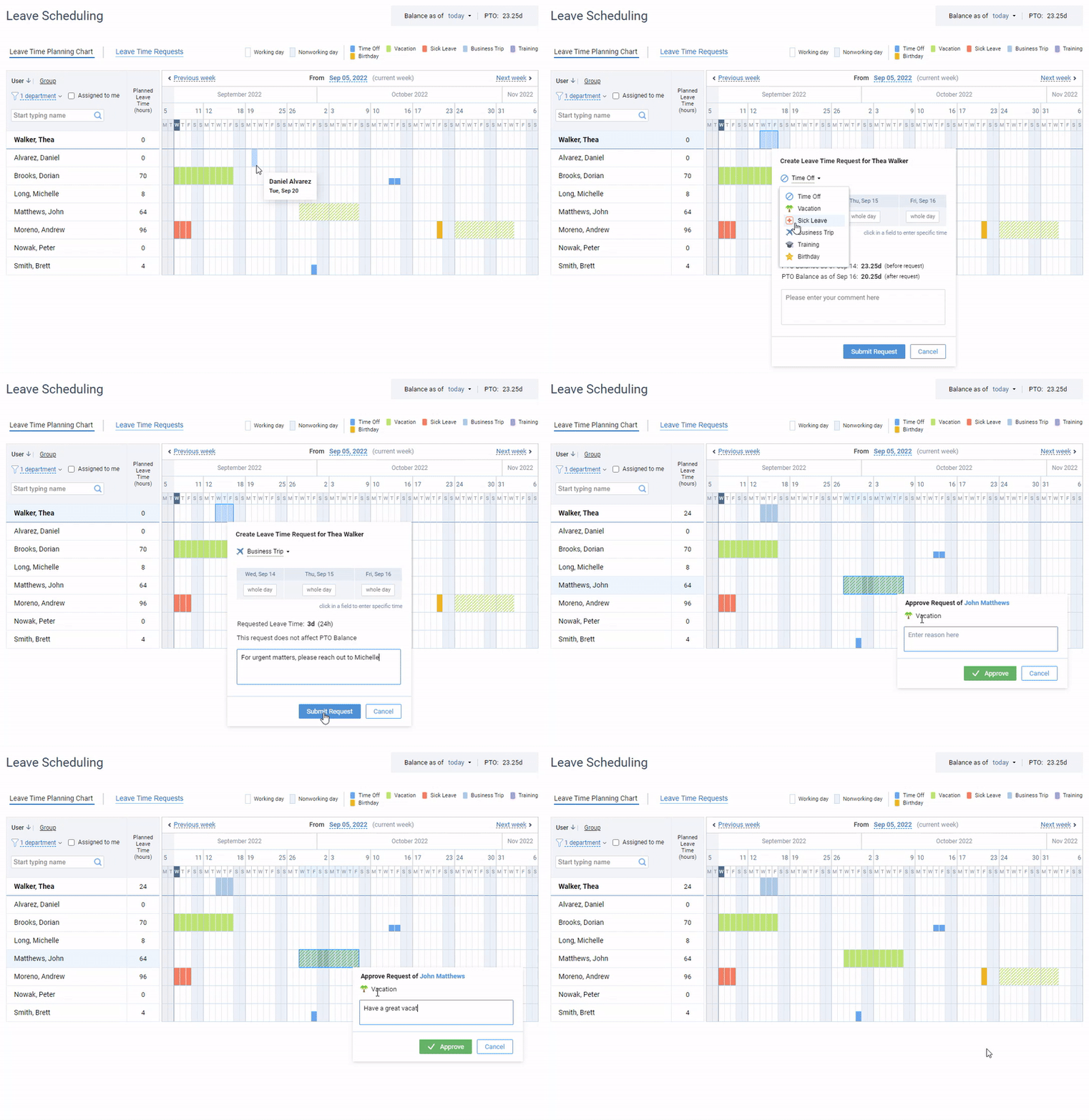
Leave management in actiPLANS: create leave types, let your team request time off and review employee availability
17. Not breaking down big projects
Big projects look overwhelming, and overwhelming tasks invite procrastination. Split into small parts, the same project feels doable, progress becomes visible and each finished piece gives you a reason to continue.
Solutions:
- Break it down into steps you can finish in 20 to 30 minutes, even if they look trivial. This works especially well with short work intervals like the Pomodoro technique.
- Work in a logical order. Easy tasks are tempting, but following the sequence gets you to the goal faster.
- Make progress visible. Use a checklist, as in The Checklist Manifesto, or a Kanban board.
If a big task keeps slipping because you dread starting it, our article on procrastination goes deeper.
18. Overloading your working memory
Working memory, the mental space where you hold what you are thinking about right now, is small. Psychologist Nelson Cowan’s review puts its typical capacity at three to five meaningful items for adults. Every open loop you try to remember competes with the task in front of you.
Solutions:
- Use external storage. Put everything you are not working on right now into notes, a task app or a single list, and trust it.
- Park future ideas in a shared space. If ideas about your next project keep interrupting the current one, write them into a shared document or board and ask the team to add to it. The ideas keep developing without taking up your attention.
- Reduce trivial decisions. Standard templates, fixed meeting days and a set lunch routine leave more energy for decisions that matter.
19. Being unmotivated
Motivation and goals are closely linked. According to goal setting theory, developed by Edwin Locke and Gary Latham, specific and difficult goals lead to higher performance than vague goals such as “do your best”. A specific goal tells you what to focus on; a difficult but attainable one calls for effort and persistence.
Solutions:
- Rewrite vague goals as specific ones. “Launch the new project” becomes “send the project brief to the client by Thursday”.
- Look further ahead. Even if the current project bores you, think about what it will let you do next.
- Use small wins. Breaking long projects into short goals gives you a steady sense of progress, which makes it easier to keep going.
20. Not taking technology along
Technology creates many of today’s distractions, and it also offers some of the best tools for better time management. The trick is to make apps work for you rather than the other way around.
Solutions:
- Plan your day in one calendar. Break the day into blocks, leave buffers between them and work through the schedule in order.
- Experiment with time trackers. Keep two tests in mind: the benefit must outweigh the cost, and the time saved must outweigh the time spent using the app.
- Consider project management tools if you lead a team. Many combine task tracking, time tracking and reports in one place, which cuts the time spent chasing status updates.
Time management problems in teams
Some time management problems are not personal at all. They come from how a team works, and no amount of individual discipline fixes them. The most common ones:
- Meeting overload. In an Atlassian survey of 5,000 knowledge workers, 78% said they are expected to attend so many meetings that it is hard to get their work done. Fix: give every recurring meeting an owner and an agenda, and cancel one in three for a month to see what breaks.
- Unclear priorities between managers. When two leads each call their request the top priority, the team member pays. Fix: one visible priority list per team, agreed weekly.
- Unrealistic deadlines. Estimates made without data lead to overtime and missed dates. Fix: compare estimated and tracked hours after each project and use the ratio for the next one.
- Constant chat interruptions. Fix: agree on response times by channel, for example chat within two hours and email within a day, so focus time is normal rather than rude.
- Uneven workload. Some people are overloaded while others wait. Fix: review tracked hours by person every week or two and rebalance assignments.
Time tracking helps here because it turns opinions into numbers. In actiTIME, team members log time against customers, projects and tasks, and managers compare the results with estimates and time budgets in reports.
FAQ
What are the most common time management problems?
The problems people report most often are poor prioritization, frequent interruptions, procrastination, perfectionism, underestimating how long tasks take, taking on too much and not tracking where time goes. In teams, meeting overload and unclear priorities are common too.
What causes poor time management?
Usually a mix of unclear goals, a reactive environment full of interruptions, optimistic estimates and no feedback on how time is actually spent. Stress, poor sleep and low motivation make all of these worse.
Why is my time management so bad?
Most often because you are reacting to the day instead of planning it, and because you do not have data on where your time goes. Track your time for one week, find the single biggest leak and fix that first instead of trying ten techniques at once.
How do you solve time management problems?
Identify the specific problem first (the table at the top of this article helps), choose one fix, test it for two to four weeks and measure the result. Time tracking data makes it clear whether the fix worked.
Is poor time management a skill problem or a personality trait?
Mostly a skill problem. Research reviewed in a 2021 meta-analysis shows that time management behaviors are linked to performance and wellbeing, and these behaviors, such as planning, prioritizing and monitoring time, can be learned. If focus problems are sudden or severe, talk to a doctor.
What are the effects of poor time management at work?
Missed deadlines, rushed work and more mistakes, longer hours, higher stress and less time for planning and learning. For teams and businesses, it also means unreliable estimates, budget overruns and lost billable time.
Fix one problem at a time
Nobody is productive all the time, and you do not need to fix 20 problems at once. Pick the one that costs you most, measure it, change it and measure again. You cannot improve what you do not measure, so start with time tracking.
actiTIME connects tracked hours to tasks, estimates and project budgets, with reports that show where time goes across your team.
Start a free 30-day trial, no credit card required, or book a demo if you want a walkthrough.