



Every law firm runs on matters – cases, engagements, client files, however your firm labels them – and how well you organize work around them affects everything downstream: which hours get billed to which client, how accurately you can price similar work next time, and whether a client’s invoice holds up to scrutiny. Matter management software exists to solve this, and it’s worth understanding what that term actually covers before deciding what your firm needs.
This guide covers what matter management means, why organizing time and billing by matter matters even if you’re not running a full case management platform, and how actiTIME’s customizable work structure and custom fields let you do exactly that.
What is matter management?
Matter management refers to how a law firm organizes, tracks, and reports on the work behind each case or client engagement – a “matter” being the general legal term for a case, file, or piece of work handled for a client. Full legal matter management platforms typically bundle several things together: document storage, deadline and calendar tracking, conflict checking, client communication, and billing, all tied to the matter record.
That’s a lot of ground, and not every firm needs all of it in one platform. A meaningful part of matter management – the part this article focuses on – is narrower and more specific: organizing your time tracking, custom categorization, and billing data by matter, so you can answer questions like which cases are actually profitable, how much time a given practice area consumes, and whether your invoices hold up to a detailed client review.
Why matter-level organization matters for billing
Law firms typically operate on a billable-hour model, and clients – especially corporate and insurance clients – increasingly expect time to be categorized in specific ways:
- Litigation and billing codes. Corporate and insurance clients often require time to be coded using standardized systems like UTBMS codes, so they can audit how outside counsel spends billable time across matter types.
- Practice area reporting. Knowing how much time and revenue comes from each practice area helps a firm see where it’s actually strong, not just where it’s busy.
- Profitability by matter type. Without matter-level structure, it’s hard to tell whether a given type of case is worth taking on again at the rates you’re charging.
- Billing disputes. A time entry that’s only tagged to a generic project, without matter-specific detail, is harder to defend if a client questions an invoice.
None of this requires a full case management overhaul – it requires your time tracking tool to support the same structure and categorization your firm already thinks in.
How actiTIME organizes your firm’s matters
actiTIME organizes work in a three-level hierarchy, and all three level names are configurable – instead of the generic default (Customer / Project / Task), most law firms rename it to something like Client / Case / Task, so the structure matches how the firm already talks about its work.
On top of that structure, custom fields let you attach whatever categorization your firm actually needs – UTBMS codes, practice areas, referral sources, or anything specific to your firm. Fields can be text, dropdown, or numeric, and once they’re set up, every task can carry that data alongside its time entries.
If most of your matters share a category – say, the same practice area – you can set a default value so new tasks don’t need it assigned manually every time. Fields you don’t need on a given task can just be left as “None.”
Matter organization also extends to how you separate billable from non-billable work. actiTIME’s Types of Work let you define which categories are billable, at what rate, and roll that straight into cost and billing reports – so a conference call that’s billed to the client and an internal team meeting that isn’t can sit in the same matter structure without getting mixed together in your numbers.
Reports built around your matter structure
Once time is tracked with matter-level structure and custom fields, actiTIME’s reports let you actually use that data instead of just storing it.
The Custom Fields Report is the one most directly tied to matter management: it lets you analyze performance data across whatever custom categories you’ve set up – practice area, litigation code, referral source – so you can see, for example, which practice areas are the most time-consuming or which case types your firm has the deepest experience in.
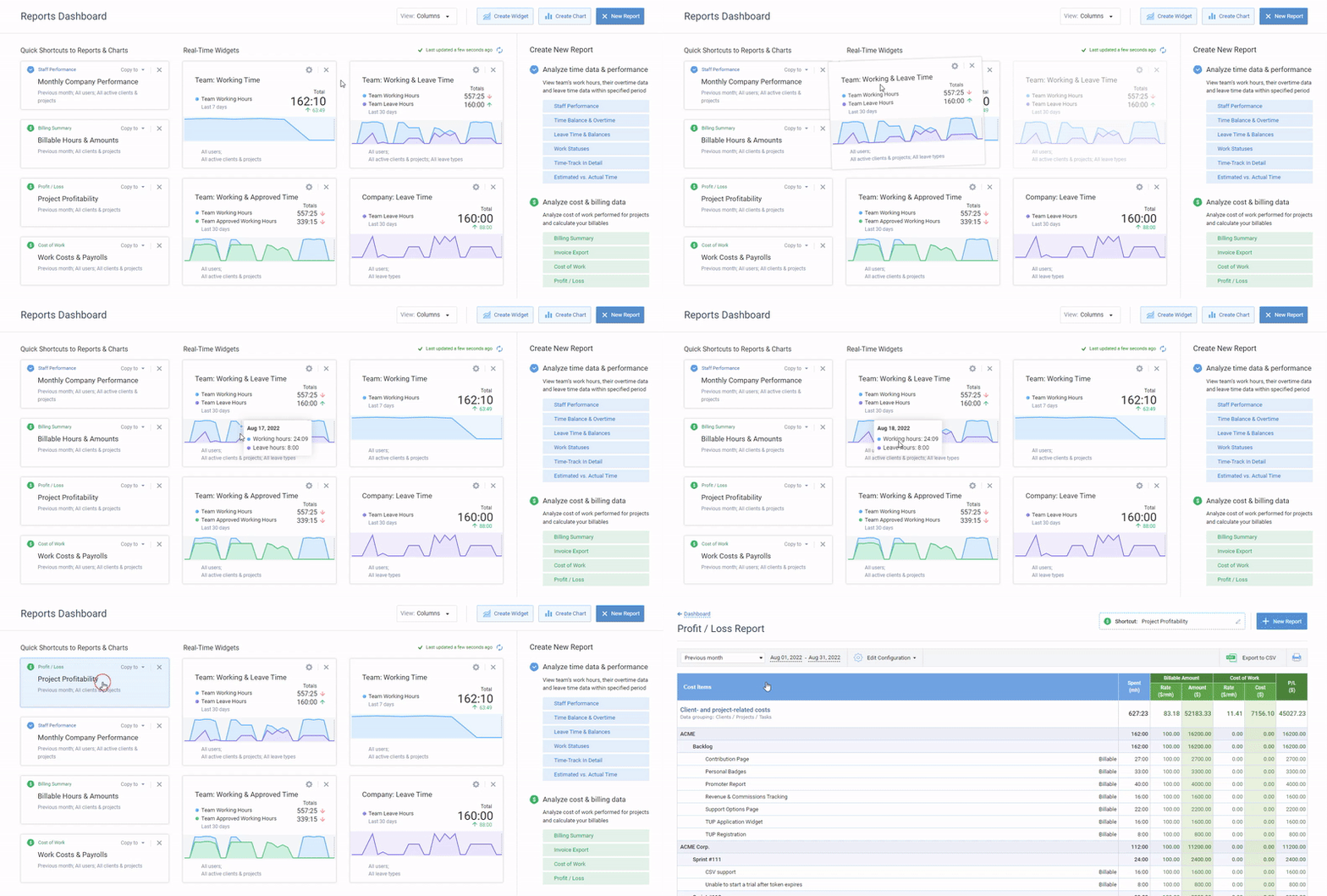
The Billing Summary Report works alongside it, showing billable amounts by period, customer, or project once hourly rates are set – useful for reconciling what a matter actually generated against what it cost to run. Between the two, a firm can see both how time breaks down by matter category and what that time is worth financially, without needing a separate business intelligence tool layered on top.
What else your firm might need
Plenty of firms run their matter-level time tracking and billing entirely in actiTIME and don’t need anything more – the structure, custom fields, and reports above cover a real chunk of what “matter management” means in practice. But depending on your firm’s size and workflow, a few adjacent needs are worth knowing how to fill:
- Document management and e-signatures. If your matters generate a lot of shared documents, a dedicated document management or case management platform may be worth pairing alongside actiTIME rather than trying to store files in a time tracker.
- Court deadlines and calendaring. Rules-based legal calendaring (extracting deadlines from court documents automatically) is a specialized feature that dedicated legal calendaring tools or full case management platforms handle; actiTIME’s own calendar view is built for logging time, not tracking statutory deadlines.
- Conflict checking. Screening new matters against existing clients and parties is a compliance feature specific to legal case management software, not something a time tracker is built to do.
- Leave and schedule management. If you need to manage PTO, shift schedules, and team availability beyond what actiTIME’s own leave tracking covers, the actiPLANS integration extends that specifically.
actiTIME connects to over 2,000 apps via Zapier, plus a direct QuickBooks integration for accounting, tax, and payroll data – so if you do run a fuller case management platform alongside actiTIME, the two can generally be connected rather than run as completely separate systems.
FAQ
Isn’t this the same as case management?
The two terms are often used interchangeably, and there’s no strict industry-wide distinction. In practice, “case management” is used more often for litigation-specific work (tracking a case through a court process), while “matter management” is the broader term covering any client engagement – litigation, transactional, advisory. Most legal software marketed under either name covers similar ground: organizing work, documents, and billing around a client matter.
Do I need a separate system for this if I’m already using actiTIME?
Not necessarily. If your main needs are organizing time and billing by matter, actiTIME already covers that on its own. A separate, fuller matter or case management platform becomes worth the added cost and complexity mainly when you also need document management, deadline tracking, or conflict checking in the same system.
Is matter-level tracking only useful for firms that bill by the hour?
No. Even on flat-fee or contingency matters, tracking time by matter shows you whether the fee you charged actually covered the work – information an hourly invoice doesn’t force you to look at, but that every firm needs before quoting the next flat-fee matter.
Ready to organize your firm’s matters?
Matter management doesn’t have to mean replacing your entire workflow with a new all-in-one platform. For many firms, it means making sure time tracking, billing, and reporting are organized around the same matter structure the firm already thinks in – which is exactly what actiTIME’s work structure and custom fields are built for.
actiTIME has law firms and individual attorneys among its clients. Start a 30-day trial (no credit card required) to see how it fits your firm’s matters.