



Attorneys lose billable time in small pieces throughout the day – a five-minute call here, a hallway conversation there – and by the time anyone sits down to reconstruct the day, most of it is gone. The Legal Trends Report puts a number on this: attorneys bill only 2.9 hours out of an 8-hour workday on average, and manual, end-of-day reconstruction is a big part of why.
This guide looks at attorney time tracking software from the attorney’s own seat – someone working inside a firm, not necessarily choosing the firm’s billing system, but trying to stop personally losing track of billable hours between calls, court appearances, and everything else that pulls attention away from a timer. Below are 16 tools worth knowing about – some are dedicated legal time tracking software, others are general-purpose trackers attorneys use anyway – most built around capturing time automatically or with minimal manual effort.
Why attorneys personally lose billable time
Time tracking for attorneys is rarely a technology problem first – it’s a habit problem. Legal work is naturally fragmented: a call taken between meetings, a question answered in the hallway, research that starts and stops across a day in court. None of that fits neatly into a timer that has to be started and stopped on purpose, so the easiest thing to do is push it to the end of the day – and by then, the details are already fuzzy.
A few patterns show up again and again in how individual attorneys lose time:
- Task-switching without logging. Moving from a call to an email to a document review rarely comes with a mental note to update a timer, so the transition itself is where minutes disappear.
- End-of-day or end-of-week reconstruction. Trying to remember Tuesday’s work on Friday means guessing at durations, which tends to understate time rather than overstate it.
- Time spent away from a desk. Court appearances, client meetings, and travel are exactly the moments a desktop timer doesn’t cover, and mobile logging often gets skipped in the moment.
- Short tasks that feel not worth logging. A two-minute email reply seems too small to record individually, but these add up across a caseload.
None of this is about a firm’s billing policy being wrong – it’s about the mechanics of a single attorney’s day working against manual time entry. That’s the gap the tools below are meant to close.
What to look for in attorney time tracking software
Whether you’re picking a personal tool to use inside a firm that already runs its own practice management system, or choosing something for a solo practice, the same handful of things determine whether you’ll actually use it every day.
Ease of use
The software should have an intuitive design that lets an attorney log hours without extensive training – anything that takes more than a few seconds of thought per entry tends to get skipped on a busy day.
Real-time or automatic capture
The ability to start and stop timers as work happens matters, but automatic or passive capture matters more: software that reconstructs a timeline from calendar events, emails, or app activity in the background catches the minutes a manual timer misses.
A genuine lawyer time tracking app, not just a mobile-friendly website
Given how much legal work happens away from a desk – court, client meetings, travel – a dedicated mobile app that works offline and syncs later matters more here than in most other professions.
Categorization and tagging
Being able to tag time by matter, client, or activity type makes it possible to review where time actually goes, not just how much of it was logged.
Reminders that fight procrastination
Alerts or nudges to log time regularly help counteract the natural pull toward end-of-day reconstruction – the earlier a gap gets caught, the easier it is to fill in accurately.
Customizable billing rates
Attorney billing software should support different rates by matter, client, or role without workarounds, so time logged automatically turns into an accurate invoice rather than something that needs manual correction first.
Data security and compliance
Time and billing records contain client-identifying information, so encryption, access controls, and clear data-handling practices matter here more than in a generic productivity tool.
With those criteria in mind, here’s a closer look at 16 tools worth considering.
Top 16 attorney time tracking tools
1. actiTIME
Key features:
- Mobile app
- Calendar view
- Automatic time tracking
- Client billing
Why it works for attorneys: actiTIME lets you track time in multiple ways – an online timesheet, a weekly calendar view, a browser extension, or the mobile app – so you can pick whichever fits how your day actually goes instead of being locked into a single timer.
You can build a custom work structure like Client – Matter/Case – Task, and add custom fields such as a Litigation Code (UTBMS coding) or Practice Area to sort and report on your own time without needing your firm’s billing administrator to set anything up.
Best for: Attorneys who want a personal, flexible way to log and review their own time – by client, matter, or practice area – without a full legal case management system.
Pricing: Free forever for 1–3 users; the paid option, from $6/user/month for 1–40 users, billed annually, dropping to $5/user/month for 41–200 users.
Free trial: 30 days, no credit card required.
Rating: Capterra 4.6 (111 reviews).
Pros:
- Multiple ways to log time (timesheet, calendar, browser extension, mobile) so you can match the tool to how you actually work
- Custom fields like UTBMS codes give you your own reporting view without firm-wide setup
Cons:
- Not built for case/matter management or trust accounting – it’s a time-tracking layer, not a full practice platform

actiTIME helps us in data analysis and international reporting
actiTIME is pretty easy and understandable even for a layman. The app requires no big technical know-how. Simple user interfaces and stylish reporting became vital factors in making a decision on the application.
It helps us a lot in data analysis, client billing, and international reporting. There has been a tremendously positive impact on the process since we’ve been using the product!
2. Practice Panther
Key features:
- Contact management
- Internal chat
- Mobile app
- Automated payment reminders
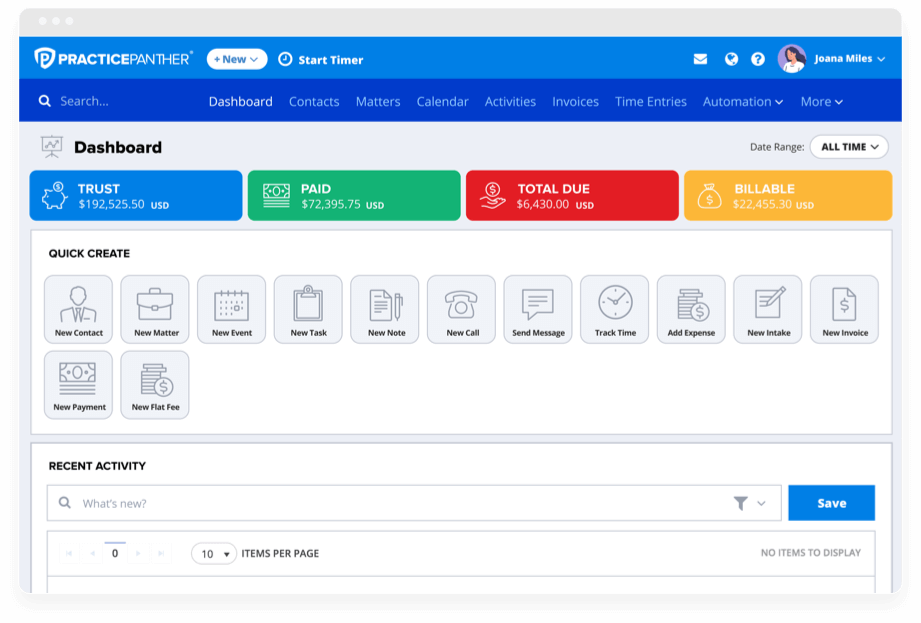
Why it works for attorneys: Time and billable-hour tracking sit inside the same screen you use for cases and client communication, so logging time doesn’t mean switching to a separate app mid-task.
Practice Panther also has advanced reporting: you can group time and expense data by period or employee and export it to Excel, which is handy if you want your own view of your billable hours separate from firm-wide reports.
Best for: Attorneys who want time tracking built into the same platform where they already manage cases and client contacts.
Pricing: $49/user/month (Solo), $69/user/month (Essential), $89/user/month (Business).
Free trial: Available, no credit card required.
Rating: Capterra 4.7 (529 reviews).
Pros:
- Time tracking, billing, and client communication live in one place, so nothing needs to be re-entered elsewhere
- Automated payment reminders reduce follow-up work once an invoice is sent
Cons:
- A full practice management platform, so it’s more than a solo attorney needs if only personal time tracking is the goal
3. Clio
Key features:
- Online payments
- Calendaring
- Task management
- Client portal

Why it works for attorneys: Clio’s AI-assisted time capture and multiple ways to enter time (timers, manual entry, retroactive capture) mean an individual attorney has options beyond remembering to start a timer at the beginning of every task.
Time entries flow directly into matters and invoices, so reviewing your own billable hours doesn’t require exporting anything or asking someone else for a report.
Best for: Attorneys at firms already running Clio as their practice management platform who want time capture built into the same system.
Pricing: Plans start at $49/user/month.
Free trial: 7 days, no credit card required.
Rating: Capterra 4.7 (1,743 reviews).
Pros:
- AI-assisted time capture reduces how much you have to remember to log manually
- Largest, most established review base of any tool on this list
Cons:
- A full practice management platform – if your firm doesn’t already use Clio, adopting it just for personal time tracking is a heavy lift
4. LawBillity by eBillity
Key features:
- Trust accounting
- LEDES and LSS invoice exports
- Conflict checker
- Mobile time and expense tracking
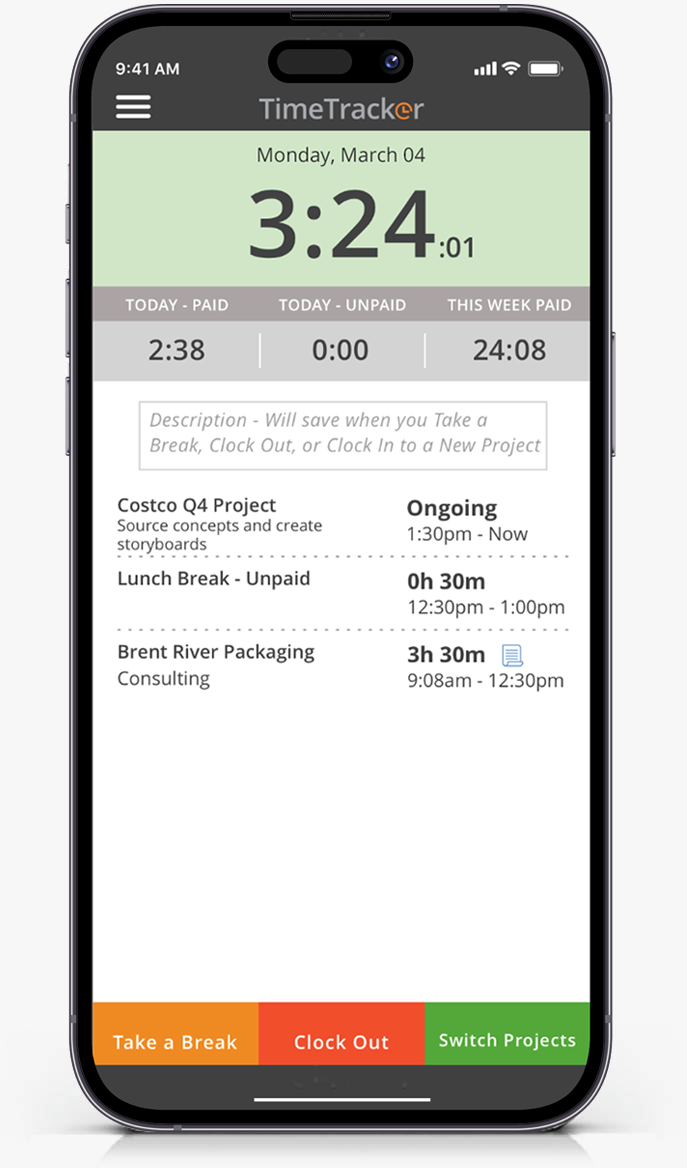
Why it works for attorneys: LawBillity is eBillity’s dedicated legal product, with free mobile apps built specifically for logging time and expenses away from the desk – conveniently, since so much attorney time happens outside the office.
It includes a conflict checker, trust accounting, and LEDES/LSS invoice formats built in, so time you personally log turns into a compliant invoice without a separate legal-billing tool.
Best for: Attorneys at solo or small practices who want legal-specific billing (trust accounts, LEDES) without a full case management platform.
Pricing: From $24/user/month billed annually (up to $33.60/user/month billed monthly).
Free trial: 14 days, no credit card required.
Rating: Capterra 4.2 (9 reviews).
Pros:
- Built-in conflict checker and trust accounting cover legal-specific needs generic tools skip
- Legal-specific features (conflict checker, trust accounting, LEDES) built in rather than bolted on
Cons:
- Small review base (9) compared to other legal-specific tools on this list
5. Bill4Time
Key features:
- One-click timers
- Invoice templates
- Online payments
- Client management
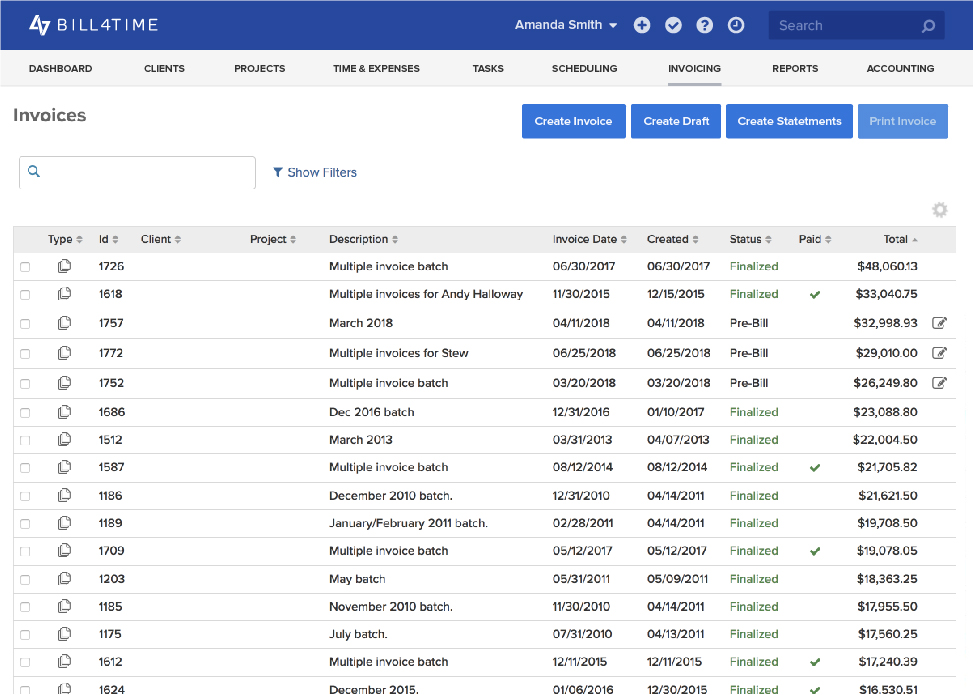
Why it works for attorneys: One-click timers and appointment-to-time-entry conversion mean less manual thinking about when a billable task started and ended – you start the timer once and the tool handles the rest of the entry.
Custom activity types and work code lists let you shape reports around how you personally categorize your work, not just how the firm bills clients.
Best for: Attorneys who want simple one-click time capture with strong invoicing, without needing automated background tracking.
Pricing: $27 to $89/user/month depending on functionality included.
Free trial: Available, no credit card required.
Rating: Capterra 4.8 (210 reviews).
Pros:
- One-click timers and appointment conversion reduce the manual effort of starting each entry
- Highly customizable activity types for your own reporting needs
Cons:
- No automated background time capture – still relies on you to click the timer
6. Aderant iTimekeep
Key features:
- AI-automated activity capture
- Outlook integration
- AI-guided compliance checks
Why it works for attorneys: iTimekeep (formerly a standalone product, now part of Aderant) captures work across your applications automatically and turns it into a draft time entry – you review and approve rather than reconstruct your day from memory.
It also checks entries against client billing rules before you submit them, catching compliance issues at the point of entry instead of after a rejected invoice comes back weeks later.
Best for: Attorneys at firms already running Aderant Expert who want AI-automated capture layered on top of their existing billing system.
Pricing: Quote-based – request a demo for firm-specific pricing.
Free trial: Not publicly listed – sold via demo request.
Rating: Limited public reviews (enterprise, demo-based sales); Aderant reports 510+ law firm clients and 70,000+ monthly active users.
Pros:
- AI-automated capture shifts you from writing time entries to reviewing them
- Compliance checks happen before submission, reducing rejected or reworked entries
Cons:
- No public pricing or self-serve trial – you need to go through a sales demo to evaluate it
7. OneAdvanced Time Capture
Key features:
- Voice dictation (NLP)
- Offline recording
- Performance dashboards
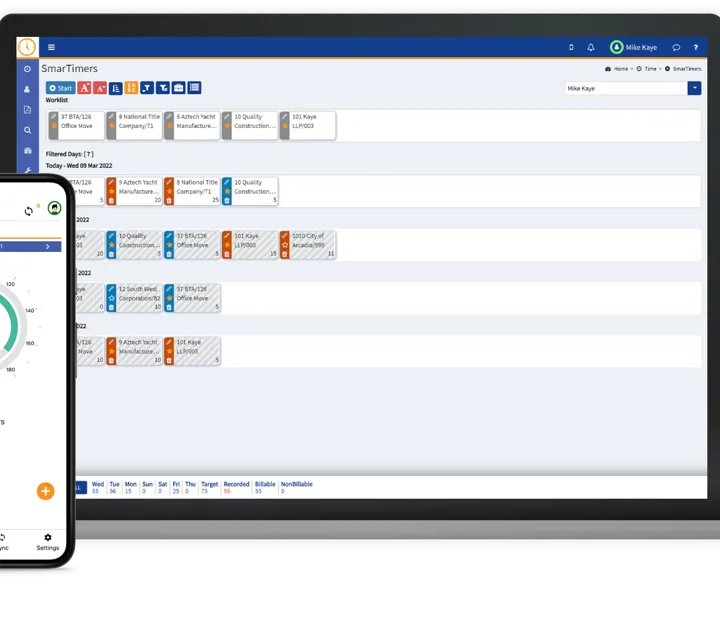
Why it works for attorneys: Time Capture (formerly Carpe Diem) lets you dictate time entries using natural language instead of typing, and its “time finder” flags gaps in your day based on your own digital footprint – calendar events, emails, documents touched.
It also works fully offline, which matters if you’re recording time on a flight or somewhere without reliable signal, syncing once you’re back online.
Best for: Attorneys at larger firms already using OneAdvanced’s legal software family who want voice-based, offline-capable time capture.
Pricing: Quote-based – not publicly listed.
Free trial: Not publicly listed – sold via demo request.
Rating: Mixed public review coverage (enterprise, demo-based sales) – serves 5,000+ law firms and barristers’ chambers per OneAdvanced.
Pros:
- Voice dictation is a genuinely different entry method from typing or clicking a timer
- Full offline support with later sync suits travel-heavy attorneys
Cons:
- Geared toward larger firms and enterprise deployments – a heavy option for a solo or small-firm attorney
8. Memtime
Key features:
- Fully automatic tracking
- 6-minute billing increments
- Local activity history
- Cross-platform
Why it works for attorneys: Memtime runs in the background on your own device and records every app, document, and website you touch, then lets you turn that activity history into time entries at whatever billing increment your firm uses – including the 6-minute increment common in legal billing.
Because the activity history is stored locally rather than requiring calendar or email access, it sidesteps some of the privacy concerns that come with cloud-based passive trackers.
Best for: Attorneys who want a personal, always-on safety net that captures everything, so nothing gets lost even on days you forget to touch a timer at all.
Pricing: From $14/user/month.
Free trial: Available, no free tier.
Rating: Capterra 4.4 (125 reviews).
Pros:
- Captures your full activity history automatically, with no timer to remember to start
- Local storage of activity data addresses some privacy concerns tied to cloud-based passive trackers
Cons:
- No free tier, and pricing is toward the higher end for a personal tool
9. Time Miner
Key features:
- Retroactive time tracking
- Integrations
- Activity reports
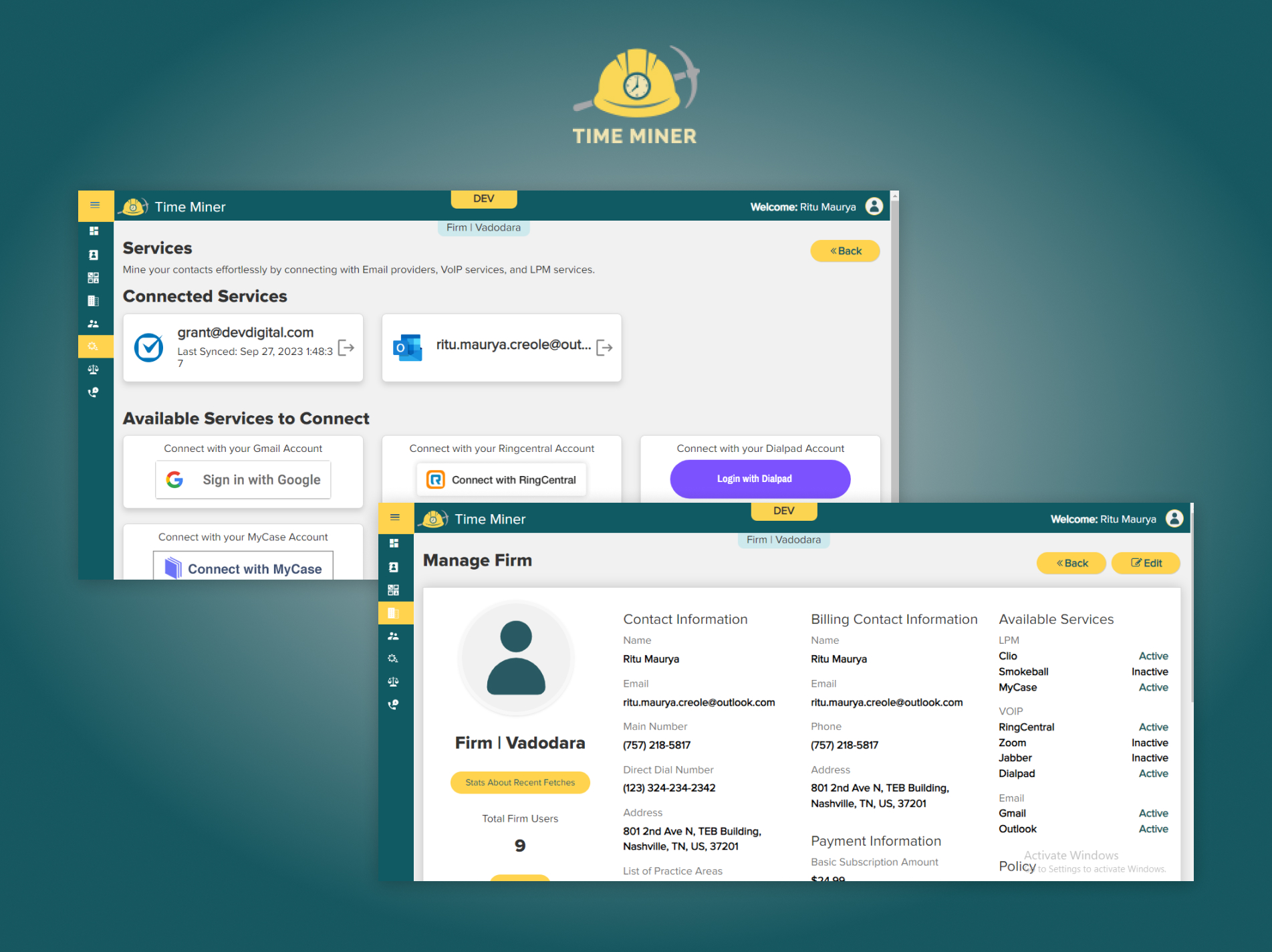
Why it works for attorneys: Time Miner scans your phone for calls, texts, and emails and converts them into billable time records automatically – useful specifically for the small, easy-to-forget client communications that happen between bigger tasks.
Because it searches retroactively rather than requiring a timer, it can recover time you didn’t think to log in the moment.
Best for: Attorneys whose billable time is heavy on calls and quick email exchanges that are easy to forget individually.
Pricing: $24.99/month, or $239.88/year; enterprise pricing is custom.
Free trial: Available – confirm current length directly.
Rating: Not listed on major review platforms (small, niche legal tool).
Pros:
- Recovers small communication-based billable time that’s otherwise easy to forget
- Retroactive search means no timer discipline required
Cons:
- Accesses your email and calendar data, which raises privacy considerations some attorneys may want to weigh carefully
10. TimeSolv
Key features:
- Location tracking
- Cost tracking
- Capacity reports
- Billing
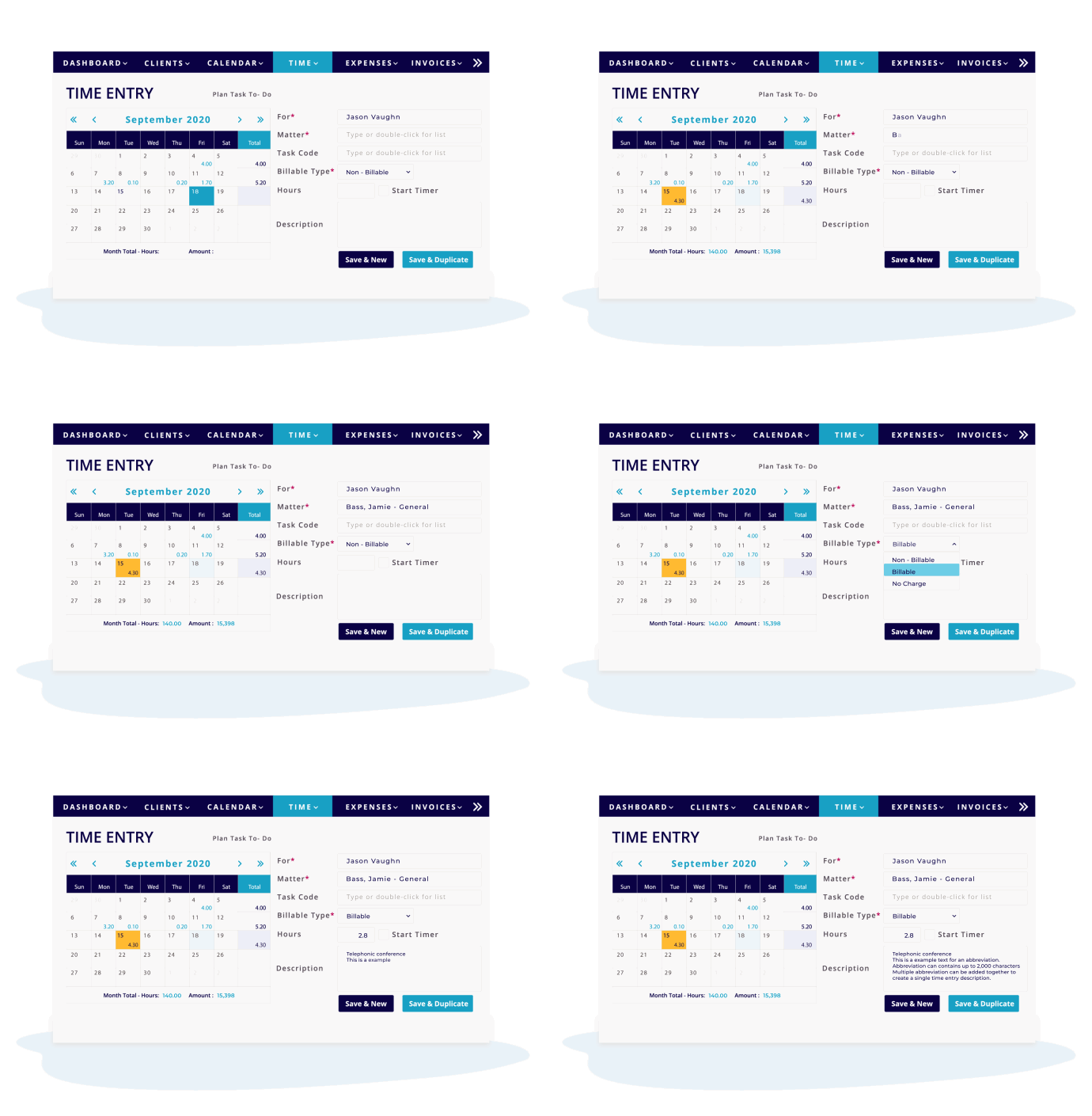
Why it works for attorneys: Built-in ABA task codes for LEDES billing mean you can categorize your own time the way corporate and insurance clients expect, without learning a separate coding system on the side.
It works offline across PC, Mac, iOS, and Android, so time logged in court or between meetings syncs once you’re back online.
Best for: Attorneys who need LEDES-compliant billing codes without adopting a full case management platform.
Pricing: TimeSolv Legal from $47.50/user/month; TimeSolv Pro from $26.99/user/month.
Free trial: Available – confirm current length directly (no free plan).
Rating: Capterra 4.7 (647 reviews, TimeSolv Legal).
Pros:
- Built-in ABA/LEDES task codes save you from manually mapping your own categories to client requirements
- Works offline across all major desktop and mobile platforms
Cons:
- No free plan, which matters if you just want to try it before committing
11. FreshBooks
Key features:
- Mobile apps
- Integrations
- Billing and invoicing
- Reporting
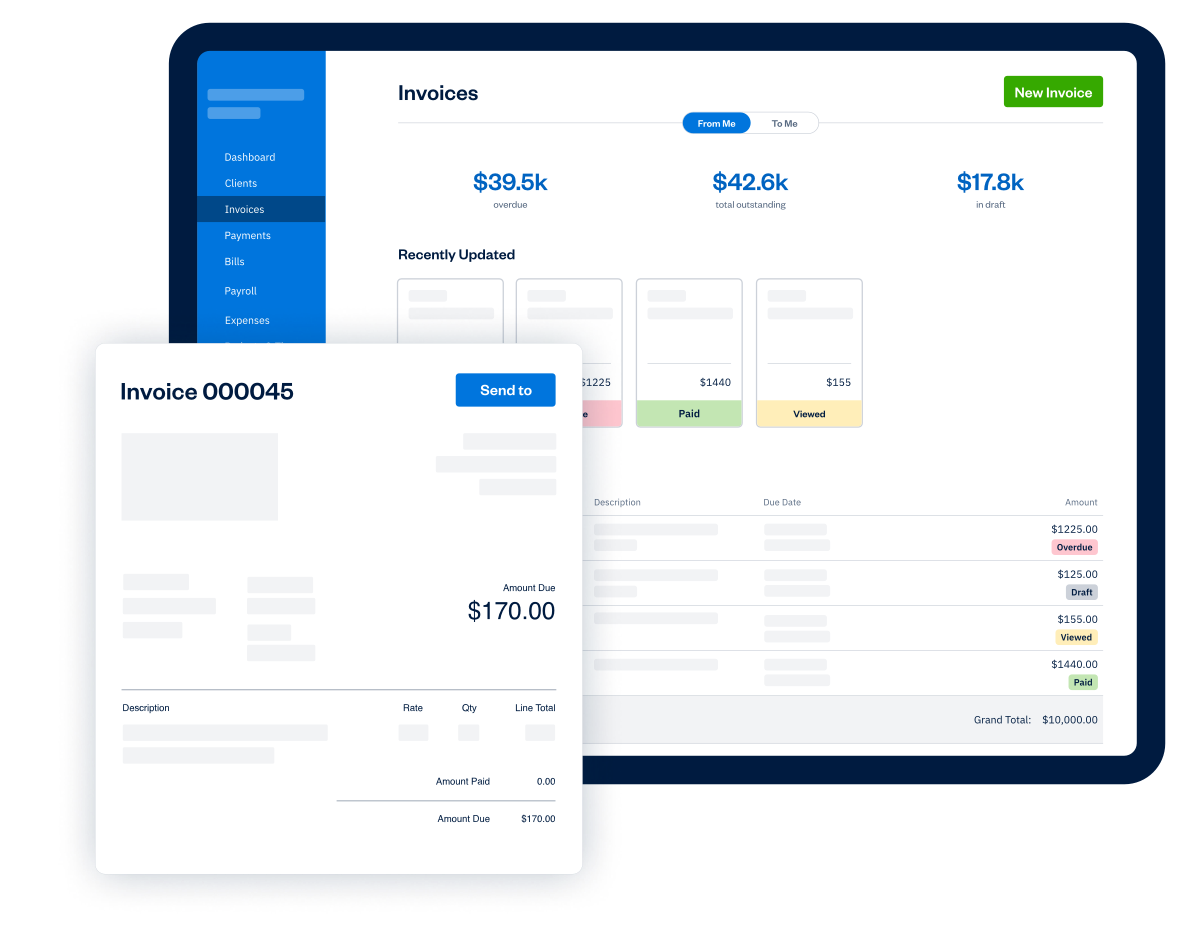
Why it works for attorneys: A start-a-timer-and-go approach, plus mobile apps and a Chrome extension timer, means logging time doesn’t require opening a dedicated legal platform – useful if your firm’s main system is elsewhere and you just want a personal, lightweight tracker.
Time logs turn directly into invoices you can send yourself, which suits attorneys who bill some work independently of the firm’s main billing system.
Best for: Attorneys who want a simple, general-purpose timer and invoicing tool rather than a legal-specific platform.
Pricing: Starting at $5.70/month, plus a 30-day trial period.
Free trial: 30 days.
Rating: Capterra 4.5 (4,523 reviews).
Pros:
- Very low starting cost for a lightweight, personal timer and invoicing setup
- Large, well-established review base across many industries
Cons:
- Not legal-specific – no trust accounting, UTBMS/LEDES support, or matter management
12. TimeCamp
Key features:
- Mobile apps
- Integrations
- Billing and invoicing
- Reporting
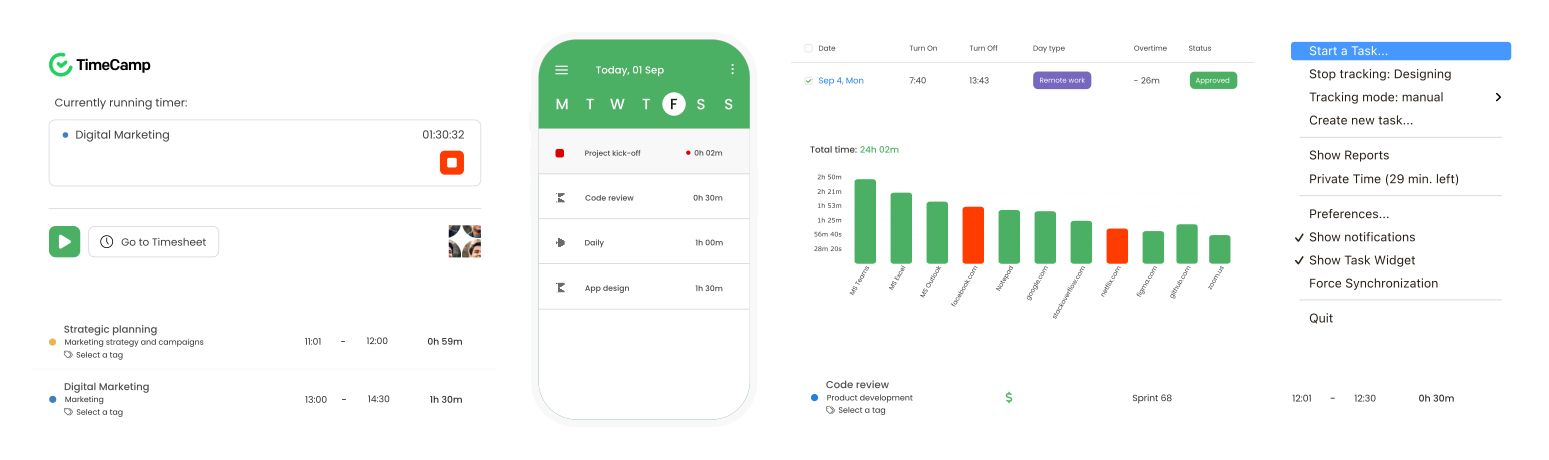
Why it works for attorneys: Time tracking is fully automated – when you switch between tasks and matters, TimeCamp looks for project-specific keywords and logs your time accordingly, so you review and adjust entries rather than create them from scratch.
Project time and cost budgets notify you before they’re about to overrun, which is a useful personal check even if formal budget tracking is handled elsewhere at the firm.
Best for: Attorneys who want automatic keyword-based time capture without manually tagging every entry.
Pricing: Starting at $2.99/user/month, plus a free 14-day trial.
Free trial: 14 days.
Rating: Capterra 4.7 (599 reviews).
Pros:
- Automatic keyword-based tracking reduces manual tagging for each entry
- Very low starting price for what it includes
Cons:
- Mobile app has less functionality than the desktop version, which matters if most of your billable time happens away from a desk. If most of your billable work happens on the go, see our guide to TimeCamp alternatives.
13. Timely
Key features:
- AI Memory Tracker
- Integrations
- Billing and invoicing
- Reporting
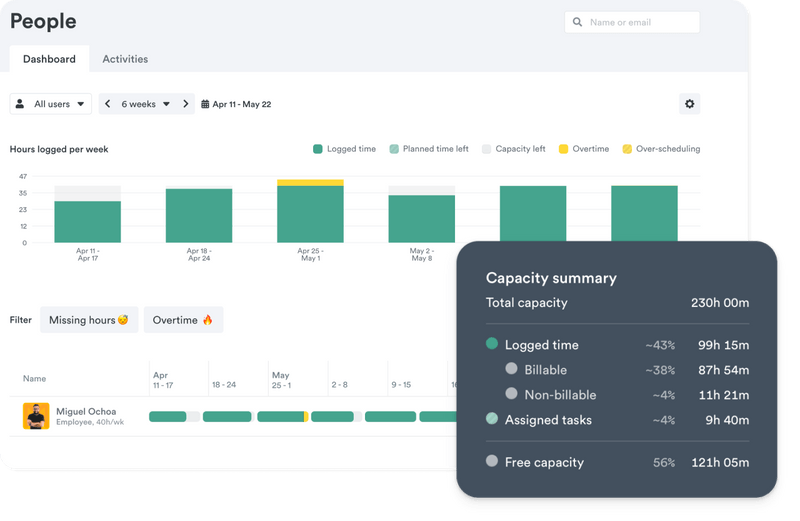
Why it works for attorneys: Timely’s AI Memory Tracker records your web and desktop activity in the background and syncs it into a single timesheet, so a day spent jumping between matters gets reconstructed automatically instead of from memory at 6pm.
Time logs export into invoices, so a personal record of your day still turns into billable output without extra steps.
Best for: Attorneys who forget to start timers and want an automatic record of the day to review and edit, rather than build from scratch.
Pricing: Starting at $9/user/month, plus a 14-day trial period.
Free trial: 14 days.
Rating: Capterra 4.7 (711 reviews).
Pros:
- AI Memory Tracker removes the need to remember to start a timer at all
- Reviewing and editing an existing record is faster than building entries from a blank timesheet
Cons:
- Primarily web-based, so a reliable internet connection matters for accessing logs and invoices
14. AccountSight
Key features:
- Expense tracking
- Project estimates
- Invoicing
- Reports
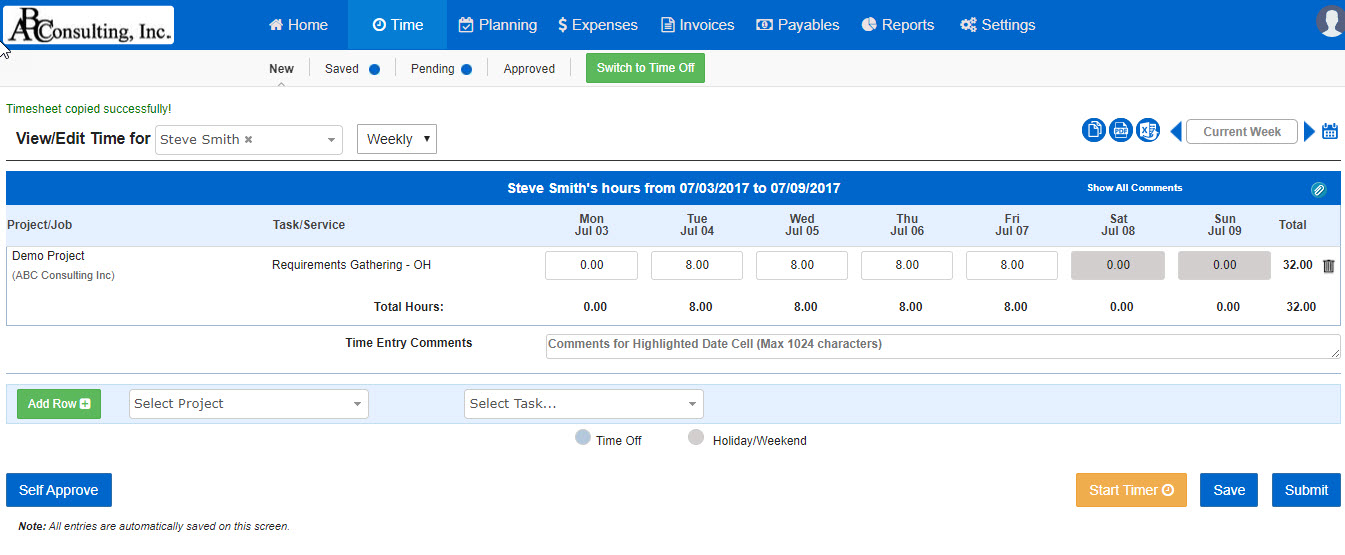
Why it works for attorneys: A free version for a single user makes it a low-risk way to start tracking your own time before deciding whether the whole practice needs something more, with online invoicing that generates client-ready bills in a few clicks.
The client portal lets clients view and pay invoices directly, which can offload some of the payment follow-up that otherwise falls on the attorney.
Best for: Solo practitioners who want to try personal time tracking and invoicing for free before paying for anything.
Pricing: Free for 1 user; paid plans from $39/user/month, plus a 30-day trial period.
Free trial: 30 days.
Rating: Capterra 4.9 (48 reviews).
Pros:
- Genuinely free for a single user, not just a time-limited trial
- Client portal offloads invoice viewing and payment from the attorney
Cons:
- Small review base (48) relative to more established tools on this list
15. Amberlo
Key features:
- Matter management
- Expense tracking
- Billing
- Legal calendaring
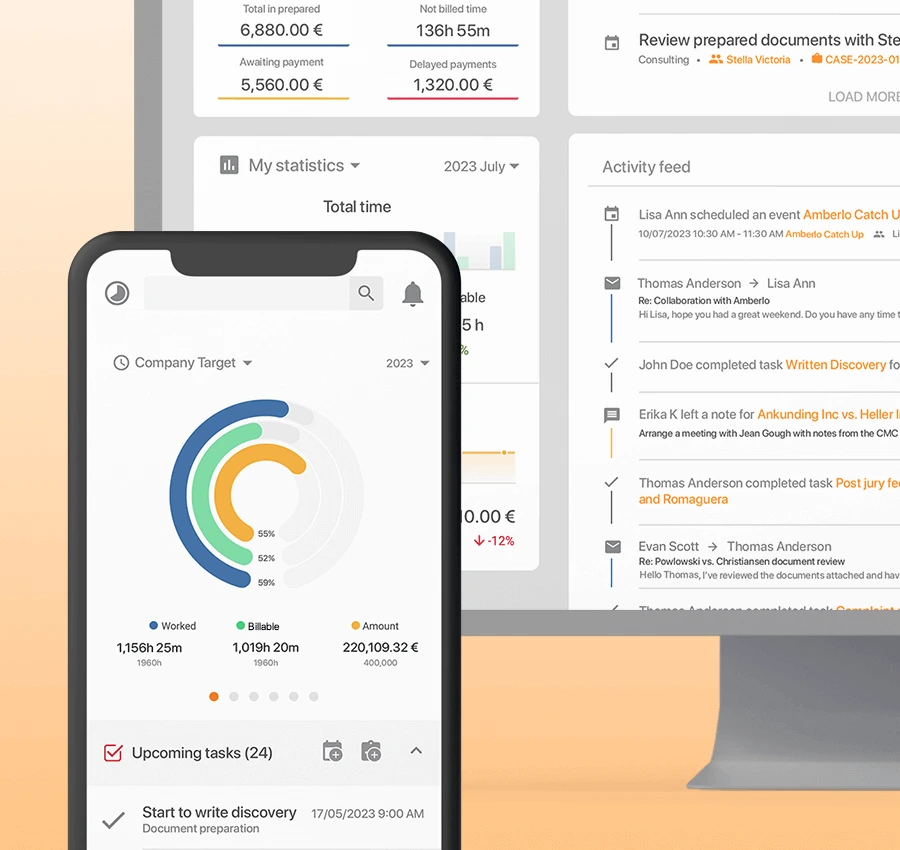
Why it works for attorneys: A stopwatch built into the matter view keeps time capture close to the actual work, so recording a billable second doesn’t mean switching to a separate app while a task is in progress.
Amberlo is a legal practice management platform (part of Septeo) used by firms in over 70 countries, with detailed performance reports available for reviewing your own time alongside the firm’s matter and contact data.
Best for: Attorneys at firms already using Amberlo for matter and contact management who want time tracking in the same place.
Pricing: Grow €59/user/month, Premium €89/user/month, Enterprise custom-priced.
Free trial: 7 days, no credit card required.
Rating: Capterra 4.7 (110 reviews).
Pros:
- Stopwatch lives inside the matter view, so tracking time doesn’t mean leaving the screen you’re already working in
- Established platform with a large international client base (1,000+ firms in 70+ countries)
Cons:
- Pricing isn’t fully public, and the euro-denominated rate may not map cleanly to a monthly USD cost
16. LexZur
Key features:
- Case management
- Time tracking
- Financial management
- Litigation management
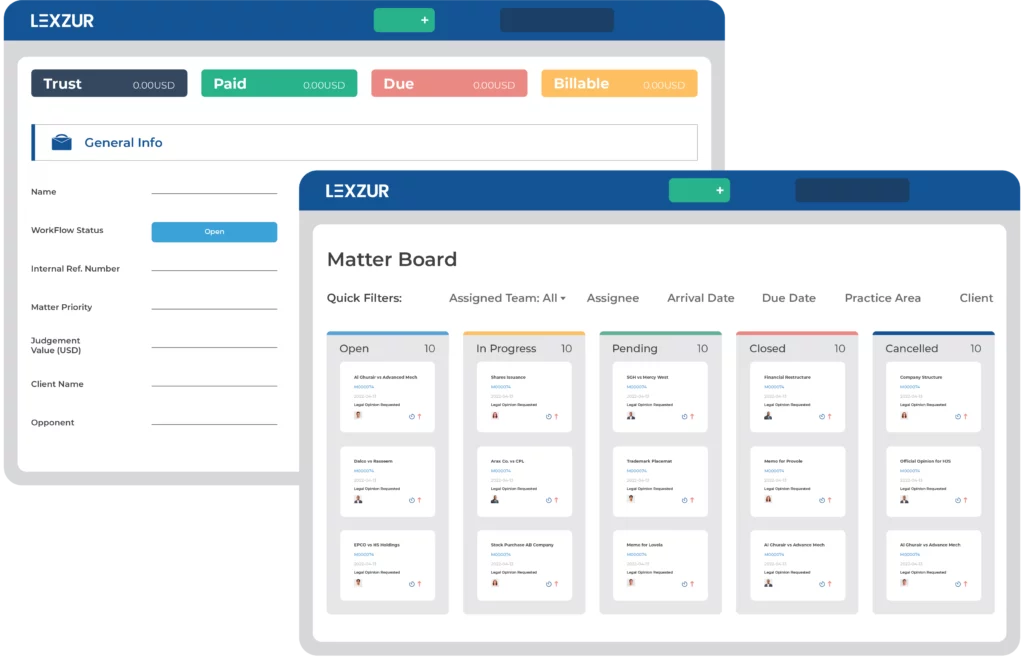
Why it works for attorneys: A simple built-in timer alongside financial management (expenses, invoices, billing) means time tracking and turning that time into a bill happen in the same place, without a separate accounting tool.
Regular updates based on user feedback mean the feature set has kept evolving since launch, rather than sitting static.
Best for: Attorneys who want case management and time tracking bundled together at a lower price than larger legal-specific platforms.
Pricing: From $6/user/month for LexZur Core.
Free trial: 2 weeks, no credit card required.
Rating: Capterra 4.6 (63 reviews).
Pros:
- Financial management module handles expenses and invoicing alongside the timer, without a separate accounting tool
- Frequent updates driven by user feedback
Cons:
- Smaller review base and less brand recognition than the larger tools on this list
Side-by-side comparison
Now that you’ve seen how each tool works, here’s the same 16 side by side – the goal is to make the trade-offs easy to scan, not to crown a single winner.
How to build a personal time-tracking habit as an attorney
Software helps, but no tool fixes a habit problem entirely on its own. A few practical steps make any of the tools above more effective:
- Pick one primary capture method and stick to it. Switching between a timer app, a notebook, and end-of-day memory guarantees gaps – pick one and treat it as the default.
- Use passive or automatic capture as a safety net, not a replacement. Even if you prefer manually starting a timer, a background tracker like Memtime or Timely catches what you forget to start – you’re reconciling against a record, not reconstructing from nothing.
- Review daily, not weekly. A gap from this morning is easy to fill in accurately; a gap from four days ago usually isn’t. Five minutes at the end of each day beats an hour of guessing on Friday.
- Log short tasks too. A two-minute email reply feels too small to record, but across a caseload these minutes are exactly what the Legal Trends Report’s 2.9-of-8-hours gap is made of.
- Treat reminders as guardrails, not nagging. A prompt after an hour of untracked activity is catching a real gap, not being annoying – turning off reminders usually just means the gap goes uncaught instead of unprompted.
None of this requires firm-wide buy-in. It’s a personal discipline that a better tool makes easier to sustain, not something that depends on anyone else changing how they work.
How actiTIME helps you personally stay on top of your time
You don’t need your firm to switch its billing system to get value from actiTIME – it works as a personal layer on top of whatever your firm already uses, as long as the hours you log eventually make it into the firm’s invoices.
An online timesheet, a weekly calendar view, a browser extension, and a mobile app cover the different ways your day actually happens – at a desk, in court, or between meetings – so you’re not stuck reconstructing anything from memory at the end of the day. Custom fields let you tag entries by matter, client, or practice area for your own reports, without needing anyone in billing to set that up on your behalf.
And because reminders and personal time-track prompts are built in, the discipline described above – logging daily, catching short tasks, treating nudges as guardrails – has something to run on rather than depending on willpower alone.
If you want to try this for yourself before involving anyone else at the firm, actiTIME’s free version covers up to 3 users with no time limit, and the full version starts at $6 per user a month for teams of 1–40, dropping to $5 for larger teams of 41–200.
FAQ
Do I need firm-wide time tracking software for law firms, or can I use my own personal tool?
You can use a personal tool. Firm-wide time tracking software for law firms is built to standardize billing across many timekeepers, but nothing stops an individual attorney from running a personal tracker – automatic or manual – alongside whatever the firm uses, as long as the final numbers still make it into the firm’s billing system. Many of the tools on this list are built for exactly that: a personal layer, not a firm-wide rollout.
Is billable hours tracking software different from a general time tracking app?
Usually yes, in a few specific ways. Billable hours tracking software is typically built around matter- or client-level categorization, supports billing increments like 0.1 hours (six minutes), and turns logged time directly into an invoice. A general time tracking app may track hours perfectly well but often lacks these legal-billing-specific mechanics, so time still needs manual reformatting before it can be billed.
Can I start using one of these tools without my firm’s IT department setting it up?
For most of the personal-use tools on this list, yes – they’re designed for individual sign-up, not enterprise deployment. Tools built for firm-wide rollout (like Aderant iTimekeep or OneAdvanced Time Capture) are the exception, since they’re typically sold and configured through IT or a practice-management administrator rather than an individual account.
Ready to stop losing billable time between tasks?
Every tool on this list can log hours. What separates them is how much of that logging happens automatically versus how much still depends on you remembering to hit start – and that’s really the core problem for most attorneys, not a lack of software options.
If you want a personal, flexible way to track and review your own billable time without adopting a full case management platform, try actiTIME free for 30 days and see how it fits your day.