



Tracking billable hours for law firms accurately is only half the picture. A firm can log every hour worked and still lose money if that time never turns into an invoice, or the invoice never turns into cash. This guide covers what billable and non-billable hours actually mean in a law firm, the realization rate for law firms that shows whether your billable time is really converting to revenue, and how actiTIME supports the tracking and billing side of that process. If you’re also looking at how client and case work is organized day to day, see how actiTIME supports matter management for law firms.
What are billable and non-billable hours?
So, what are billable hours, and what counts as non-billable? Billable hours are the time a lawyer spends on work that’s charged directly to a client’s matter – drafting, research, court appearances, client calls, anything tied to that client’s case. Non-billable hours cover everything else that keeps the firm running but isn’t charged to any particular client: internal meetings, business development, administrative work, and time tracking itself. For the fundamentals outside the law-firm context, see what billable hours are and how to track them.
Most law firms bill in small increments – commonly six minutes (a tenth of an hour) or fifteen minutes (a quarter) – so the billable vs non-billable hours split needs to be drawn consistently at a granular level, not just estimated at the end of the day. Getting this distinction right at the point of entry, not reconstructed later, is what makes the rest of a firm’s billing and financial reporting trustworthy. Many firms standardize this with an attorney billable hours template before they ever start comparing software.
Realization rate: are your billable hours turning into revenue?
Logging billable hours accurately is necessary, but it doesn’t guarantee that time turns into cash. Realization rate is the metric that measures the gap between what you worked and what you actually collect – and industry benchmarks put the average firm’s realization rate somewhere around 85–92%, meaning a meaningful slice of billable work never gets paid for.
There are three realization rates worth knowing, each measuring a different stage between doing the work and getting paid for it:
- Billing realization rate – how much of your standard billable value actually makes it onto an invoice, after discounts and write-downs. Formula: amount billed ÷ standard value of recorded time.
- Collection realization rate – how much of what you billed is actually collected. Formula: amount collected ÷ amount billed.
- Overall realization rate – the combined effect of both, comparing cash actually collected to the full standard value of time worked. Formula: amount collected ÷ standard value of recorded time.
A quick example: an attorney logs 50 hours at a $200 standard rate, for $10,000 in billable value. If the client negotiates the invoice down to $9,000, the billing realization rate is 90%. If the firm then collects $8,000 of that $9,000, the collection realization rate is about 89%. Combined, the overall realization rate is 80% – a fifth of the value of the work never reached the firm’s bank account.
None of this is necessarily a problem on its own – discounts for good clients and the occasional write-off are normal. The point of tracking realization rate is noticing when it drifts, and being able to trace the drop to a specific cause: inconsistent time entry, discounting that’s crept beyond policy, or invoices that simply aren’t being followed up on. It sits alongside other profitability metrics worth tracking if you want the fuller financial picture, not just the billing side.
How actiTIME helps you track billable time accurately
actiTIME lets you define Types of Work to separate billable from non-billable activity, with hourly rates attached to whichever categories your firm actually bills for. A client call is billable at that client’s rate; an internal team meeting is tracked but flagged as non-billable, so it never accidentally shows up on an invoice.
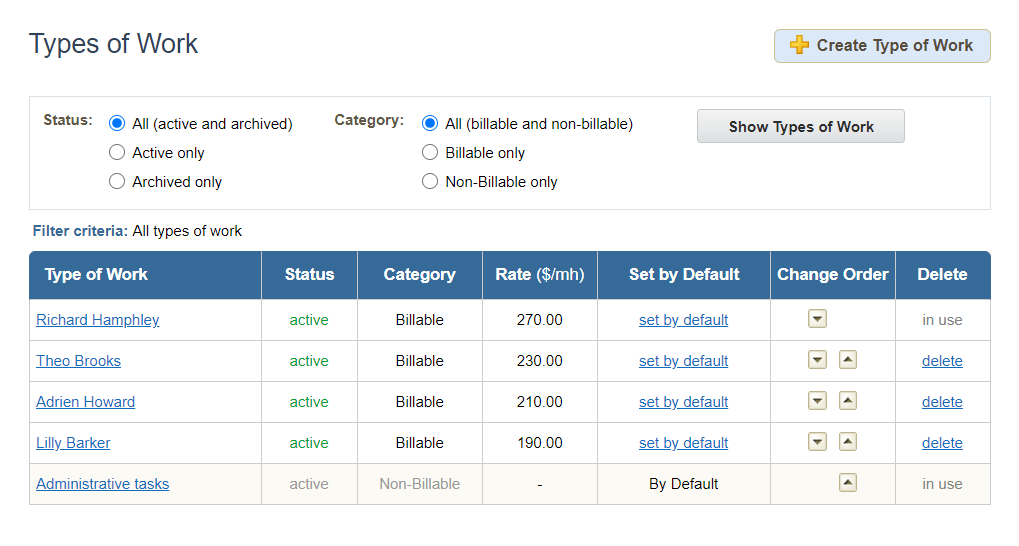
Because rates can be set per lawyer, per client, or per task, the same structure that separates billable from non-billable time also captures the rate variation most firms actually have – a partner and an associate billing different rates on the same matter, or a client with a negotiated rate that differs from your standard one.
Pro tip: Ask your team to log billable and non-billable time consistently, not just billable hours. Seeing where non-billable time actually goes is often what reveals capacity you didn’t know you had. If you’re still weighing tools, see how actiTIME compares to other time tracking software built for lawyers.
Reports that support your realization numbers
With billable rates and Types of Work defined, actiTIME’s reports turn logged time into the numbers that feed a realization calculation – not the full calculation itself (that also needs your invoicing and collections data), but the billable-value side of it.
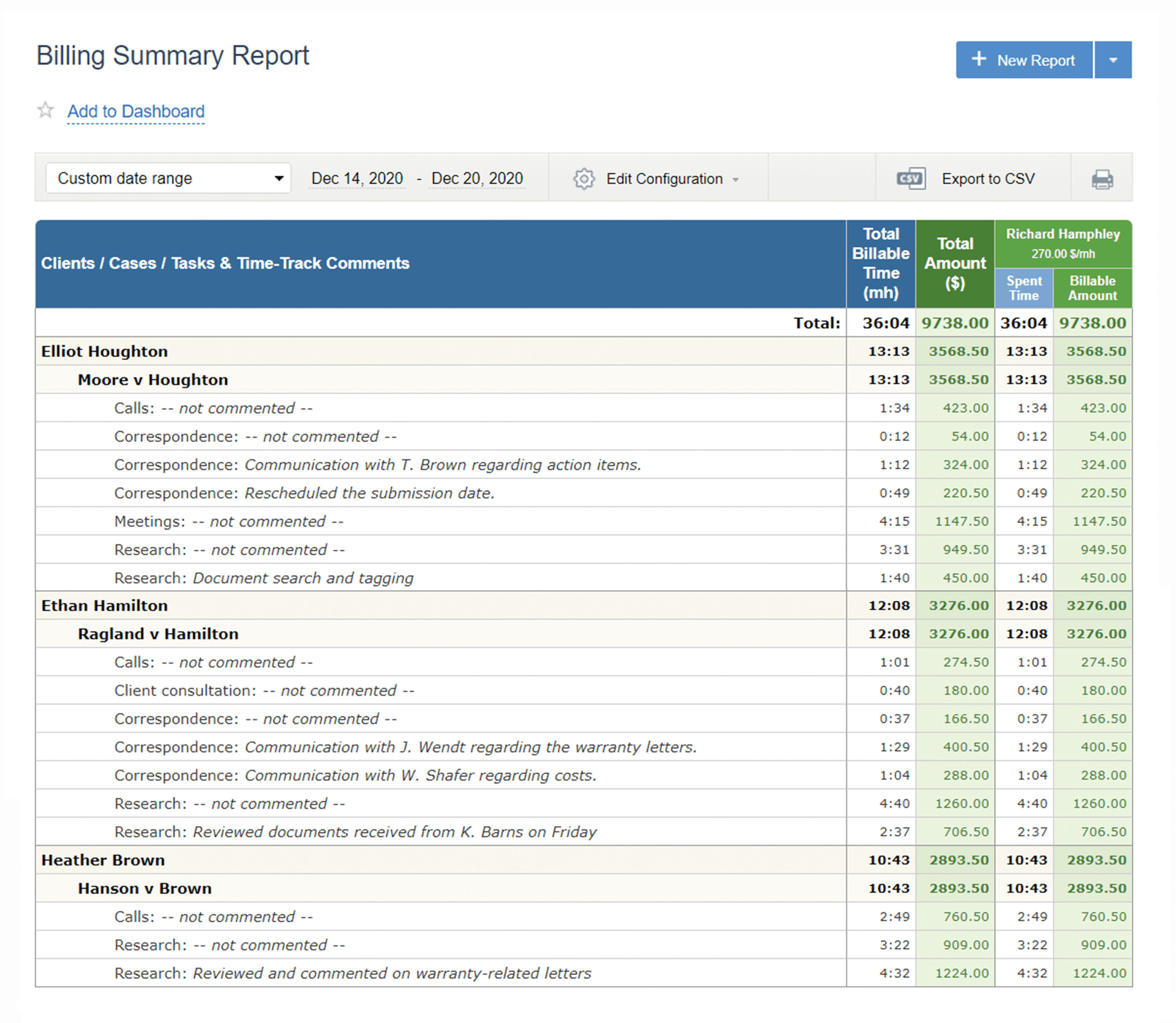
The Billing Summary Report shows billable amounts by period, calculated from tracked time and assigned hourly rates – this is your standard billable value, the starting point for any realization rate calculation.
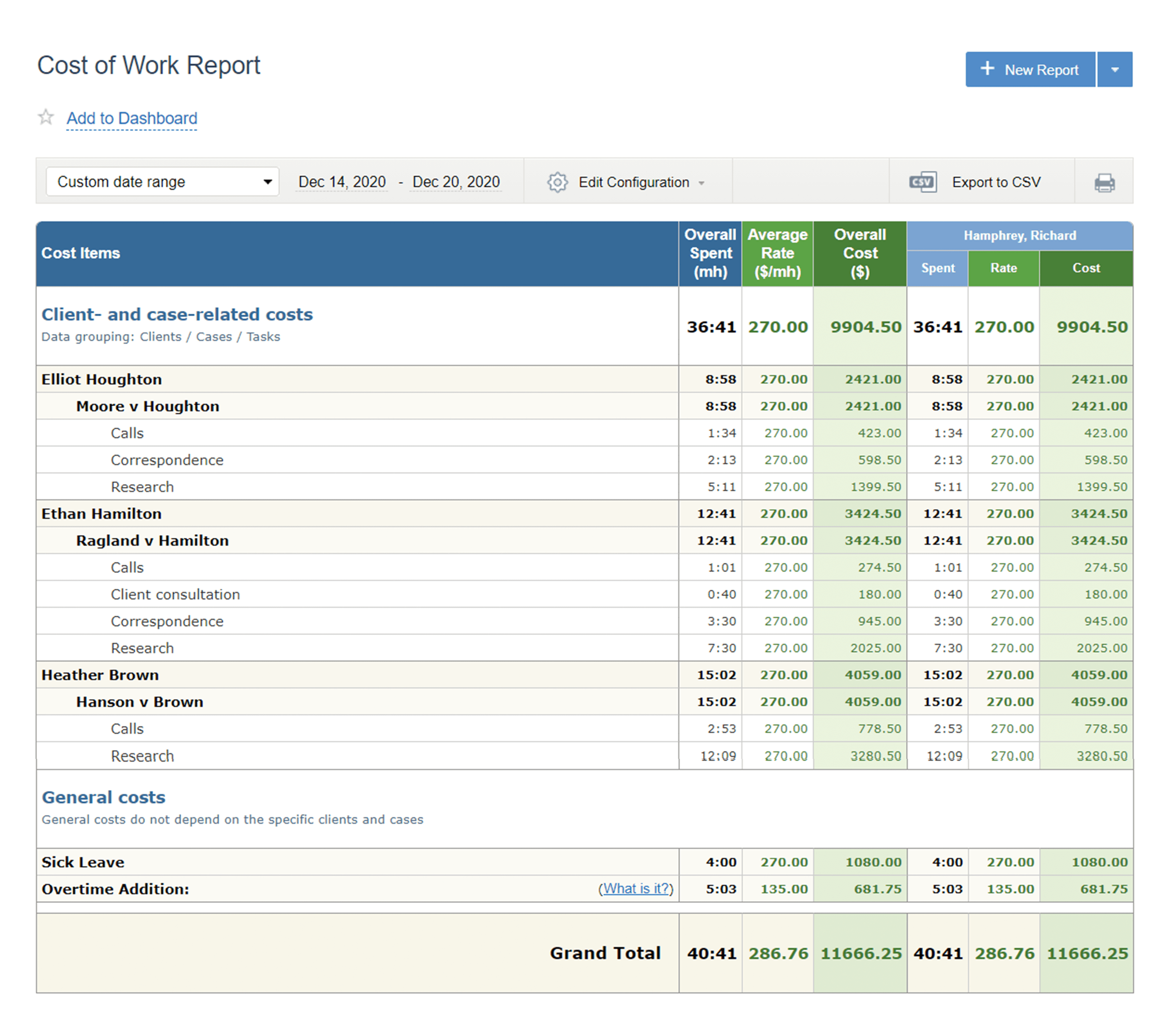
The Cost of Work Report shows the other side – costs calculated from working and leave hours at each user’s hourly rate – useful for seeing whether a matter is actually profitable once staff cost is factored in, not just what it billed for.
Pro tip: Run the Billing Summary Report on a consistent schedule (weekly or monthly) rather than only at invoicing time. Spotting a drop in billable value early gives you time to ask why – inconsistent logging, more non-billable work than usual, or a specific matter eating more time than budgeted – before it shows up as a bigger problem on the next invoice.
What else your firm might need
For a lot of firms, tracking billable/non-billable time accurately and running the reports above is enough to keep realization rate visible and under control. A few adjacent needs are worth knowing how to fill if your firm runs into them:
- Accounts receivable and collections tracking. The collection side of realization rate – which invoices are overdue and by how long – is an accounting/billing function, not something a time tracker is built to report on. Connecting actiTIME to QuickBooks moves your billing data into a system that handles that side.
- Trust accounting. If your firm handles client retainers or trust funds, that needs dedicated legal accounting software built around trust compliance rules – not a general time and billing tool.
- Data security for cloud-hosted time and billing data. If you use actiTIME Online, your data sits in a data center with an encrypted connection, firewall protection, and daily backups. Firms with stricter self-hosting requirements can run actiTIME Self-Hosted instead.
FAQ
What’s a good realization rate for a law firm to aim for?
Industry benchmarks generally put average realization rates around 85–92%, with strong performers closer to 90% or higher. There’s no single universal target – it varies by practice area and firm size – but tracking the trend over time matters more than hitting a specific number: a steady 85% is healthier than a rate that swings unpredictably.
Do discounts always hurt this number?
Not in a way that means something’s wrong. A discount for a long-term client or a strategic write-down are deliberate business decisions that lower billing realization on purpose. The goal isn’t to eliminate every discount – it’s to know when and why they’re happening, so they reflect firm policy rather than drifting upward unnoticed.
Can flat-fee or contingency firms still track this?
Yes, with a small adjustment. Instead of comparing collected revenue to a standard hourly rate, compare it to what the work would have cost at your normal billing rates – that gives you a sense of whether a flat fee is actually covering the time it takes, the same insight hourly firms get from realization rate directly.
Ready to see where your billable hours actually go?
Accurate billable and non-billable tracking is the foundation, but realization rate is what tells you whether that time is actually turning into revenue. Both matter, and neither works well without the other.
actiTIME has law firms and individual attorneys among its clients. Start a 30-day trial (no credit card required) to see how it fits your firm’s billing.